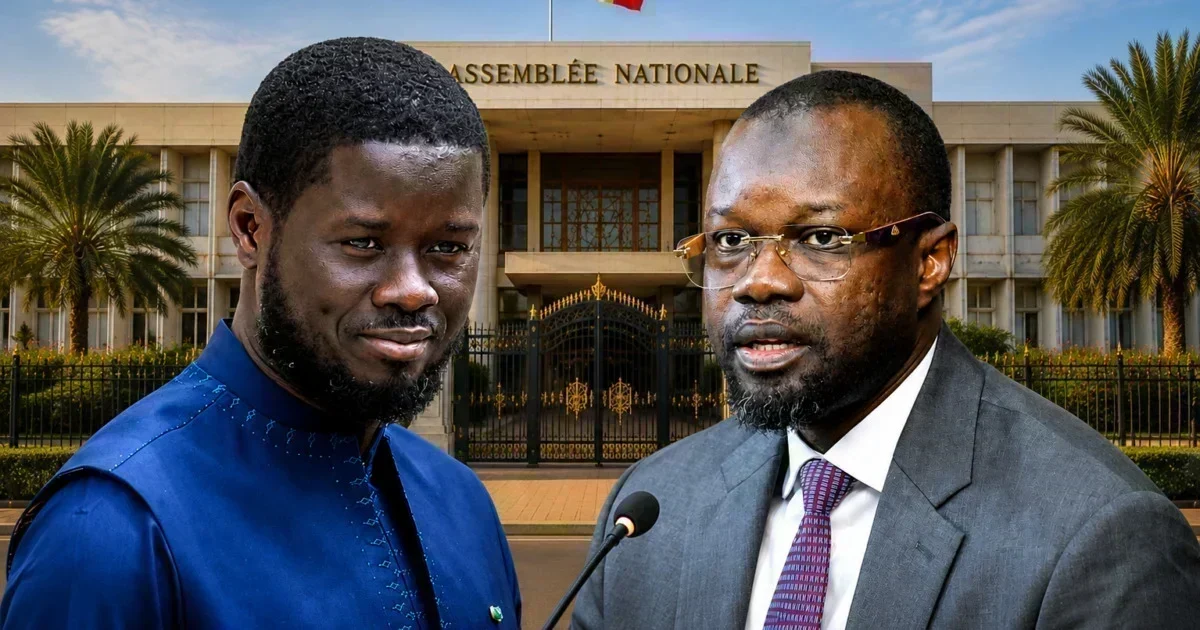
The tension between Senegal’s executive and legislative branches has escalated into a full-blown confrontation. Yesterday, lawmakers in the National Assembly rejected every amendment proposed by Bassirou Diomaye Faye’s government during a technical committee review of a bill on special credit frameworks.
Government’s Strategic Move Backfires
In an unexpected shift, President Diomaye Faye bypassed Cheikh Diba, the Economy Minister, by appointing Justice Minister Moussa Sarr as the government’s representative in the Finance Committee. Sources confirm the interim decree was signed on August 7, days before the session. The move raised eyebrows, as it signaled a direct challenge to parliamentary autonomy.
Minutes after the session began under the leadership of committee chair Cherif Ahmed Dicko, Moussa Sarr raised objections to the bill’s drafting, citing inconsistencies. He then submitted six amendments aimed at expanding the scope of special credits. The Pastef deputies, however, called for a recess to deliberate—an unusual resistance that delayed proceedings for hours.
All Amendments Rejected, One Compromise Adopted
The government’s proposed changes faced unanimous rejection from Pastef legislators. Only one amendment, introduced by deputy Alphonse Mané Sambou, survived the vote. His revised version strengthened parliamentary oversight by explicitly empowering the Finance Committee to monitor special credit allocations, replacing vague language in the original draft.
The executive’s amendments targeted key aspects of the bill. One sought to include credits for the National Assembly presidency and Prime Minister’s office under the same framework as the presidency, a proposal swiftly dismissed. Another aimed to redefine special credits beyond defense and security, incorporating vague terms like “African solidarity” and “social cohesion” in emergencies—language critics argue lacks legal precision.
Defining Special Credits: A Battle of Interpretations
The core dispute lies in the definition itself. While the bill proposed limiting special credits to defense, national security, and intelligence activities, the government pushed for a broader interpretation. Diomaye’s administration argued for including expenditures tied to “social order preservation” and “national stability,” terms open to manipulation.
Oversight mechanisms also became a flashpoint. The executive insisted on standard financial regulations for audits, whereas legislators demanded exclusive parliamentary control through the Finance Committee—a stance reinforced by Sambou’s successful amendment.
With the technical review complete, the bill now heads to the plenary session next week. Analysts expect another showdown, with Moussa Sarr likely invoking Article 82 to force a blocked vote. However, Assembly President Ousmane Sonko has publicly vowed to resist such maneuvers unless the bill qualifies as urgent—a stance that could trigger a constitutional referral.