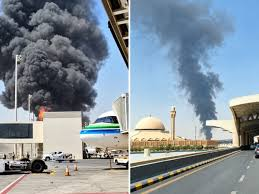
The King Khalid International Airport in Riyadh has become the latest flashpoint in the escalating conflict between Saudi Arabia and Yemen‘s Houthi rebels. In a bold and deadly strike claimed by the militants, multiple missiles and drones rained down on the airport, leaving a trail of destruction and a rapidly shifting security landscape across the region.
Unprecedented attack sparks regional security crisis
On Saturday, October 10, the Houthi movement launched a coordinated attack targeting the Riyadh airport, resulting in 13 fatalities and 308 injuries according to official Saudi reports. The assault marked a sharp escalation in the long-running conflict, with the Houthis explicitly warning airlines to avoid the airport and Saudi airspace entirely.
The following day, a secondary projectile struck Terminal 4, igniting a fire and claiming one additional life while injuring 11 others. Saudi authorities confirmed that defensive systems intercepted several incoming threats, yet one missile breached their defenses, striking a passenger hall. In response, the airport was temporarily shut down for damage assessment and safety inspections, sending shockwaves through the aviation industry.
Houthis escalate strikes on strategic Saudi targets
The Houthi military spokesperson, Yahya Saree, took responsibility for the attack, declaring that missiles and drones had been deployed against Riyadh’s airport, Dammam’s airport, and key Saudi oil facilities. The group framed the offensive as retaliation for Saudi Arabia’s military involvement in Yemen, where Riyadh has backed government forces against the Houthi-led opposition.
This latest strike follows a recent surge in fighting after Saudi-backed offensives regained momentum in Yemen. The Houthis have vowed to intensify their operations against Saudi territory, signaling a dangerous new phase in the conflict. Saudi officials condemned the attacks, emphasizing the threat posed to national security and civilian infrastructure.
Saudi Arabia’s shifting defense strategy
In the wake of the assault, Saudi authorities have bolstered security measures around airports and other high-risk sites. Defense systems successfully intercepted numerous projectiles, but the breach at Riyadh’s airport exposed vulnerabilities in the kingdom’s air defense network. The incident has accelerated discussions about upgrading interception capabilities and implementing stricter aviation safety protocols.
Travel disruptions and economic fallout
The airport closure and subsequent safety inspections have led to significant disruptions in air travel, with flights delayed or canceled across the region. Diplomatic missions and travel advisories have urged passengers to verify flight statuses before heading to the airport, as the situation remains fluid.
Beyond the immediate human cost, the attack raises concerns about the broader economic and security implications for Saudi Arabia. The targeting of critical infrastructure, including airports and oil facilities, threatens to destabilize regional trade and tourism. Analysts warn that further escalation could trigger a cycle of retaliatory strikes, deepening the crisis.
What’s next for Saudi Arabia and the Houthis?
The Houthi offensive represents a pivotal moment in the Yemen conflict, with far-reaching consequences for Riyadh and its allies. As diplomatic efforts to de-escalate tensions intensify, the kingdom faces mounting pressure to reinforce its defenses and prevent future strikes.
For now, the Riyadh airport remains closed as authorities assess the damage and restore security. The question on everyone’s mind is whether this attack will serve as a turning point—prompting a strategic shift in Saudi Arabia’s approach to the conflict—or merely mark the beginning of a more volatile chapter.