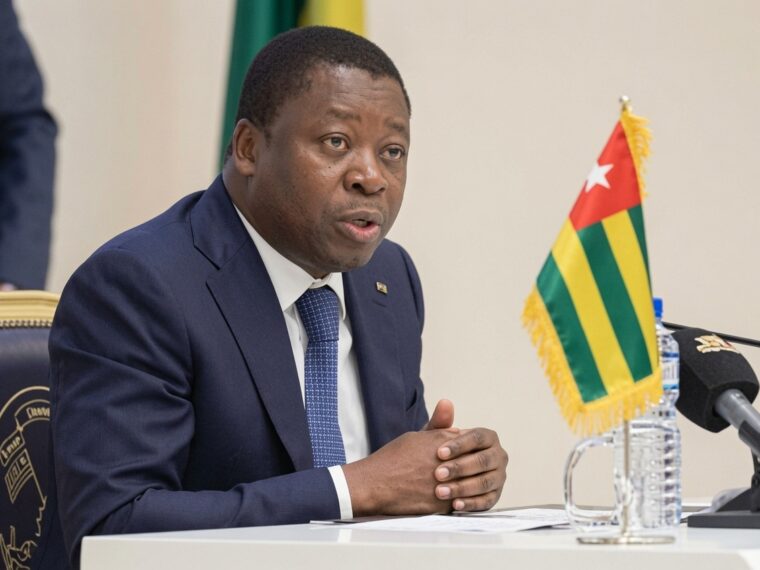
Diplomacy takes a backseat as Lomé’s patience runs thin
The eight-day Beijing mission begins on 9 October 2026, but the question on every Togolese mind is not what the optics will look like—it is when the promised dividends will actually reach home. Faure Gnassingbé arrives with a diplomatic arsenal: high-level meetings, trade talks, and a fresh mandate to deepen the Togo–China partnership. Yet the yardstick for success is no longer the elegance of a handshake or the length of a communiqué. It is the number of jobs created, the kilowatts of electricity delivered, and the kilos of locally processed cocoa that reach the market.
From historic ties to hard-to-see gains
The foundations were laid in 1972, cemented in 2024 when both capitals elevated ties to a Comprehensive Strategic Partnership. China’s gaze has long been fixed on Lomé’s port, touted as the region’s most efficient gateway. For its part, Togo has banked on Chinese cash for power plants, toll roads, and digital networks. The flow of goods has swollen, but the inflow of tangible improvements—higher wages, shorter commutes, cheaper solar lanterns—has not kept pace. After decades of cooperation, the time for polite applause has passed; the moment for measurable delivery has arrived.
What the ledger must show this time
Turning memoranda into steel and concrete is where past visits stumbled. This mission must move beyond intentions and place concrete figures on the table: how many hectares of irrigated farmland will be online by 2028? How many vocational centres will train the next cohort of solar technicians? How much of the promised $1.2 bn green-energy package will be earmarked for local firms rather than flown in from Shanghai?
Power, jobs, and a generation waiting for proof
The agenda is heavy on sectors that decide daily life: energy mix diversification, agro-industrial parks, and last-mile connectivity. Each carries the potential to shift thousands of households from kerosene lamps to grid power or from subsistence farming to factory floors. The catch: every promise needs a name, a date, and a budget line. Without these, the exercise risks becoming another round of donor pledges filed away and forgotten once the red-carpet exits fade from memory.
Skills transfer: the missing link
A partnership that trains ten Chinese engineers while leaving 500 Togolese technicians idle is not a partnership—it is an extension of the old order. The Beijing talks must secure binding commitments on technology transfer schedules, joint curricula with local polytechnics, and quotas for Togolese managers in every new project’s governance board. Only then does the word cooperation stop sounding like a polite fiction.
Accountability in an era of constitutional change
Faure Gnassingbé’s 2025 constitutional overhaul centralised authority in the new post of Council President. With longevity and decision-making power now concentrated, citizens are entitled to expect that every billion borrowed abroad is tracked with the same rigor as a domestic infrastructure budget. A public dashboard, updated quarterly, listing every signed line of credit, its utilisation rate, and the employment figures it has generated, would do more for confidence than any ribbon-cutting ceremony ever could.
Three red flags that cannot be ignored
- Vague timelines: Projects announced as “mid-term” provide cover for endless gestation; every endeavour must come with a calendar attached.
- Foreign dominance: If contract after contract is awarded to Chinese SOEs without competitive bidding, the promise of local industrialisation rings hollow.
- Opacity costs: When financial terms are shrouded in confidentiality clauses, the public has no way to know whether loans are concessional or predatory—until the first repayment instalment lands.
Will October mark the turning point?
The Beijing itinerary is set, the red carpets are rolled out, and the microphones are ready. Yet the most consequential conversation is the one that starts not in the Great Hall of the People, but in Lomé’s markets and classrooms. Togolese citizens are no longer satisfied with the potential of partnership—they demand the proof. The coming weeks will reveal whether this mission is remembered as the day the rhetoric finally gave way to reality, or just another stop on the diplomatic carousel.