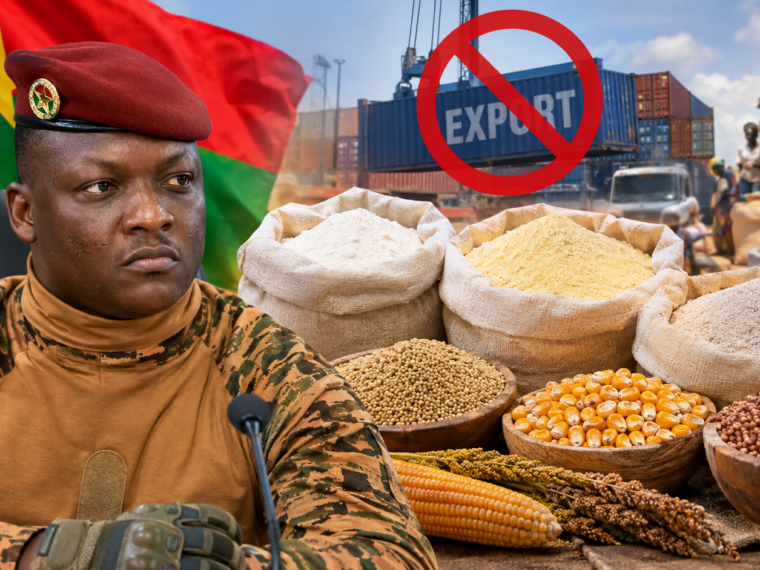
Government imposes temporary ban on millet, maize and sorghum flour exports
The government of Burkina Faso has implemented a sweeping measure aimed at halting the export of key staple flours indefinitely. According to an official directive from the Ministry of Commerce, the suspension covers millet, maize, and sorghum flours, as well as their processed derivatives. All existing export licenses for these products have also been revoked with immediate effect.
While the stated goal of this policy is to ensure sufficient supply within the domestic market a concern driven by ongoing food security challenges it raises critical questions about the balance between national protection and economic liberty. When does safeguarding internal markets justify such restrictive measures, and how much authority should the state wield in shaping economic activities?
This decision reflects a broader trend in Burkina Faso’s governance approach, one that increasingly centers state control over individual and commercial freedoms. It prompts reflection: is this a responsible policy to stabilize food supplies, or a step toward tighter governmental oversight with limited public consultation?
Beyond supply security: examining the unintended consequences of trade restrictions
At first glance, limiting exports appears to be a straightforward solution for boosting local availability and potentially lowering prices. However, such an outcome is not guaranteed. The effectiveness of this policy hinges on several variables, including actual stock levels, production capacity, and the government’s ability to oversee equitable distribution without stifling competition.
Moreover, the assumption that all Burkinabè consumers rely solely on domestically produced flours overlooks significant regional and dietary diversity. Restricting export opportunities may inadvertently undermine producers, traders, and small businesses that depend on international markets to sustain their livelihoods. Rather than ensuring stability, could this move instead destabilize entire segments of the economy?
The ripple effects extend beyond immediate commercial interests. They touch on fundamental issues: the protection of economic freedoms, the necessity of stakeholder engagement, and the transparency of public decision-making. Where is the line between prudent regulation and overreach?
From food policy to broader governance: assessing the trajectory of state intervention
The recent export ban is not an isolated incident. It aligns with a growing pattern in Burkina Faso, where state interventions are becoming more frequent and comprehensive in daily life. This trend invites comparison not in terms of equivalence, but in terms of growing public unease. Citizens and business operators are increasingly questioning whether such measures are being implemented with sufficient justification, oversight, and adaptability.
One underlying concern is whether these restrictions, while justified in the short term, might set a precedent for further encroachments on personal and economic freedoms. If millet and sorghum flours are now subject to controls, what’s next? Could other sectors from telecommunications to agriculture face similar scrutiny? The uncertainty itself poses a challenge to investor confidence and public trust.
It is important to recognize that a single policy does not define a nation’s political character. Yet, in a society that values democratic principles, heavy-handed economic measures demand clear rationale, robust debate, and periodic review. The government’s responsibility extends beyond announcing a ban; it includes demonstrating tangible outcomes in food accessibility, affordability, and equitable distribution.
What success looks like: concrete outcomes over policy declarations
The ultimate test of this export restriction will not be its implementation, but its impact on the lives of Burkinabè citizens. Will prices stabilize? Will local producers receive fair compensation? Will small traders continue to operate without undue hardship? Most critically, will the most vulnerable populations those already struggling with rising costs see meaningful relief?
Consumer protection, in its fullest sense, goes beyond limiting exports. It requires strengthening purchasing power, supporting sustainable agriculture, and ensuring accountability from public authorities. A policy that fails to deliver these results risks becoming little more than symbolic intervention, devoid of real benefit to the people it aims to serve.
The government’s challenge now is twofold: to enforce this measure effectively while remaining open to dialogue and adaptation. Transparency about stock levels, pricing mechanisms, and distribution strategies will be essential. Equally important is reassuring stakeholders that this decision is not a precursor to broader restrictions, but a targeted response to an urgent concern.
Only time will reveal whether this turning point leads to stability or further strain. One thing, however, is clear: the path forward must prioritize both food security and economic freedom or risk undermining the very goals it seeks to achieve.
By Thomas Nkoulou — Journaliste / Rédacteur