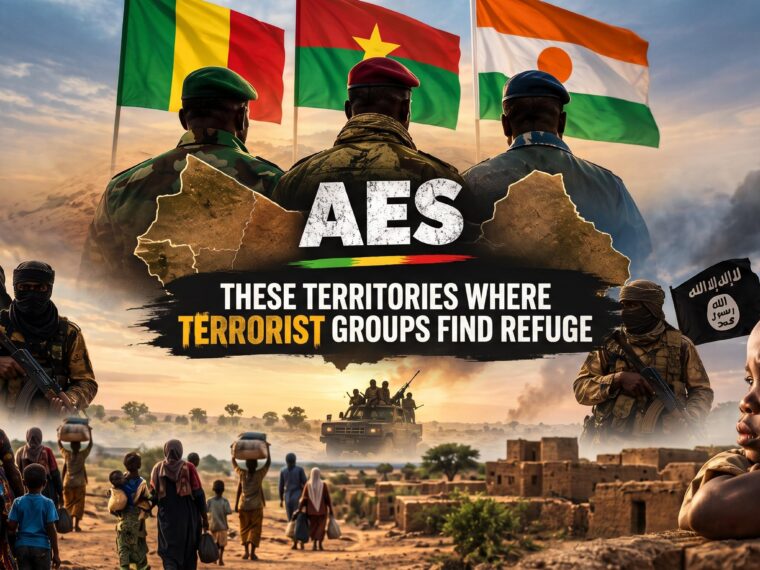
The turning point in Burkina Faso’s border crisis: what Tessit revealed
The dawn of October 9, 2026, marked a decisive shift in the Sahel’s security crisis. Violent clashes erupted between the Group for the Support of Islam and Muslims (JNIM) and the Islamic State in the Greater Sahel (ISGS) near Tessit, on Burkina Faso’s southern flank. Far from resolving who struck the harder blow, the fighting laid bare a harsh truth: armed groups continue to operate with impunity in areas that the region’s military juntas claim to have secured.
Contradictory accounts from both sides obscure the true outcome. JNIM-linked sources insist the rival ISGS suffered heavy losses, while ISGS-aligned voices declare victory and territorial gains. What cannot be disputed, however, is the persistent presence of armed factions in a zone where civilian life remains under constant threat. Displacement, economic paralysis, and disrupted access to essential services have become the daily reality for communities caught in the crossfire.
These events raise a critical question: why do militant groups retain their footing despite the Alliance of Sahel States’ (AES) stated mission to reclaim sovereignty and restore security?
Contradictions in Bamako, Niamey, and Ouagadougou’s security narratives
The AES’s military regimes Mali, Burkina Faso, and Niger rose to power promising a definitive break with terrorism. Their rhetoric emphasized reclaiming control over national territory, expelling foreign forces, and forging new alliances to end the scourge of armed insurgencies. Yet the Tessit clashes underscore a glaring disconnect between these ambitions and ground-level realities.
The core challenge is not merely the existence of armed groups but their ability to regroup, expand, and challenge state authority across porous borders. While authorities frequently point to external support for militants citing neighboring countries as sanctuaries or transit routes such accusations demand verifiable evidence. The persistence of insurgent activity within a state’s borders does not, by itself, prove state-level complicity. What it does prove is an urgent failure to implement strategies that translate into tangible security for civilians.
Reports from the region indicate ongoing operations by both JNIM and ISGS in areas such as Menaka (Mali), as well as cross-border movements into Niger and Burkina Faso. These patterns reveal a regional dynamic that resists simplistic narratives of foreign interference. They also highlight the need for intelligence, administrative presence, and community protection measures not just military realignments or withdrawal of Western troops.
From declarations to delivery: measuring sovereignty through action
The rhetoric of sovereignty has been loud, but the results remain distant. The AES’s pivot from Western partnerships to engagements with alternative security providers was framed as a decisive step toward restoring order. Yet the violence in Tessit demonstrates that no alliance, no matter how potent, can substitute for effective governance and sustained security operations on the ground.
A 2026 United Nations assessment confirmed continued militant activity in Tessit and Menaka, alongside frequent territorial contests between JNIM and ISGS. Such findings challenge the notion that external actors are solely responsible for the Sahel’s instability. While regional spillovers and transnational networks exist, they do not absolve national governments of their duty to secure their own populations.
The burden of proof now rests on the AES leadership. Can they move beyond symbolic gestures such as criticizing foreign powers or reshuffling military commands to deliver measurable improvements in safety, mobility, and access to services for civilians in contested zones?
The political cost of persistent insecurity
Beyond the humanitarian toll, the security crisis carries deep political implications. In Mali, Burkina Faso, and Niger, authorities have framed their military rule as a necessary response to existential threats. Yet when insurgent violence persists and expands, public trust erodes. Calls for transparency, accountability, and a return to constitutional governance grow louder not only from civil society, but from communities living under daily siege.
It is premature to accuse AES leaders of deliberately fostering terrorism to prolong their rule. Such claims require concrete, corroborated evidence. What is undeniable, however, is the risk that prolonged insecurity becomes a self-sustaining justification for militarized governance and for deferring democratic transitions indefinitely.
For the region’s citizens, the equation is simple: they demand not rhetoric, but results. They need protection. They need functioning markets. They need schools and clinics that function. Until these needs are met, no narrative of sovereignty no matter how strident can restore legitimacy to governments that claim to serve their people.
What the future holds: beyond Tessit, a path forward
Tessit’s violence may fade from headlines, but its lessons endure. The AES faces a stark choice: double down on regional cooperation and intelligence-driven operations, or risk ceding more territory and more lives to armed factions that thrive in the vacuum of state control.
Concrete steps are required: restoring administrative presence in remote areas, rebuilding local trust through civic programs, and dismantling the economic lifelines that sustain militant networks. These measures must accompany any further reconfiguration of international alliances.
The sovereignty the AES claims is not measured in flags raised or foreign bases vacated. It is measured in the safety of children walking to school, farmers tending their fields, and families sleeping without fear of attack. Until that reality is achieved, the promise of a Sahel free from terror remains unfulfilled and the people of Tessit, Menaka, and beyond continue to pay the price.
By Agnès Mvogo — Journaliste / Rédacteur