Benin’s 2027 budget milestone has arrived—a historic leap forward that signals a decisive turning point in the nation’s economic and social journey. Submitted to the National Assembly for review and approval, the draft finance bill for 2027 clocks in at **4.76 trillion FCFA**, an ambitious 14.7% surge from the revised 2026 budget. This isn’t just a numbers game—it’s the government’s bold blueprint to ignite economic growth, sustain fiscal discipline, and uplift communities across the country.
From 4.15 trillion to 4.76 trillion: a budget on the move
The numbers tell a powerful story of momentum. The 2027 budget rises by **608.7 billion FCFA** compared to the revised 2026 allocation, reflecting a clear commitment to scale up public investment and strengthen social safety nets. Behind this increase lies a strategic vision: accelerating GDP growth to **7.5%**, keeping the deficit within **2.8% of GDP**—well under the UEMOA target—and anchoring inflation below the regional threshold at **2.0%**. These benchmarks aren’t just targets; they’re pillars of a sustainable growth strategy designed to protect purchasing power while driving structural transformation.
Five engines to power Benin’s economic engine
To turn ambition into impact, the government is focusing on five transformative levers:
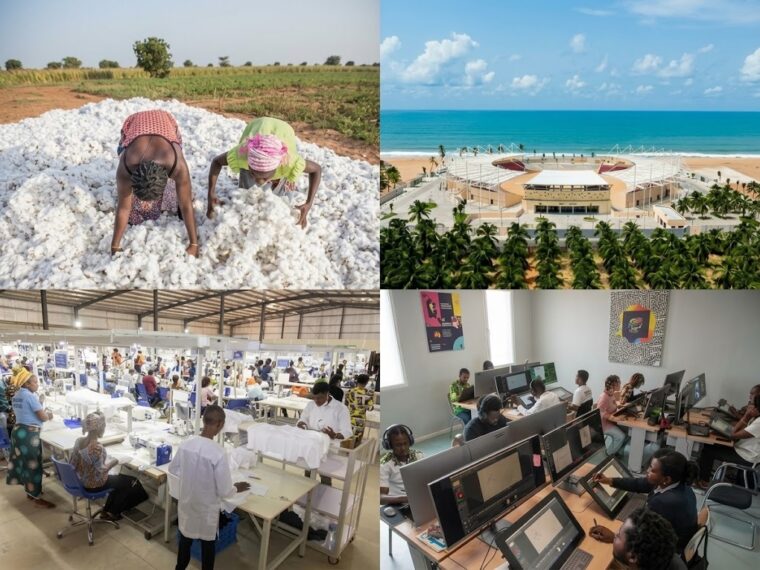
- Agricultural modernization: Boosting productivity, strengthening value chains, and boosting local processing to turn Benin into a regional food hub.
- Industrial promotion: Catalyzing value-added production, enhancing business competitiveness, and creating high-opportunity jobs across industries.
- Tourism and cultural valorization: Unlocking the potential of Benin’s rich heritage to diversify the economy and attract investment.
- Technological innovation: Digitizing public services, modernizing infrastructure, and fostering fintech and agro-tech ecosystems.
- Human capital development: Prioritizing education, health, and youth empowerment to build the skilled workforce of tomorrow.
Each of these levers is designed not only to boost GDP but to create pathways out of poverty and into dignified, sustainable livelihoods.
Investment surge: building the Benin of tomorrow
The 2027 budget places **public investment at its core**, allocating resources to sectors with the highest catalytic impact. Key areas include:
- Education: Constructing and rehabilitating high schools, modernizing university campuses, and expanding digital learning.
- Health: Building five new zone hospitals, rehabilitating regional facilities, and rolling out emergency care systems.
- Social protection: Scaling up cash transfers, school feeding programs, and tuition-free education for girls nationwide.
- Digital transformation: Expanding broadband access, digitizing government services, and supporting tech startups.
- Agriculture and energy: Financing irrigation, clean energy projects, and rural electrification to unlock rural growth.
These investments are about more than infrastructure—they’re about building a resilient, inclusive economy where no region or community is left behind.
Social protection takes center stage
With social expenditure rising to **1.6 trillion FCFA**—a 24% jump—the 2027 budget reinforces the social contract between the state and its citizens. Flagship programs include:
- ARCH Program (Human Capital Strengthening Insurance): Expanding cash transfers to ultra-poor households to enable entrepreneurship and income generation.
- Universal school meals: Rolling out canteen programs nationwide to improve learning outcomes and reduce dropout rates.
- National social welfare platform: Creating a unified system for emergency aid, health coverage, and disaster response.
- Free secondary education for girls: Extending tuition-free access in general and technical schools to enhance gender parity and reduce early marriage.
These initiatives reflect a deliberate shift toward inclusive growth—where economic progress translates into real improvements in daily life.
Healthcare expands with new hospitals and nutrition programs
The health sector receives a major boost with the construction of **five new zone hospitals** and the upgrading of district facilities. Additional measures include:
- Scaling up child nutrition programs to combat stunting and malnutrition.
- Expanding vaccination drives and maternal health services in underserved regions.
- Launching a universal emergency care system to reduce response times and save lives.
- Strengthening disease surveillance and malaria control initiatives.
Together, these investments signal a long-term commitment to a healthier, more resilient population.
Education reform: classrooms, careers, and digital reach
Benin is doubling down on education as the foundation of human development. The 2027 budget funds:
- Construction and rehabilitation of high schools and university facilities.
- Rollout of digital learning platforms and tech-enabled classrooms.
- Streamlined teacher recruitment and career advancement reforms to improve service delivery in public schools.
- Bursary reform to align scholarships with high-demand fields and labor market needs.
These efforts aim to ensure every child—especially in rural and underserved areas—has access to quality education and a clear path to opportunity.
Empowering local governments: the power of decentralized investment
The 2027 budget strengthens the role of local authorities by boosting the Communal Investment Fund and launching a new territorial economic zoning mechanism. These reforms are designed to:
- Enable municipalities to access diversified funding beyond state allocations.
- Increase transparency and predictability in local project financing.
- Support the delivery of community-level infrastructure—roads, markets, water systems—that directly improve livelihoods.
- Promote regional balance by redistributing resources based on need and development potential.
This decentralized approach ensures that growth is not just national, but local—felt in every village, town, and city.
The moment of truth: turning budget into better living
The 4.76 trillion FCFA budget isn’t just a financial statement—it’s a declaration of intent. With a projected **7.5% growth rate** and a **2.8% deficit**, Benin is walking a tightrope between ambition and prudence. Inflation held at **2.0%** shows fiscal discipline isn’t at the expense of stability.
But the real test lies ahead: transforming these resources into tangible outcomes. Can Benin convert its investment surge into:
- More and better-paying jobs?
- Stronger agriculture and more competitive industries?
- Universal access to quality health and education?
- A measurable decline in extreme poverty?
The draft budget is now in the hands of parliament. As lawmakers deliberate, one thing is clear: Benin has set a bold course—but the journey to transformation has just begun.