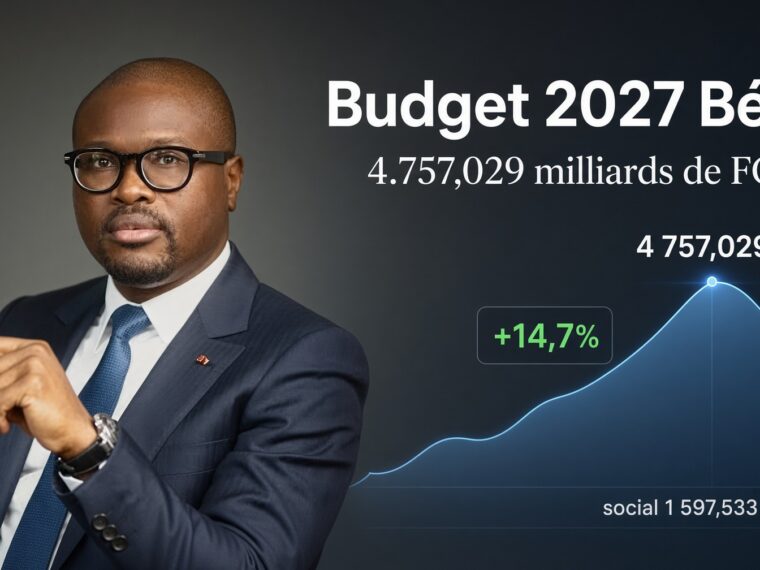
Benin has reached a decisive turning point in its economic trajectory with the submission of the 2027 draft finance bill to the National Assembly for review and approval. This landmark budget proposal, set at 4,757.029 billion FCFA—a 14.7% increase from the revised 2026 budget—signals a bold shift toward long-term growth, fiscal responsibility, and inclusive development. The government is betting on a 7.5% GDP growth rate while keeping the budget deficit at 2.8% of GDP and inflation steady at 2.0%, well below the West African Economic and Monetary Union’s (WAEMU) 3% threshold.
From numbers to action: how the 2027 budget drives Benin’s economic momentum
The 2027 budget isn’t just a financial document—it’s a roadmap for Benin’s future. With an additional 608.672 billion FCFA in resources compared to 2026, the government is prioritizing public investment and social policies to stabilize the economy while fostering sustainable progress. By maintaining macroeconomic stability and targeting high-impact sectors, this budget sets the stage for transformative change across industries and communities.
Five strategic pillars to unlock Benin’s economic potential
The government’s vision for 2027 is built on five key levers designed to accelerate structural transformation:
- Agricultural modernization: Boosting productivity, strengthening value chains, and increasing local processing to reduce import dependency and enhance food security.
- Industrial promotion: Fostering value addition, supporting SMEs, and creating jobs through targeted incentives and infrastructure improvements.
- Tourism and culture: Leveraging Benin’s rich heritage to diversify the economy, attract investment, and generate sustainable revenue streams.
- Technological innovation: Investing in digital infrastructure and smart solutions to improve service delivery, governance, and economic competitiveness.
- Human capital development: Strengthening education, healthcare, and social protection to build a skilled workforce and reduce inequality.
Public investment: the driving force behind 2027’s social and economic goals
More than half of the 2027 budget—nearly 3 trillion FCFA—will be directed toward high-impact public investments. Critical sectors such as education, healthcare, agriculture, energy, and digital transformation will receive substantial funding to lay the foundation for long-term prosperity. The government’s focus is twofold: accelerating economic diversification and ensuring equitable access to essential services.
Key infrastructure projects include the construction of five new regional hospitals, rehabilitation of university facilities, and expanded digital connectivity to bridge urban-rural divides. These investments aim to create jobs, improve living standards, and position Benin as a regional leader in innovation and sustainability.
Breaking barriers: how the 2027 budget raises the bar for social inclusion
The 2027 budget places social protection at the heart of its strategy, allocating 1,597.533 billion FCFA to programs aimed at lifting vulnerable populations out of poverty and improving quality of life. This represents a significant increase from 2026, with initiatives designed to address systemic challenges and empower communities.
Education: breaking the cycle of inequality
The government is doubling down on free secondary education for girls and expanding school feeding programs to reduce dropout rates. Teacher recruitment and career reforms are also underway to improve the quality of education and align it with labor market needs. Over 500,000 additional school desks will be distributed, while digital learning platforms will expand access to remote education.
Healthcare: expanding access and saving lives
With five new regional hospitals on the horizon, the 2027 budget aims to strengthen healthcare infrastructure and emergency response systems. Priority actions include:
- Expanding vaccination campaigns for children.
- Intensifying malaria prevention and maternal health initiatives.
- Rehabilitating district hospitals and equipping university medical centers.
- Implementing a national emergency healthcare program to reduce delays in critical care.
Social protection: building resilience for the most vulnerable
The government is scaling up the ARCH (Assurance pour le Renforcement du Capital Humain) program, expanding cash transfers to households in extreme poverty, and introducing a national social benefits platform to streamline assistance delivery. The goal is to provide a safety net that enables economic self-reliance while ensuring no one is left behind.
Local empowerment: unlocking the potential of Benin’s municipalities
The 2027 budget introduces bold reforms to empower local governments, including the launch of the Fonds d’Investissement Communal (FIC) and territorial economic zoning mechanisms. These tools are designed to help communes diversify funding sources, reduce reliance on state allocations, and implement community-driven projects with greater transparency and equity.
Beyond the numbers: the real test of 2027’s budget
While the 4,757.029 billion FCFA allocation and ambitious growth targets are cause for optimism, the true measure of success will lie in execution. Can Benin translate this financial momentum into tangible outcomes—more jobs, better infrastructure, improved healthcare and education, and lasting poverty reduction?
With fiscal discipline, strategic investments, and a commitment to inclusive growth, the 2027 budget positions Benin at a critical juncture. The National Assembly’s review and approval will determine whether this plan becomes the catalyst for a new era of prosperity or remains a missed opportunity.