After decades of dependency on French giant Orano, Niger has made a decisive pivot in its uranium strategy. The 2023 coup marked the beginning of a bold policy shift, culminating in the nationalization of the Somaïr mining company in June 2025. This move signaled Niamey’s determination to reclaim control over its strategic mineral wealth—but the path to higher revenues remains uncertain. While international uranium prices have surged, evidence suggests that better deals have yet to materialize.
From Orano to new partnerships: a major strategic shift
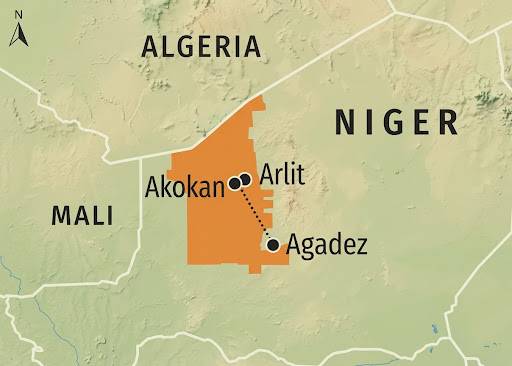
Niger’s break with Orano wasn’t just a diplomatic rupture—it was a complete restructuring of its uranium sector. The French group lost operational control in late 2024, and by mid-2025, the state had fully nationalized Somaïr, which had operated Niger’s Arlit mine for over half a century. Orano has since launched international arbitration proceedings, arguing that the nationalization violated agreed terms. Yet for Niamey, regaining ownership of the mine was only the first step in a much larger ambition: to reshape its uranium trade on its own terms.
The government’s strategy has since expanded beyond France. Niger has actively courted new partners, including Russia, China, and Western firms, aiming to diversify its buyer base and potentially secure better pricing. But this shift comes with challenges. After years of decline, uranium production has plummeted—from 4,116 tonnes in 2015 to just 962 tonnes in 2024. With only one operational mine today, Niamey must rebuild not only its mining capacity but also its commercial leverage.
Higher prices, but higher stakes: are new deals really better?
One widespread assumption is that Orano paid unfairly low prices for Niger’s uranium. However, comparing spot market prices to historical contract rates oversimplifies the reality. Uranium isn’t traded like oil on a single exchange; contracts are privately negotiated, often blending spot prices with long-term formulas tailored to buyers’ needs. In 2020, for example, Niger reportedly earned 83.75 euros per kilogram from Somaïr deliveries—a figure that seems high in hindsight when compared to older data indicating payments as low as $33 per pound for some contracts.
Today, the market looks far more favorable. By September 2026, spot uranium prices had surged to nearly $90 per pound, with long-term contracts averaging over $96. While these figures suggest Niger could command higher revenues today, no public data confirms that the country is actually fetching these prices in new deals. The opacity surrounding recent negotiations raises questions about whether improved price conditions are being realized.
Opportunities and mysteries: the Russian and Iranian deals
The most talked-about case involves a reported 2025 agreement with Russia. Multiple sources claimed Niger sold 1,000 tonnes of yellowcake to Rosatom’s Uranium One Group for $170 million—approximately $77 per pound. While the government and Rosatom have denied the deal’s existence, the story gained credibility after reports surfaced of a massive convoy transporting uranium from Arlit to Niamey under military escort. The shipment was reportedly halted at the capital’s airport, leaving its final destination unclear. Without an official contract, the deal remains speculative—but the logistics suggest serious negotiations were underway.
Iran’s involvement adds another layer of complexity. In 2024, reports emerged of confidential talks for 300 tonnes of yellowcake, valued at around $56 million. While Niger denied finalizing the sale, a senior advisor acknowledged discussions had taken place. Again, the distinction between negotiations and executed contracts is critical. There is evidence of interest and dialogue, but no verifiable proof of a completed Iranian purchase.
Beyond France: can diversification deliver real gains?
Russia and China are now prominent in Niger’s uranium diplomacy. In December 2025, the newly formed Timersoi National Uranium Company signed a cooperation agreement with Rosatom’s Uranium One to explore new deposits. Meanwhile, Chinese firms have reportedly explored purchasing up to 1,000 tonnes from Arlit’s stockpiles. These partnerships offer Niamey alternative channels for sales and investment, but they do not guarantee better prices.
The real prize, for now, is negotiating power. By expanding beyond France, Niger can play buyers against each other, potentially driving up bids. Yet the country still faces hurdles: declining production, logistical bottlenecks, and legal uncertainty stemming from the Orano dispute. In September 2025, a World Bank tribunal even ordered Niger not to sell uranium tied up in the litigation, complicating efforts to monetize existing stockpiles.
Rebuilding the supply chain: a long-term play
Niger’s uranium strategy is no longer just about replacing Orano—it’s about repositioning the country as a key player in a multipolar market. In 2026, Niamey established the Teloua Safeguarding Uranium Mining Company to manage its nationalized assets. At the same time, new Western investors are returning. In September 2026, the U.S. approved a $414 million financing package for the Dasa project, led by Canadian firm Global Atomic, signaling renewed international interest.
This is the heart of the breakthrough: Niger isn’t merely swapping one buyer for another. It’s creating competition among global powers to extract maximum value from its mineral wealth. The question now is whether this strategy will translate into tangible revenue gains—or if the opacity of recent deals will leave the benefits unclear for years to come.
The bottom line: revenue gains still unproven
Niger has undeniably gained leverage. International prices are higher, partnerships are diversified, and the state now controls a critical part of the supply chain. Yet the evidence needed to confirm that these changes have led to better financial outcomes for Niger remains elusive. While higher market prices offer promise, the actual terms of new contracts, including pricing formulas, premiums, and logistical costs, are kept confidential. Without transparency, it’s impossible to say whether Niamey is truly benefiting more now than under Orano’s tenure.
For now, the uranium breakthrough is still more about potential than proven profit. The true test will come when Niger finalizes contracts that deliver clear, competitive prices—and ensures that a meaningful share of those revenues stays in the country.