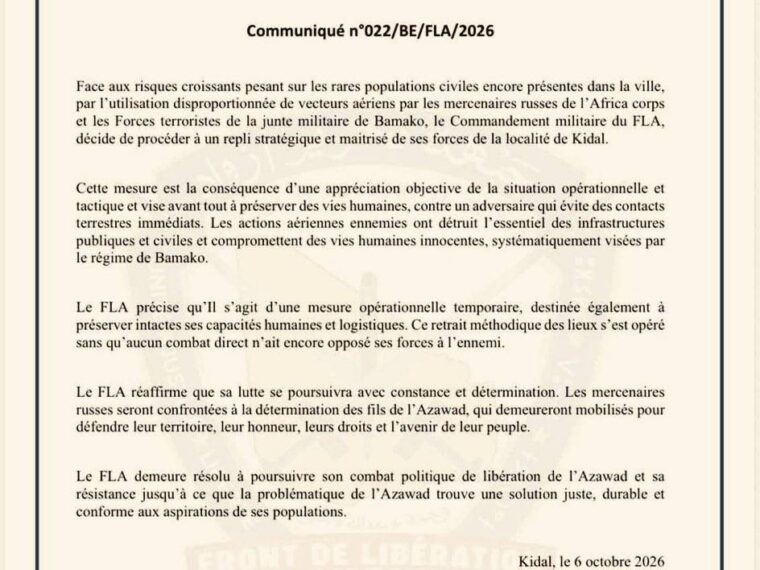
The Front de Libération de l’Azawad (FLA) has executed a major pullback from Kidal, the strategic stronghold in northern Mali, marking what it calls a ‘strategic and controlled retreat.’ The move, presented as temporary, arrives after the group reclaimed the city in a sweeping April 2026 offensive that forced the withdrawal of African Corps troops—successors to Russia’s Wagner Group. With Mali’s transitional authorities having touted the city’s 2023 recapture as a military victory, the FLA’s latest withdrawal signals a dramatic shift in the balance of power.
A city steeped in history and rebellion
Kidal is not merely a wartime battleground; it is the ideological and symbolic epicenter of the decades-long Azawad rebellion. For Tuareg separatists, control of the city represents a core demand—regional autonomy within Mali’s borders. For Bamako, its loss in 2014 and recapture in 2023 symbolized both failure and triumph in the state’s fight to preserve territorial integrity.
The FLA’s strategic withdrawal follows a pattern observed in earlier phases of the conflict. After Mali’s army reclaimed Kidal with Russian support in late 2023, the group cited tactical retreat as a means of conserving forces amid overwhelming firepower. But this time, the context has shifted entirely. Not only has the FLA re-established control over key areas, but it now appears to be voluntarily relinquishing a high-value position—raising critical questions about its long-term strategy.
From Wagner to Africa Corps: lessons unlearned
Russia’s paramilitary presence in Mali evolved from Wagner to Africa Corps, yet the challenges remain unchanged. The brutal 2024 battle of Tinzaouatène, near the Algerian border, exposed the limits of conventional military power in the Sahel. A convoy of Malian soldiers and Russian contractors faced coordinated attacks by Tuareg fighters amid a sandstorm, resulting in heavy losses. While Moscow and Bamako downplayed casualty figures, rebel claims of over 130 dead rattled the alliance.
This defeat forced Africa Corps units to withdraw from Kidal in April 2026—just months before the FLA’s recent offensive. The loss of Anéfis in July 2026 further underscored the fragility of government control. Despite superior firepower, Malian and Russian forces struggle against an enemy that leverages terrain, mobility, and local intelligence.
What does the FLA’s retreat really mean?
The FLA’s leadership insists the pullback is a deliberate maneuver to avoid direct confrontation and preserve combat readiness. Such retreats have been common in the conflict’s ebb and flow. In 2014, Mali’s army launched a failed offensive to retake Kidal, suffering heavy losses. Rebels withdrew before the advance, framing it as a tactical necessity to prevent further bloodshed.
But today’s dynamics are distinct. The FLA’s April 2026 offensive demonstrated renewed operational strength. A withdrawal now—especially from a city symbolically reclaimed by Bamako just three years prior—suggests an intention to conserve forces for future objectives, rather than retreat under pressure.
Is this the calm before the next storm?
The desert offers an unparalleled sanctuary. With vast expanses, scattered oases, and deep tribal networks, separatist fighters can disperse, regroup, and strike without warning. A temporary retreat from Kidal does not equate to surrender. Instead, it may signal a pivot toward consolidating gains elsewhere—possibly along the Algerian border or in southern Azawad regions.
For Bamako, the loss of Kidal—again—emboldens critics who question the government’s ability to secure the North. It also risks undermining the political narrative of territorial restoration, which was central to the junta’s legitimacy.
A turning point, not an endgame
History shows that in northern Mali, victories are rarely final. Cities like Kidal change hands, but the underlying conflict endures. The FLA’s withdrawal may be strategic, but it also signals that the group sees Kidal as expendable in the short term. That doesn’t mean the battle is over—it means the war has entered a new, unpredictable phase.
With the FLA regrouping its forces, the next move will determine whether this retreat becomes a prelude to peace—or the setup for another round of devastating clashes.