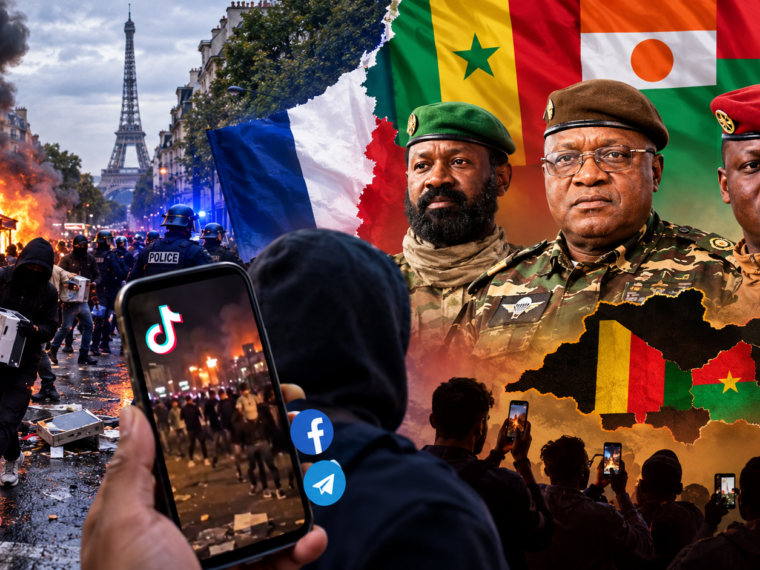
Unrest in France has far-reaching implications beyond its borders, particularly in the Sahel region where military-led governments in Mali, Burkina Faso, and Niger are exploiting the scenes of urban violence to fuel anti-Western narratives. Across platforms like TikTok, Facebook, and Telegram, images of looting, property damage, and clashes with law enforcement are being recycled to challenge France’s credibility on democracy, security, and the rule of law.
From urban chaos to political ammunition
For supporters of the Alliance of Sahel States (AES), these developments offer a strategic opportunity to turn France’s own standards against it. The argument is straightforward: if France faces internal disorder, how can it legitimately criticize Sahel governments for governance or security failures? The goal is clear erode France’s moral authority while positioning AES regimes as defenders against Western hypocrisy.
Yet this narrative overlooks a critical distinction: while political rhetoric may amplify certain narratives, the legal consequences of individual actions remain separate from geopolitical posturing.
Legal accountability takes precedence over propaganda
As investigations unfold, authorities are determining the precise involvement of suspects including foreign nationals allegedly taking part in violence. If evidence confirms their participation in looting, destruction, or other crimes, they will face judicial proceedings under French law, irrespective of nationality. The principle is non-negotiable: adherence to local laws applies equally to all residents, regardless of origin.
Key considerations include:
Establishing individual responsibility through verified evidence
Assessing administrative status of foreign suspects (e.g., visa compliance)
Applying penalties proportionate to proven offenses
Manipulating reality: when images become weapons
AES-aligned networks are selectively amplifying footage to portray France as a failing state. However, isolated incidents do not reflect systemic collapse. A single video of looting or confrontation does not substantiate broader claims of institutional breakdown. Similarly, such footage cannot validate assertions that AES governments have achieved superior security or governance outcomes a claim that requires measurable evidence, not anecdotal imagery.
Digital forensics plays a crucial role in distinguishing organic unrest from coordinated disinformation campaigns. Identifying repeat accounts, cross-posted narratives, and edited content helps determine whether these materials are part of a deliberate strategy rather than spontaneous reactions.
The weight of individual justice in a climate of geopolitical feud
The unfolding legal proceedings will test France’s judicial system, which must operate independently of political or foreign pressure. Regardless of the outcome, the legitimacy of any claim against Paris will ultimately depend on verifiable facts not viral narratives or state-sponsored interpretations.
At the same time, it is essential to reject blanket accusations against Malian, Burkinabè, or Nigerien communities in France. The vast majority of these individuals are law-abiding residents, and their nationality should not be conflated with the actions of a few. Justice demands personal accountability, not collective punishment.
Beyond viral outrage: the limits of political score-settling
As France grapples with unrest, AES governments are leveraging the moment to challenge Western influence across Africa. Yet this tactic risks overshadowing a fundamental truth: if foreign nationals are found to have violated French law, they must answer to the courts, not to foreign propagandists or online agitators.
The justice system, not social media feeds, will decide the fate of those implicated. And in that forum, evidence not ideology must prevail.
By Agnès Mvogo — Journalist