Government intervention underscores growing scrutiny of public broadcasters in West Africa
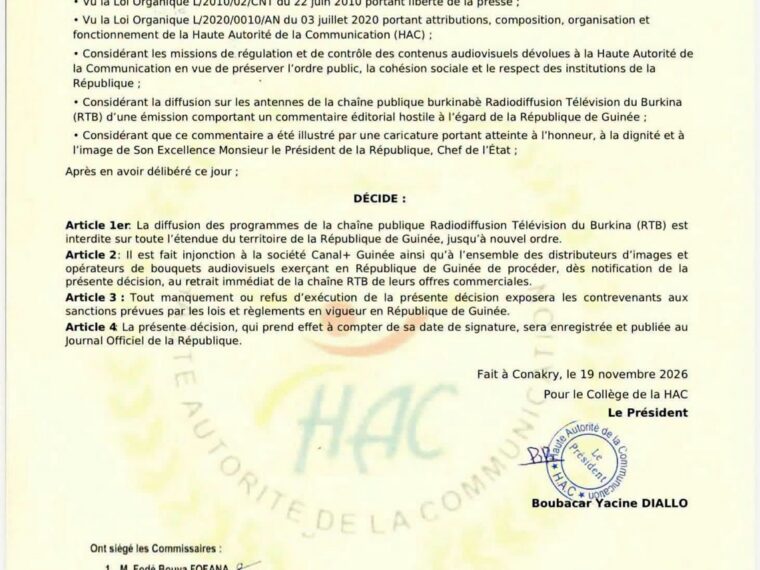
The Guinean High Authority for Communication (HAC) has taken decisive action by suspending the broadcast of Burkina Faso’s Radiodiffusion Télévision du Burkina (RTB) across the entire national territory, citing serious violations of professional journalism standards. This unprecedented move highlights broader concerns about the role of state television in the region, where public broadcasters increasingly appear to function as extensions of political agendas rather than independent sources of information.
When public media loses sight of its core mission
The RTB, operating under Burkina Faso’s transitional authorities, has faced mounting criticism for its perceived alignment with political narratives, particularly under the leadership of Captain Ibrahim Traoré. Rather than adhering to the fundamental principles of public service broadcasting rigorous fact-checking, balanced coverage, and inclusive pluralism the network has been accused of prioritizing partisan messaging over factual reporting. Such practices erode public trust and distort the democratic role of media in society.
Signs of systematic editorial drift
Several red flags have emerged in recent months, including:
Selective omission of critical perspectives in national and regional news coverage;
Use of inflammatory language to discredit opposing viewpoints rather than fostering constructive debate;
Repetitive dissemination of state-sanctioned narratives without factual verification or context;
Failure to provide equal access to multiple political voices during electoral and policy discussions.
These patterns suggest a troubling convergence of journalism with propaganda, raising questions about the RTB’s commitment to serving the public interest above all else.
Broader implications for African public broadcasting
This decision by Guinea’s HAC is not merely an administrative response it reflects a regional reckoning with the erosion of media integrity. Public broadcasters, as stewards of national information ecosystems, carry a heavy responsibility: to uphold truth, challenge power, and empower citizens through accurate, transparent reporting. When state-owned networks stray from these principles, the consequences extend far beyond their borders, influencing perceptions of democracy and governance across West Africa.
The sovereignty paradox: defending nations by silencing facts
At its core, the question is whether nations can genuinely claim media sovereignty while systematically suppressing dissenting voices. A public broadcaster’s legitimacy rests on its ability to reflect the complexity of society not to amplify a single narrative. The suspension of RTB in Guinea serves as a cautionary tale for other African states grappling with similar tensions between government control and journalistic integrity. True sovereignty is not achieved through censorship but through the uncompromising pursuit of truth.
What lies ahead for RTB and regional media
The immediate future for the RTB remains uncertain, as the suspension remains in effect pending a thorough review of its editorial practices. For Guinean authorities, this decision sends a clear message: public media must prioritize citizens over political expediency. For the broader African media landscape, it underscores the urgent need for independent oversight mechanisms that can hold state broadcasters accountable to their mandates.
One thing is certain: the integrity of public broadcasting is not a negotiable asset it is the bedrock of a functional democracy. As discussions on media reform intensify across the continent, the case of RTB in Guinea may well serve as a turning point in the fight to reclaim journalism from partisan capture.
By Agnès Mvogo — Journalist