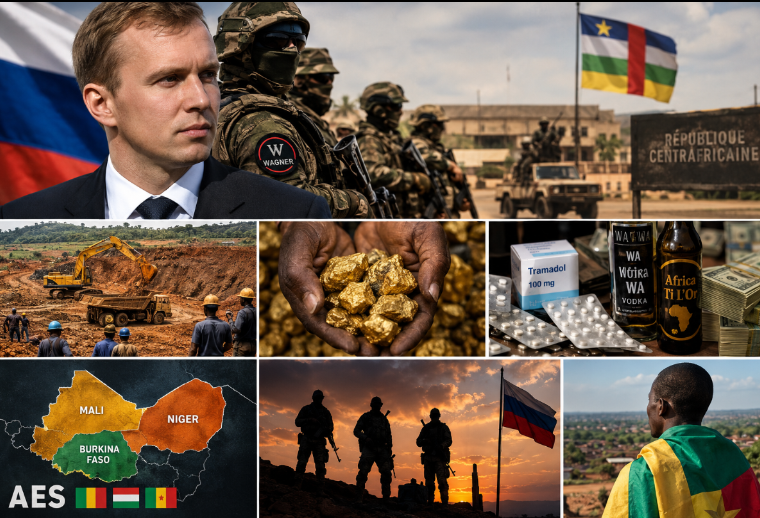
The latest wave of security partnerships between Russia and Sahel nations is revealing a troubling pattern: access to gold reserves is increasingly traded for military protection. In the Central African Republic, fresh investigative findings show how these arrangements are evolving beyond immediate security needs, embedding economic control within fragile states.
From guns to gold: the evolving Russian footprint in Central Africa
Investigations indicate that Yevgeny Prigozhin’s son, Pavel, has expanded a commercial empire linked to Russian security contractors in the Central African Republic. Estimates place annual revenues derived from this network in excess of $400 million. Unlike traditional military support, this model ties security personnel to direct involvement in gold mining and related logistics, creating a cycle of dependency between protection services and resource extraction.
While the fighting force in the country remains around 500 contractors, their presence supports a broader economic infrastructure. One major gold mine tied to this network reportedly generates roughly $250 million annually in production value. Export routes and pricing mechanisms, however, remain opaque, raising concerns about revenue transparency and the actual financial returns reaching Central African institutions.
When security partnerships become economic leverage
The Russian security model in Central Africa uniquely combines combat deployment, political influence, and resource control. For governments under threat, such a partnership can appear as a rapid solution to insurgencies. But when the same actors gain stakes in mines, transport networks, and commercial hubs, the alignment of interests shifts.
Reports highlight additional revenue streams attributed to these networks, including alcohol distribution, small arms trade, and control over the tramadol market. While not legally adjudicated, these activities underscore a governance gap: when armed groups operate with close ties to local authorities, oversight and accountability grow difficult to enforce.
Can the Sahel’s AES nations avoid Central Africa’s path?
The Alliance of Sahel States—comprising Mali, Burkina Faso, and Niger—faces similar pressures from jihadist insurgencies and shifting international alliances. While their dealings with Moscow do not mirror the Central African model exactly, the risks are comparable. Questions persist over the long-term contracts, mining concessions, and hidden economic benefits granted in exchange for security support.
In Mali, the presence of Russian personnel has sparked debate over operational effectiveness and civilian casualties. In Burkina Faso and Niger, deeper military collaboration raises concerns about the commercial terms attached to these agreements. The core dilemma remains: can these nations diversify partnerships without surrendering control over their strategic wealth and decision-making?
The Kremlin’s dual strategy: military influence and mineral control
Following the mutiny and death of Yevgeny Prigozhin in 2023, Russia has attempted to formalize its African operations under the Africa Corps, a Defense Ministry-linked initiative. Yet local networks and economic interests rooted during Wagner’s presence remain intact. In the Central African Republic, these ties have allowed Pavel Prigozhin to maintain operational autonomy, blurring the line between state policy and private profit.
This dual approach poses a challenge for Sahel governments: Moscow’s long-term intent is not solely military, but economic and geopolitical. While not every engagement is exploitative, the pattern demands careful scrutiny of contracts, concession terms, and revenue flows.
Sovereignty at stake: who holds the keys to gold and security?
The Central African case offers a cautionary tale. When a state’s security depends on foreign forces that also control its mines, the cost of protection extends beyond bullets and borders. The real issue is not whether to engage with Moscow, but how to structure such cooperation.
Transparent contracts, independent oversight of mining operations, verifiable human rights safeguards, and direct public benefits from resource revenues are essential. The goal should not be limited to security gains, but include measurable improvements in governance, development, and civilian protection. In Central Africa, the model has skewed toward enrichment and influence. In the Sahel, it remains a choice—not an inevitability.
The key question is no longer which power protects a regime, but who controls the gold beneath the ground, who benefits from its sale, and who answers for the consequences of the deal.