Senegal political shake-up as president sacks popular prime minister
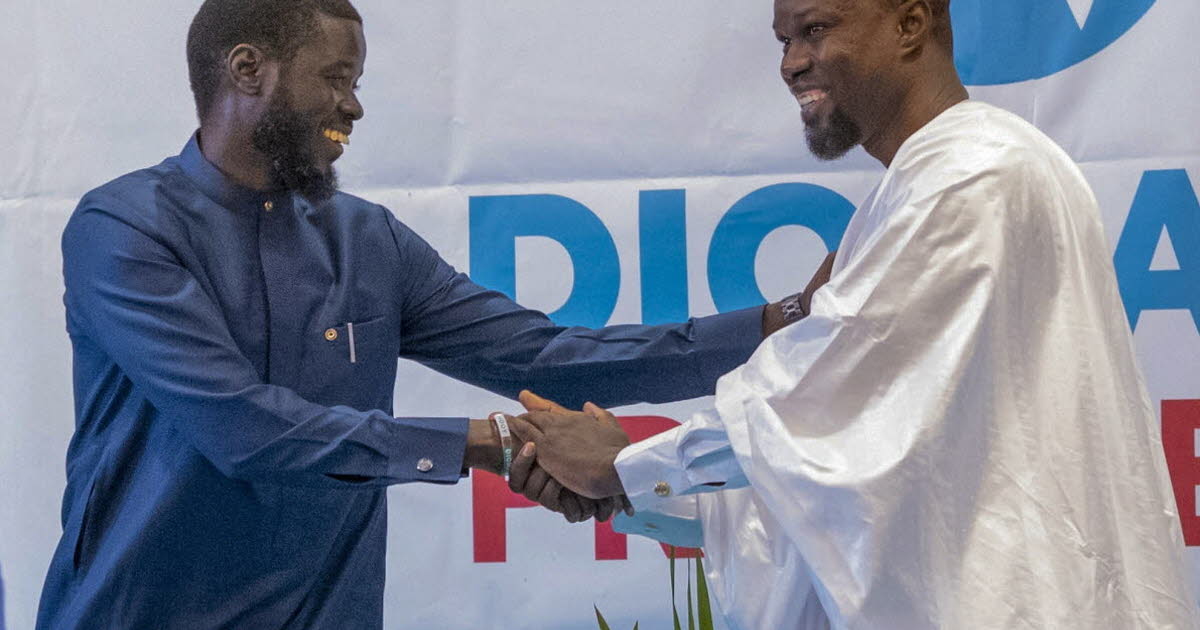
The unexpected dismissal of Prime Minister Ousmane Sonko by President Bassirou Diomaye Faye has plunged Senegal into a deep political crisis. The two leaders, once seen as an unbeatable duo promising radical change, are now at loggerheads, leaving the nation in uncharted territory.
Tensions that had been simmering between President Bassirou Diomaye Faye and his former mentor, Prime Minister Ousmane Sonko, have finally erupted. The president’s decision to dismiss Sonko on Friday marks the end of an alliance that had captivated Senegalese voters. Elected with 54% of the vote in March 2024, Faye owed much of his victory to Sonko, whose charismatic leadership had galvanized support for the Pastef party despite his ineligibility due to a defamation conviction.
At the height of their collaboration, the duo projected an image of unbreakable unity, encapsulated in the slogan *Diomaye moy Sonko, Sonko doy Diomaye* (*Diomaye is Sonko, Sonko is Diomaye*). Their release from prison and swift ascent to power just 10 days later symbolized a new beginning for a nation weary of political instability and social unrest. Yet the promise of systemic reform and anti-corruption measures, which fueled their rise, now lies in tatters.
The partnership rapidly unraveled as Sonko overshadowed his protégé. Growing rivalry ahead of the 2029 presidential election stifled progress on key reforms. Disagreements over economic strategy, particularly on reducing Senegal’s staggering debt—currently 132% of GDP, the second-highest in sub-Saharan Africa—deepened the rift between the two leaders.
A battle for 2029 and beyond
The dismissal of Sonko has triggered an unprecedented political crisis. President Faye now faces a critical challenge: governing without the support of the Pastef party, which Sonko still leads and which holds a commanding 130-seat majority in the 165-member National Assembly. Even in opposition, Sonko remains the de facto winner of the 2024 election.
Analysts highlight Sonko’s enduring influence among Senegal’s youth and his vision for sovereignty, free from corruption or unconstitutional power grabs—a stark contrast to trends elsewhere in Africa. *He embodies real hope for his country*, noted Pascal Boniface, director of the Institute for International and Strategic Relations (IRIS), after a debate with Sonko in Dakar. *Despite enormous financial and structural challenges, he is not anti-French; rather, he advocates for a reimagined partnership based on Senegalese sovereignty.*