The month of May has long been a pivotal period for Senegal, echoing decades of social and political upheaval. From student protests to labor strikes, the nation braces itself as the calendar flips to a month synonymous with resistance and change.
why may is a flashpoint for Senegal’s social tensions
Since 1968, May has been intrinsically linked to social and university protests in Senegal. The month kicks off with International Workers’ Day on May 1st, a global call for labor rights and social justice. This year, the country finds itself once again at the epicenter of multiple fronts of discontent, spanning transportation, education, and public services.
The convergence of these events isn’t mere coincidence. May 1st, celebrated as Labor Day, amplifies calls for fair wages, job security, and meaningful social dialogue. The month also draws parallels to the historic May 1968 protests in France, which began with student revolts before spreading to the working class, paralyzing the nation. These ideological tremors resonated deeply in Senegal and other former French colonies, leaving a lasting imprint on the country’s social fabric.
transport workers strike disrupts Dakar’s urban mobility
Transportation in Dakar faced severe disruption as members of the Association for Financing Urban Transport Professionals (AFTU) initiated a strike. The protest targeted a long-standing dispute with a transport operator over the management and regulation of electronic ticketing systems. The Tribunal de Grande Instance de Dakar intervened, ordering the suspension of new ticketing machines and the removal of those already deployed across terminals and sales points. This decision fueled the anger of AFTU workers, who retaliated by crippling parts of Dakar’s urban transport network.
trade point Senegal faces internal governance crisis
Meanwhile, the Trade Point Senegal Foundation held a press conference to expose what they described as an alarming internal governance crisis. The foundation’s representatives painted a grim picture of deteriorating social and managerial conditions, citing unjustified mass recruitments and a toxic work environment as key grievances.
ageroute’s hr director criticizes new leadership’s management style
At the Agency for Roads and Highway Management (Ageroute), Human Resources Director Cheikh Ahmed Tidiane Thiam publicly condemned the new Director-General’s administrative approach. Thiam highlighted a lack of consultation and a systematic undermining of human capital within the agency. Workers at Ageroute also raised concerns over the abrupt dismissal of 23 employees, further escalating tensions.
university students demand unpaid scholarships
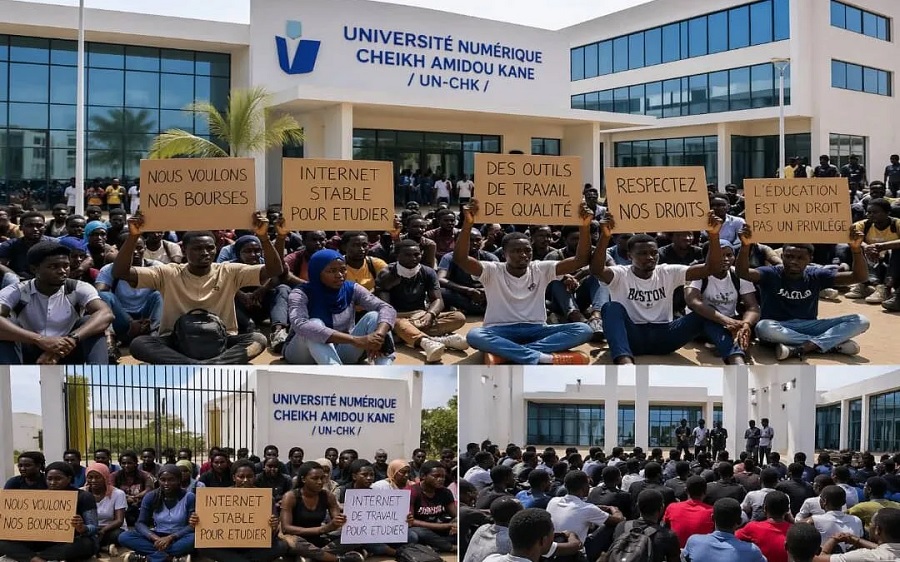
Students from the 10th cohort of the Cheikh Hamidou Kane Digital University (UN-CH) added to the unrest by protesting the partial payment of their scholarships. They revealed that they had only received financial support for two out of the three years allocated for their undergraduate degree. The students urged authorities to resolve the issue urgently, emphasizing the financial hardship they faced.
From transport workers to university students, civil servants to private sector employees, the voices of dissent are growing louder across Senegal. The month of May, with its historical and ideological significance, has once again become a battleground for social justice, accountability, and reform.