International
Senegal’s president faye dismisses prime minister sonko amid rising tensions

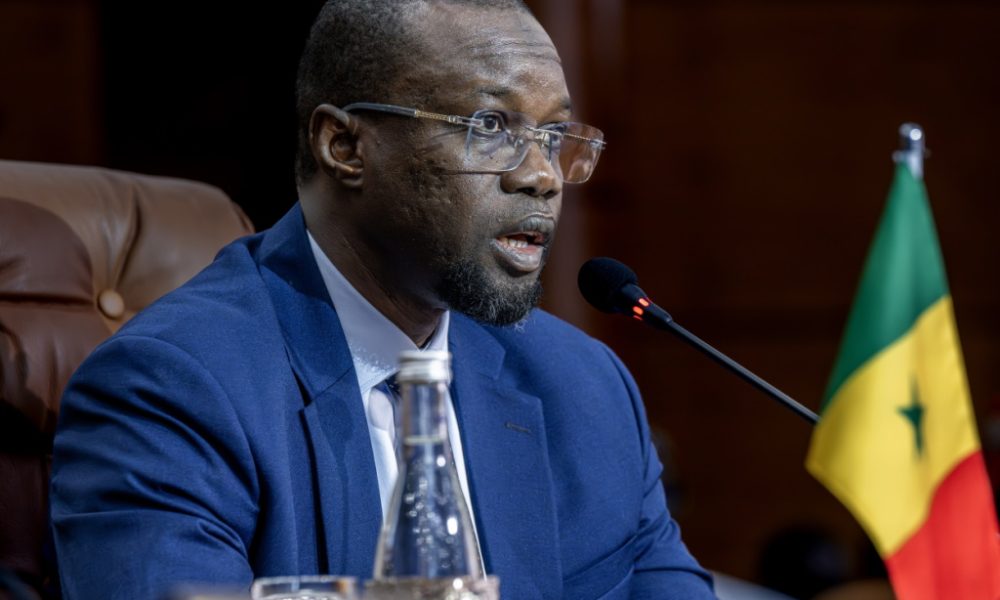
President Bassirou Diomaye Faye of Senegal has announced the dismissal of Prime Minister Ousmane Sonko, his former political ally. This significant development on Friday evening follows a period of escalating tensions between the two leaders, who ascended to power in April 2024 amidst widespread public anticipation.
The presidential secretary-general, Oumar Samba Ba, delivered the official statement on national television, confirming that President Faye had “ended the duties of Mr. Ousmane Sonko, Prime Minister, and consequently, those of the ministers and secretaries of state comprising the government.”
The statement further specified that “members of the outgoing government are tasked with managing current affairs” until new appointments are made. No immediate details were provided regarding the selection of the next Prime Minister.
Since their joint electoral victory, a discernible strain had grown between President Faye and his charismatic former mentor, whose considerable influence was instrumental in propelling their political movement to power. Their alliance, once a symbol of unity, had become increasingly fraught.
Ousmane Sonko, a vocal critic of former President Macky Sall (2012-2024), was barred from contesting the 2024 presidential election due to a defamation conviction that resulted in the loss of his civic rights. Following this, Sonko designated Bassirou Diomaye Faye as his chosen successor in the presidential race.
Sonko’s fervent pan-Africanist rhetoric had captivated Senegal’s disillusioned youth, particularly in the lead-up to the elections. This came after months of intense confrontation with Macky Sall’s administration, which had violently suppressed protests against him and the possibility of him seeking a controversial third term.
Both leaders, freshly released from prison under an amnesty law designed to de-escalate years of political unrest, campaigned under the powerful slogan “Diomaye Moy Sonko,” which translates to “Diomaye is Sonko” in Wolof, emphasizing their shared vision and solidarity.
Spontaneous Gathering
Reacting swiftly to the news, Mr. Sonko posted on his Facebook account, “Alhamdoulillah. This evening I will sleep with a light heart in the Cité Keur Gorgui,” referring to his Dakar residence.
Journalists observed hundreds of Sonko’s supporters converging on his home Friday evening, cheering him on following the announcement of his departure from the government.
Earlier in the day, the now-former Prime Minister had publicly criticized what he termed the “tyranny” of the West, which he claimed sought to “impose [homosexuality] on the rest of the world.” His remarks were made before Parliament, just weeks after Senegal, a predominantly Muslim West African nation, enacted a law increasing penalties for homosexual relations.
For several months, the growing discord between the head of state and the head of government had become increasingly evident, casting doubt on the long-term viability of their partnership.
At the beginning of the month, President Faye had expressed concerns about his Prime Minister’s “excessive personalization” within the ruling party.
In a televised interview, President Faye had stated, “As long as he remains Prime Minister, it is because he has my confidence. When that is no longer the case, there will be a new Prime Minister.”
Mr. Sonko’s party secured a dominant majority in the Senegalese National Assembly following its overwhelming victory in the November 2024 legislative elections.
Weeks ago, Parliament paved the way for Ousmane Sonko’s potential candidacy in the next presidential election in 2029 by passing an electoral code reform, which was subsequently promulgated by the President. This law drew criticism from the opposition, who argued it specifically benefited Mr. Sonko.
In July 2025, the Supreme Court of Senegal had rejected an appeal by Mr. Sonko, who was then Prime Minister since April 2024, against his conviction, reigniting questions about his eligibility. However, Sonko was elected as a deputy in the November 2024 legislative elections before resigning to remain Prime Minister, a fact his party cites as proof of his eligibility. Local elections are scheduled for 2027, preceding the 2029 presidential vote.
While Mr. Faye may not command the same widespread popular enthusiasm as the Pastef leader, he has been steadily consolidating support over recent months through the “Diomaye Président” movement, suggesting a potential bid for the 2029 presidency.
Upon assuming office, the country’s new leadership inherited a challenging economic landscape, grappling with a substantial debt from the previous administration. According to the International Monetary Fund (IMF), Senegal’s debt reached the equivalent of 132% of its GDP, positioning it as the second most indebted nation in Sub-Saharan Africa.
In 2024, the new government, formed after the opposition’s electoral triumph, accused the former President Macky Sall’s administration of obscuring the true extent of this alarming budgetary situation. This led to the suspension of an IMF aid program totaling 1.8 billion dollars.