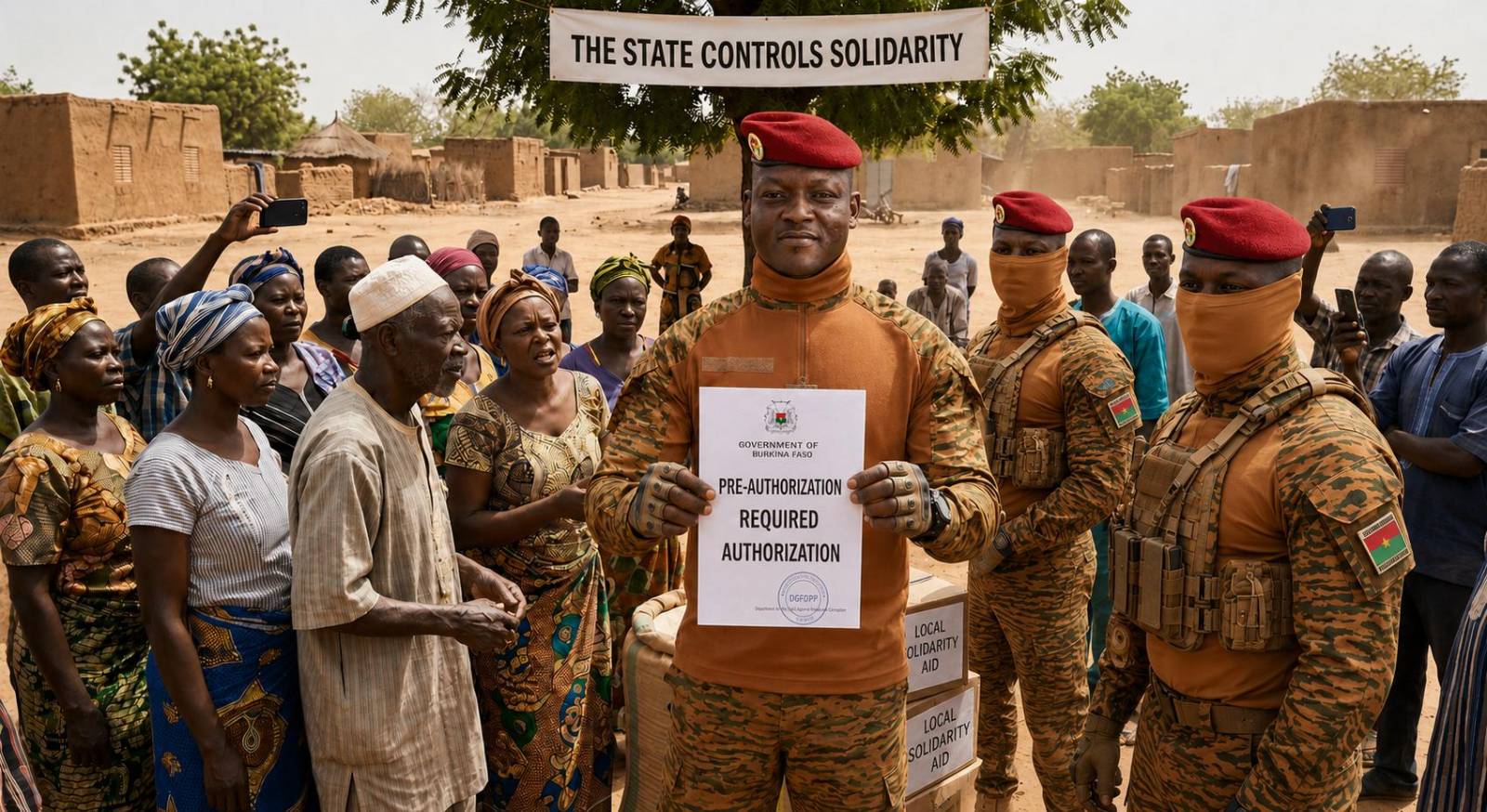
The era of spontaneous charity and unregulated online fundraisers has come to an end in Burkina Faso. The Ministry of Solidarity has implemented a sweeping policy requiring prior authorization for all charitable initiatives—or face penalties. While authorities justify this move as a safeguard against dignity violations and digital voyeurism, a more troubling question emerges: can altruism survive when generosity itself becomes a punishable offense?
On the surface, regulating charitable acts may appear justified. Social media has undeniably exploited human suffering for engagement, and financial exploitation of vulnerable individuals does occur. Yet the government’s blanket approach risks conflating legitimate grassroots solidarity with illicit activities. By demanding pre-approval for every act of kindness, authorities may inadvertently criminalize the most basic human impulse—helping others—under the guise of oversight.
Undermining the very fabric of civil society
This policy strikes at the heart of Burkina Faso’s crisis response model, where civil society, religious groups, and diaspora communities often act long before state institutions mobilize. Their agility stems from autonomy—an attribute now under threat. Requiring official authorization for aid distribution transforms life-saving gestures into bureaucratic ordeals, delaying assistance when minutes matter most.
The government’s logic reveals a deeper concern: a distrust of independent civic action. The transition administration under Captain Ibrahim Traoré appears to view all unregulated solidarity as a challenge to its authority. In its quest to monopolize humanitarian efforts, the state risks replacing organic community bonds with top-down control—a model that has repeatedly failed in other contexts.
The illusion of dignity versus the reality of deprivation
Proponents argue that regulating online charity protects dignity by preventing public displays of suffering. But true dignity lies not in hiding distress behind red tape, but in ensuring swift, dignified access to aid. There exists a middle ground: ethical fundraising, consent-based transparency, and rapid response systems that uphold both respect and efficiency. Instead, Burkina Faso’s policy risks rendering vulnerable populations invisible—while claiming to protect them.
The consequences are already unfolding. Financial constraints, logistical bottlenecks, and administrative delays mean state institutions cannot replace the very networks they are dismantling. Families displaced by conflict, victims of economic collapse, and communities under siege now face a cruel paradox: assistance is either forbidden without approval or rendered meaningless by bureaucracy. A medical emergency does not wait for a ministry signature. A displaced mother does not survive on empty promises of future aid.
Eroding trust, one permission slip at a time
Fear of sanctions may deter even well-intentioned citizens from helping. The “bush solidarity” that once sustained Burkina Faso—direct aid from diaspora, urban centers to rural villages—is being suffocated. What began as a well-intentioned clampdown on abuses now risks becoming a structural collapse of social cohesion. When generosity becomes a crime, society fractures from within.
History shows that resilient nations thrive when state and civic actors collaborate—not compete. Burkina Faso’s current trajectory inverts this model. By centralizing compassion, the government may achieve short-term control, but at the cost of long-term resilience. The true measure of a state’s strength lies not in how much it regulates, but in how much it empowers its people to act, especially in times of crisis.