Washington raises alarm as Sahel nations hit travel ban level
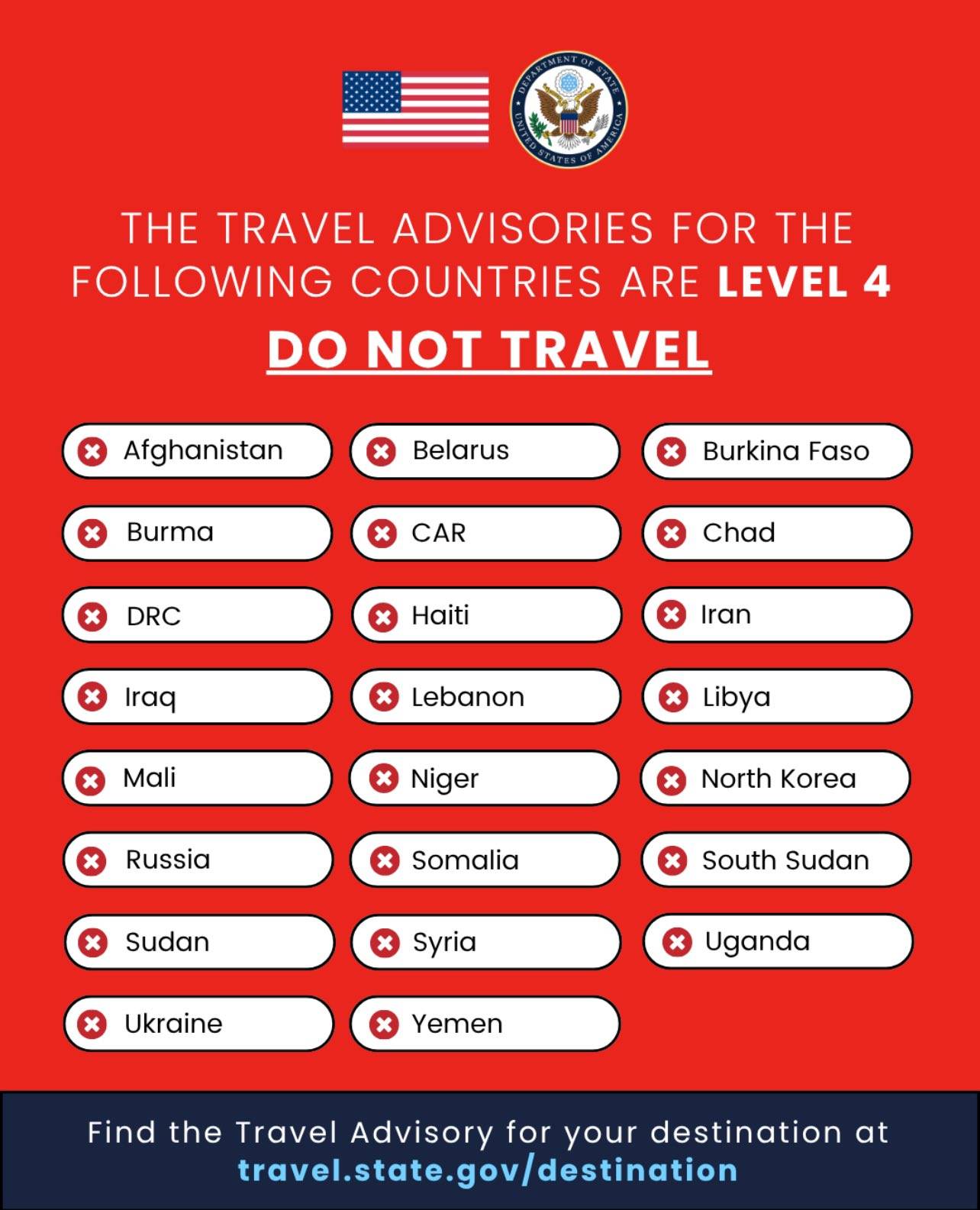
The United States government has once again updated its global travel advisory, placing 23 countries under its highest alert level—Level 4, commonly referred to as “Do Not Travel.” Among the most prominent entries on this list are Russia, the Democratic Republic of the Congo (DRC), Chad, and notably, the three founding members of the Alliance of Sahel States (AES): Burkina Faso, Mali, and Niger. The driving force behind this decision is a dramatic surge in security threats and the unrelenting spread of terrorism across this fragile West African belt, which has become a global hotspot for instability.
The meaning behind Level 4: a stark warning for travelers
For American authorities, safeguarding citizens abroad is non-negotiable. The travel advisory scale ranges from 1 to 4, with Level 4 reserved for countries deemed too dangerous for any form of travel. When a nation is classified at this level, it serves as an unmistakable signal to avoid the country entirely. The U.S. government underscores that its ability to offer emergency assistance—whether consular, medical, or evacuation—is severely compromised, if not entirely absent, due to the withdrawal of non-essential diplomatic staff. This reality underscores the severity of the risks faced by those who disregard the warning.
AES nations in the crosshairs: Burkina Faso, Mali, and Niger at breaking point
The inclusion of Burkina Faso, Mali, and Niger on the Level 4 list comes as no shock to regional analysts. These three countries, united under the AES banner, are grappling with a deep-seated crisis that spans political upheaval, military transitions, and a strategic rift with former Western allies, particularly France and the European Union. The security crisis in the AES region stems from multiple structural weaknesses, including the gradual withdrawal of state authority in remote and border areas, systemic poverty that fuels recruitment by armed groups, and the ongoing reorganization of military alliances—marked by the departure of Western forces and the forging of new partnerships, notably with Russia. The effectiveness of these new alliances remains unproven, leaving a vacuum that armed factions continue to exploit.
Terrorism’s relentless march across the Sahel
The primary justification for the U.S. State Department’s stern warning is the geographical expansion of terrorist networks. Groups such as the Jama’at Nusrat al-Islam wal Muslimin (JNIM), affiliated with Al-Qaeda, and the Islamic State in the Greater Sahara (ISGS) no longer operate within isolated desert strongholds. Instead, they are conducting coordinated offensives and steadily extending their influence, embedding themselves into local communities and transforming vast swaths of territory into contested zones.
Burkina Faso: a nation under siege by armed factions
Burkina Faso stands as the hardest-hit country within the AES, where armed groups have seized control or encircled large portions of the national territory. Dozens of towns and villages remain under strict blockades, completely cut off from the rest of the country. Attacks on supply convoys and military outposts are a near-daily occurrence, forcing thousands of civilians to flee their homes and seek refuge elsewhere in the country.
Mali: from north to south, insecurity tightens its grip
In Mali, the security landscape has deteriorated further following the withdrawal of the United Nations peacekeeping mission (MINUSMA) and the resurgence of clashes between government forces and rebel factions in the north. Terrorist groups are capitalizing on this security void, launching increasingly bold incursions. The threat has now extended dangerously close to the capital, Bamako, once considered a relatively safe haven, raising concerns about a potential escalation in violence.
Niger: a triple-front crisis
Niger faces a dual military pressure, with insecurity raging in the western “tri-border” zone shared with Mali and Burkina Faso, as well as in the southeastern Lake Chad Basin, where Boko Haram and the Islamic State’s West Africa Province (ISWAP) remain active. Despite efforts by Nigerien authorities to reorganize and strengthen their armed forces, the threat persists. Regional diplomatic tensions further complicate cross-border cooperation, undermining collective efforts to stem the tide of violence.
A world on edge: beyond the Sahel, other hotspots emerge
While the Sahel dominates the headlines, the U.S. advisory also highlights broader global instability. Russia’s continued placement at Level 4 stems from the ongoing war in Ukraine, arbitrary detentions of foreign nationals, and the unpredictable enforcement of local laws. Meanwhile, eastern DRC remains engulfed in a brutal conflict involving dozens of armed groups, including the M23, leading to frequent civilian massacres and kidnappings. Neighboring Chad, already reeling from regional spillover effects, faces constant threats from border-based terrorism and the looming specter of civil unrest.
The ripple effects: economic and humanitarian fallout
The repercussions of a Level 4 classification extend far beyond tourism. For already fragile AES nations, the warning acts as a powerful deterrent to foreign investment. Multinational corporations, wary of exorbitant insurance costs for their executives, are scaling back or canceling projects in infrastructure and resource exploration. The impact on humanitarian organizations is equally severe, as stringent safety protocols drastically limit access to vulnerable populations in dire need of food, medical care, and education.
The Sahel’s security deadlock: a decade of failed strategies
The U.S. State Department’s decision to keep AES member states at Level 4 underscores the shortcomings of past stabilization efforts. Despite political transitions in Bamako, Ouagadougou, and Niamey, and shifting geopolitical alliances, the underlying security crisis has only worsened. Civilians continue to bear the brunt of the violence, with military solutions proving increasingly ineffective. Until governance, social justice, economic development, and access to essential services are addressed holistically, the Sahel’s map may remain painted in the red hues of instability for years to come.