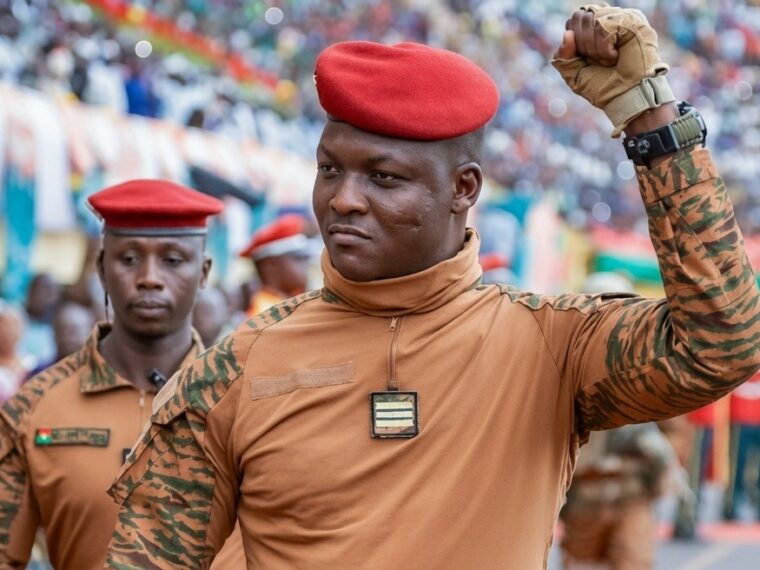
Burkina Faso’s military junta has formally reinstated the death penalty, passing the controversial amendment through its transitional legislative assembly in a unanimous vote. The move, framed under the slogan « Sentimentalism is over, » marks a stark shift toward authoritarian enforcement as the nation’s interim government tightens its grip on power.
From abolition to execution: the regime’s shift toward capital punishment
Once abolished in 2018, the death penalty has now been restored to Burkina Faso’s penal code, giving the state sweeping power to execute individuals convicted of serious crimes, including what authorities define as « high treason » and « acts endangering state security. » While presented as a measure of national firmness, critics argue the timing aligns suspiciously with ongoing political purges—particularly targeting former transitional leader Lieutenant-Colonel Paul-Henri Sandaogo Damiba.
Damiba in the crosshairs: judicial persecution or political engineering?
Former President Damiba, currently facing prosecution for alleged conspiracy against state security, now stands at severe risk under the newly expanded penal code. By eliminating provisions for clemency or leniency, the regime has effectively removed any legal safeguard against execution, turning the judicial process into a potential execution chamber. Observers warn this is no accident: the law appears designed to streamline Damiba’s conviction—and subsequent sentencing—into a weapon of state intimidation, sending a chilling message to political opponents and dissident factions within the military.
Revolution eats its children: how Damiba’s own past now haunts him
The irony is not lost on political analysts: the same tactics Damiba once used to seize power are now being used against him. In January 2022, he led a military coup ousting elected President Roch Marc Christian Kaboré. Just eight months later, in September 2022, Captain Ibrahim Traoré staged an identical takeover, removing Damiba himself. What was once praised as a « patriotic renewal » now stands condemned as « high treason » when applied to the current ruler:
- Same playbook, opposite verdict: Damiba’s 2022 coup was framed as a « moral uprising » by supporters. Today, Traoré’s regime brands similar actions as criminal treason.
- From liberator to criminal: The narrative shift exposes a brutal double standard—one that weaponizes legal language to erase former allies and consolidate power.
The spiral of vengeance: when justice becomes an instrument of vengeance
The military government’s embrace of capital punishment signals a dangerous escalation in Burkina Faso’s cycle of instability. By normalizing the death penalty for political crimes, the regime risks embedding revenge into law itself—turning the judiciary into an arm of retribution rather than justice. History shows that those who restore the hangman’s noose today may find themselves tomorrow handcuffed to the same gallows. As the junta trades sentimentality for suppression, Burkina Faso inches closer to a future where no leader—current or aspiring—is beyond the reach of judicial execution.
What comes next: a regime unshackled—or a nation unraveling?
With the death penalty back in force, Burkina Faso faces a stark choice: will this hardline stance suppress dissent or ignite deeper unrest? The world watches as a military government rewrites the rules of engagement—both in war and in its own corridors of power.