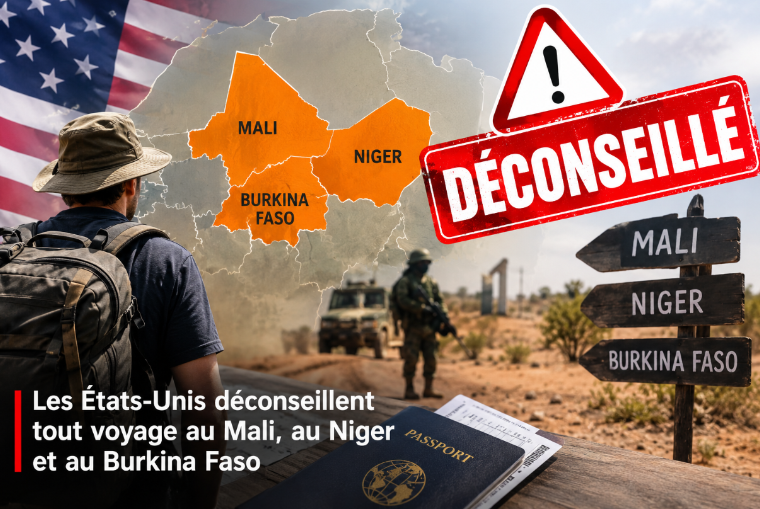
Washington has reaffirmed its sternest travel warnings for the Sahel, placing Mali, Niger, and Burkina Faso in the United States’ highest-risk category. The Level 4: Do Not Travel designation reflects ongoing threats including terrorism, kidnappings, violent crime, and systemic instability across the region.
Why the US has issued a blanket travel ban for three Sahel nations
In 2026, US authorities maintained their Level 4 warnings for Mali, Niger, and Burkina Faso—classifications reserved for environments deemed too dangerous for any travel. The decisions were formalized in mid-year security advisories, underscoring persistent concerns over armed group activity, frequent kidnappings, and deteriorating public safety conditions.
The three countries share critical risk factors: porous borders, active jihadist networks, and limited state control in peripheral zones. These elements have converged to create a security landscape where civilian travel, humanitarian operations, and economic activity face constant threat.
Mali: Terror threats and restricted movement beyond Bamako
The Malian capital of Bamako is not insulated from risk. US officials have restricted diplomatic staff movements to the city center, citing credible threats of attacks on transportation hubs, markets, and residential compounds. In rural areas, the presence of Al-Qaeda and Islamic State-affiliated factions has triggered roadside ambushes and violent clashes with security forces.
The June 2026 State Department advisory highlights kidnapping hotspots in central and northern regions, where foreign nationals—especially contractors and aid workers—have been targeted. Consular support in remote areas remains constrained, increasing the consequences of incidents.
Rising kidnappings and limited consular response
- Armed factions increasingly target high-profile installations, including industrial sites and border crossings.
- Travel between regional capitals via land routes is strongly discouraged due to persistent ambush risks.
- Security restrictions for American personnel reflect the inability to guarantee safe ground movement outside urban centers.
Niger braces against escalating militant activity
Niger’s government has struggled to contain spillover violence from neighboring Mali and Burkina Faso. The July 2026 US assessment lists terrorism, kidnappings, and criminal violence as persistent threats, especially in border districts near Mali and Burkina Faso.
Diplomatic staff in Niamey are prohibited from traveling to the country’s east and west, where armed groups conduct cross-border raids and civilian abductions. The lack of reliable transportation infrastructure compounds risks in rural areas, where medical and emergency response remains unreliable.
Border insecurity complicates travel planning
- The Diffa, Tillabéri, and Tahoua regions are classified as high-risk zones due to militant presence.
- Commercial flights to remote areas are scarce, forcing overland travel that is frequently disrupted by insecurity.
- Humanitarian agencies report frequent roadblocks and demands for informal payments, raising travel costs and exposure to criminal elements.
Burkina Faso faces sustained jihadist pressure
Burkina Faso’s nationwide security crisis worsened in 2026, with armed groups launching attacks in new districts. The May State Department warning emphasizes threats in the Sahel, Centre-Nord, and Est regions, where jihadist factions target civilians, security outposts, and resource infrastructure.
Kidnappings near gold mining sites and in urban centers such as Ouagadougou have surged. The capital remains under elevated threat, prompting US officials to restrict all non-essential travel outside the city.
Urban and industrial risks intensify
- Hotels, restaurants, and public service areas in major cities have been targeted in recent incidents.
- International mining and energy companies face frequent security demands, increasing operational costs and staff exposure.
- Humanitarian convoys require armed escorts, and project delays are common due to route cancellations.
Broader African context: Where else are warnings high?
The Sahel’s Level 4 alerts mirror heightened concerns in other African regions. Nigeria’s northeast and northwest face similar extremist threats, placing parts of the country under similar advisories. Central African Republic and Chad also maintain Level 4 status, while Cameroon and Mozambique face localized restrictions linked to insurgent activity and criminal violence.
While not all of Africa is under blanket warnings, travelers must evaluate each destination independently. State Department advisories are tailored to regional risks, and conditions can shift rapidly following attacks or political developments.
Practical guidance for travelers and organizations
With frequent road closures, unreliable communications, and limited emergency support, travel to Mali, Niger, and Burkina Faso demands rigorous risk assessment. The US government urges:
- Regular review of official travel advisories before and during trips.
- Rigorous adherence to local security protocols, including curfews and restricted zones.
- Preparedness for delayed or canceled itineraries due to sudden instability.
- Avoidance of overland travel between countries and within high-risk regions.
For businesses and NGOs operating in these countries, contingency plans are essential. Evacuation protocols and remote-work capabilities should be tested and updated regularly to respond to sudden deterioration in security.
What 2026’s warnings mean for the Sahel’s future
The sustained US Level 4 advisories send a clear message: the Sahel remains one of the world’s most volatile regions. With armed groups expanding operational reach and governments struggling to restore control, the risks for civilians, aid workers, and foreign investors continue to escalate.
For travelers, the message is unequivocal: the safest course of action in 2026 is to postpone or cancel plans to Mali, Niger, and Burkina Faso. Until security conditions improve, the region’s instability will continue to outweigh its potential rewards.