In the official rhetoric of Captain Ibrahim Traoré and the military leadership in Ouagadougou, a catchphrase has taken center stage: “Y’a pas crédit dedans”—a bold declaration of economic self-reliance. Repeated endlessly across social media and by regime supporters, the phrase aims to convey that major projects—from road rehabilitation to infrastructure construction and state modernization—are being funded entirely through domestic resources, with no recourse to foreign borrowing.
At first glance, the message is compelling: Burkina Faso is advancing under its own steam, free from the grip of international donors. Yet beneath the polished narrative lies a far more complicated financial landscape.
Sovereignty as a political tool
The pursuit of economic sovereignty is undeniably a valid goal for any nation. Reducing reliance on external partners, strengthening domestic revenue collection, and bolstering national capabilities are aspirations few would dispute. But when every public investment is framed as being entirely self-funded, the claim clashes sharply with documented financial agreements, loan conventions, and official disclosures that reveal a different story.
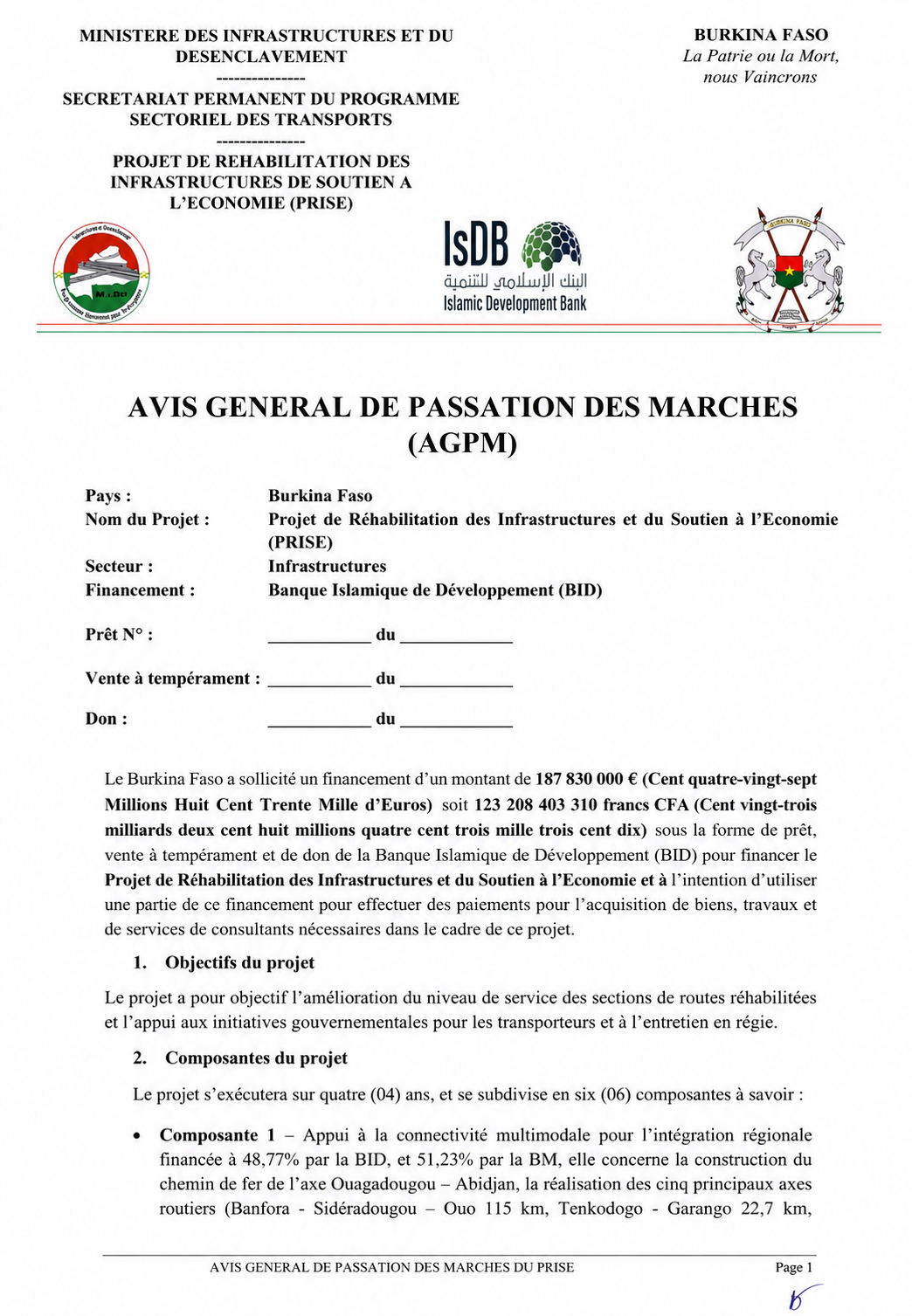
Recent financing deals with the Islamic Development Bank (IDB) for critical road projects, for instance, underscore this discrepancy. These initiatives, while beneficial, are not funded by Burkina Faso’s own coffers. Instead, they rely on concessionary loans that must be repaid according to agreed schedules, even if the terms are favorable. In effect, these are not free resources but financial commitments recorded in the national ledger.
Why the contradiction matters
The disconnect between the government’s messaging and the reality of its financing methods raises a fundamental question: if multiple projects depend on international funding, why insist that “there is no credit in it”?
Borrowing is a standard practice for states, especially when domestic revenues fall short of development needs. What is unusual is the insistence on presenting these investments as entirely self-financed when evidence points otherwise. This gap between word and deed fuels skepticism about the credibility of the government’s communications.
A nation straining under economic pressure
Burkina Faso’s economic environment further complicates the feasibility of a debt-free development strategy. The country faces a confluence of challenges:
- A deepening security crisis with staggering financial costs;
- A sharp rise in military expenditures;
- Shrinking fiscal space due to reduced economic activity in key regions;
- Massive population displacements disrupting social and economic structures;
- Insufficient domestic revenue to cover the vast infrastructure needs.
Under these conditions, financing multi-billion-franc infrastructure projects exclusively through national funds stretches credibility. Economists argue that while borrowing itself is not inherently problematic, the scale of investment required in such an environment makes it highly unlikely without external support.
The real issue: transparency, not credit
It is essential to clarify: public borrowing is not inherently bad. When used wisely, loans can fund productive infrastructure, improve mobility, stimulate growth, and enhance public services. The crux of the matter lies not in the existence of debt, but in its management.
Citizens have every right to demand clarity on:
- The exact sources of financing for public projects;
- The total amounts borrowed;
- The interest rates applied;
- The repayment timelines;
- The guarantees provided;
- The true cost of infrastructure over its lifecycle.
Responsible financial governance hinges on transparency—not slogans. When communication overshadows budgetary education, it risks fostering unrealistic expectations about the state’s capacity to fund development independently.
The future burden of today’s choices
Every loan contracted today will be repaid tomorrow—through future tax revenues. While today’s infrastructure may serve generations to come, so too will the financial obligations that accompany it. This is why transparency in debt reporting is not just a technical matter—it is a democratic imperative.
It allows citizens to assess whether borrowed funds are being used to finance productive investments capable of generating sufficient returns to service the debt. True economic sovereignty is not measured by the absence of borrowing, but by the ability to manage it wisely, publish clear accounts, and remain accountable to the people.
A call for fiscal responsibility
The slogan “Y’a pas crédit dedans” has resonated deeply, but sustainable public finance cannot rest on catchphrases alone. The financing agreements with international partners confirm what many observers already suspected: Burkina Faso, like most developing nations, continues to rely on external resources to fund a portion of its development.
The debate, therefore, should not pit borrowing against sovereignty. Rather, it should focus on:
- The quality of governance in financial decision-making;
- The transparency of loan agreements and their public disclosure;
- The efficiency of investments in generating long-term economic value;
- The gradual reduction of dependency through a more competitive and resilient economy.
Ultimately, a strong nation does not deny the reality of its debt—it acknowledges it, manages it with integrity, and uses it as a tool for sustainable progress. The burden of today’s choices will be carried by tomorrow’s taxpayers. Ensuring that those choices are sound, transparent, and responsible is the true test of leadership.