
Burkina Faso’s defence spending: the true cost of proclaimed sovereignty
A narrative of reclaimed destiny
Since Captain Ibrahim Traoré assumed power, official communications have steadily advanced a particular narrative: that Burkina Faso has regained command of its own future, curtailed its reliance on foreign actors, and opted to bankroll its campaign against armed groups from its own coffers.
Politically, the message lands effectively. Rearmament is cast as the tangible expression of sovereignty. Military procurement deals are highlighted, the Patriotic Support Fund is portrayed as the embodiment of a nationwide endeavour, and appeals for citizen contributions serve to demonstrate that the nation purportedly leans first and foremost on its own means.
Yet a far less ideological question lingers: what does this sovereignty actually cost, and who ultimately bears the bill?
A dramatic surge in defence outlays
Budgetary figures already reveal the change in magnitude.
The allocation for defence and security, which hovered around 95 billion CFA francs in 2016, has climbed to several hundred billion CFA francs and surpassed 800 billion in 2024, depending on the budgetary parameters applied.
The shift is considerable.
It reflects a clear political priority: in a country grappling with a major security crisis, the state now channels a far larger share of its resources into the army, security forces, equipment and the war effort.
But such a spectacular increase cannot be viewed solely through a military lens. Every additional billion devoted to security is also a billion that must be sourced from somewhere.
And it is precisely at this juncture that the sovereignty discourse warrants scrutiny against financial mechanisms.
The Patriotic Fund does not cover everything
The Patriotic Support Fund stands as one of the foremost symbols of this strategy.
Contributions have reached significant sums since its inception: nearly 99 billion CFA francs in its first year, approximately 175 billion in 2024 and more than 200 billion according to figures released for 2025.
It would therefore be unfair to deny the scale of the national mobilisation.
But another illusion must be avoided: the Patriotic Fund does not, on its own, represent the entirety of war-effort financing.
The state budget remains the primary funding structure for public policies. Military expenditure is thus also sustained by tax revenues, ordinary state resources and, when revenues fall short, by recourse to borrowing.
In other words, contributing voluntarily to the war effort does not mean the war is financed without debt.
Debt takes on a new complexion
This is where the debate grows more compelling.
Burkina Faso’s public debt has risen sharply since 2021. It now exceeds 8,000 billion CFA francs, according to available data and projections for recent years.
A substantial portion of this debt is now raised on the WAEMU regional market, notably through the issuance of public securities.
This enables Burkina Faso to diversify its funding sources and reduce certain dependencies on external creditors.
But debt contracted on the regional market remains debt.
Whether held by a bank, an institutional investor or another financial actor in the region, its economic nature is unchanged: the state borrows today and must repay tomorrow, with interest.
This is where the sovereignty narrative reaches its limits.
One may perfectly well defend the choice to prioritise domestic financing. One may also consider that borrowing from the regional market is preferable to certain forms of external dependency.
But presenting this mechanism as the disappearance of financial dependency would be misleading.
The real question: where does public money go?
The issue, then, is not whether Burkina Faso has the right to rearm. It obviously does.
The issue is determining what this rearmament costs the public finances as a whole.
When a growing share of resources is directed towards security, the government must arbitrate among competing priorities: defence, education, health, infrastructure, agriculture, social protection and debt repayment.
These trade-offs are rarely visible in political speeches.
Yet they constitute the true test of economic sovereignty.
A state can purchase more weapons while remaining financially vulnerable. It can reduce certain foreign military cooperations while increasing its reliance on borrowing. It can mobilise patriotic contributions while devoting a growing portion of its future revenues to debt repayment.
Diplomatic rupture therefore does not automatically mean financial rupture.
The mechanical effect of debt
There is also a less spectacular but far more enduring risk: that of debt servicing.
Every loan contracted today creates an obligation for the years ahead. When interest rates are high and investment needs remain substantial, the government must allocate more resources to meeting repayments.
The mechanism is simple: the more the state borrows, the more it must set aside tomorrow from its revenues to pay its creditors.
The problem is not necessarily indebtedness itself. All modern states borrow.
The question is rather whether expenditure financed by debt generates sufficient economic and social returns to enable the country to bear the future burden.
For military spending, the equation is even more delicate: military equipment may be indispensable for national security, but it does not necessarily generate revenues that can repay the loan that financed it.
Military sovereignty, economic dependency?
This is the very contradiction the Burkinabè model reveals.
The authorities claim strategic autonomy: new partners, diversified alliances, national mobilisation and reduced traditional cooperations.
But in parallel, the economy continues to operate with the classic instruments of public financing: taxation, domestic debt, the regional market, multilateral creditors and economic cooperation.
This is not an exceptional contradiction. It is the normal functioning of a state confronted with limited resources and considerable security needs.
The difficulty begins when political communication transforms this financial reality into a narrative of absolute self-sufficiency.
Beware of spectacular figures
Certain claims circulating on social media also require clarification.
Speaking of military indebtedness of “hundreds of billions of dollars” is incompatible with the scale of Burkina Faso’s economy.
The country’s GDP falls within a range of a few tens of billions of dollars, not hundreds of billions. A military debt of several hundred billion dollars would far exceed the nation’s economic capacity.
The reality is already substantial enough that it need not be exaggerated.
It is hundreds of billions of CFA francs at stake, not hundreds of billions of dollars.
This distinction is essential for any serious analysis.
The true paradox of “sovereignty on credit”
Burkina Faso can therefore perfectly well assert political and military sovereignty while remaining an indebted state.
But this reality compels a more demanding question: how far can war financing go without weakening the state’s other functions?
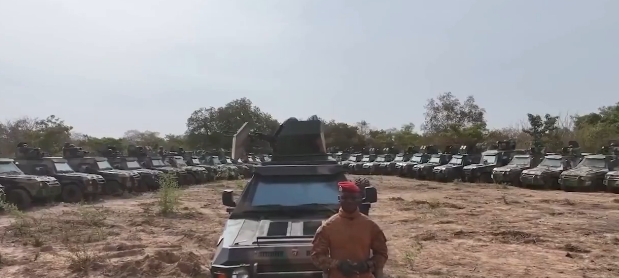
Sovereignty is not measured solely by the number of armoured vehicles, drones or weapons acquired.
It is also measured by the capacity to pay civil servants, invest in education and health, finance infrastructure, support the productive economy and, above all, repay loans contracted in the name of the community.
The real issue, then, is not to deny the efforts made by the Burkinabè authorities. It is to look behind the narrative.
Who pays? How much? With what resources? And for how long?
If a significant portion of rearmament rests on public revenues, national contributions and borrowing, then the proclaimed sovereignty is not a sovereignty without cost.
It is a sovereignty financed by taxpayers, savers, financial markets and future generations.
And it is precisely for this reason that the phrase “sovereignty on credit” deserves to be posed as a question, rather than as a slogan.
For political independence can be proclaimed in a few speeches.
Financial independence, however, is verified in the accounts.