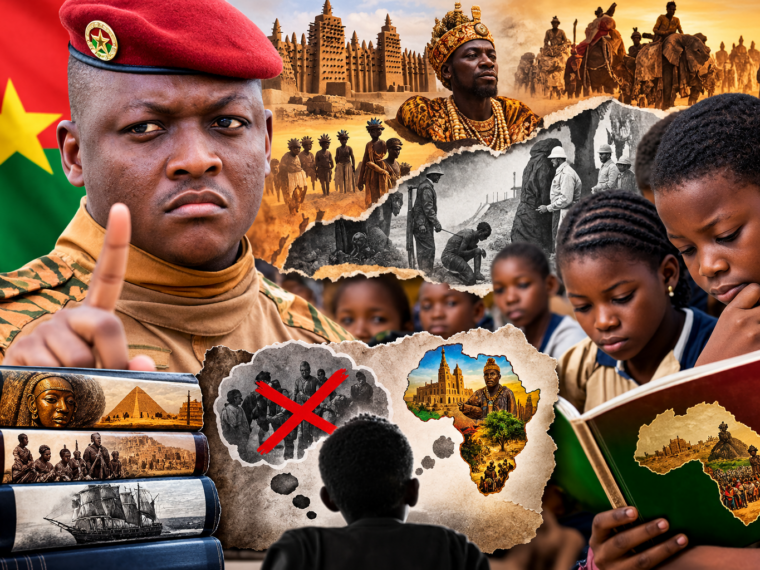
Burkina Faso has initiated a sweeping overhaul of its history and geography curricula, aiming to ‘decolonize’ school textbooks. While this effort highlights critical questions about the representation of African history in education, it also demands careful consideration: reshaping academic programs should not confine future generations to a partial understanding of their own heritage.
Beyond colonial narratives: the complexity of crafting a comprehensive history education
A nation’s history is not defined solely by colonization, its injustices, or the conflicts it engendered with the West. It is also a tapestry woven with civilizations, empires, kingdoms, trade networks, cultural exchanges, social transformations, and interactions between peoples. Presenting this history to young learners requires a balanced approach one that acknowledges past wounds without reducing an entire collective memory to them.
Can curriculum reform alone address historical grievances?
If the reform is primarily designed to correct historical wrongs by altering the narrative taught in classrooms, Burkina Faso risks fighting the wrong battle. Educational programs can indeed shed light on colonial injustices, restore the visibility of African resistance movements, and celebrate long-marginalized figures. However, they cannot, on their own, alter the trajectory of history or retroactively heal the wounds inflicted upon populations.
To foster a more complete understanding, textbooks must avoid constructing memory around a single adversary. Otherwise, a reform intended to liberate minds may inadvertently produce a generation whose grasp of the past is confined by a new ideological framework.
Balancing local and global perspectives in history education
The case of Côte d’Ivoire offers a compelling model for reflection. A well-rounded history curriculum should integrate national narratives, the stories of African kingdoms and empires, the contributions of key continental figures, and the international events that shaped the modern world. Understanding one’s own country does not mean disregarding the broader context it means positioning local history within a global framework to clarify power dynamics, exchanges, and societal evolution.
Lessons from neighboring reforms: principles for an inclusive approach
The goal should not be to replicate a model from Burkina Faso, Côte d’Ivoire, or any Western framework. Instead, the guiding principle must be clear: history should enlighten, not indoctrinate; explain, not polarize; and empower, not restrict. Decolonizing education holds value if it corrects omissions, restores overlooked truths, and reclaims space for African civilizations. Yet this objective is undermined if it merely replaces one narrow narrative with another.
Students must learn about the crimes of colonization without being deprived of the complexities of European societies. Similarly, they should explore Africa’s great civilizations without overlooking their internal contradictions, conflicts, and evolution. True historical education requires grappling with the full spectrum of human experience.
What kind of legacy does Burkina Faso want to leave its children?
The debate in Burkina Faso extends beyond textbook revisions: what type of memory does the nation wish to pass down to its youth? Will it be a memory that binds them to perpetual confrontation with the past, or one that equips them with the intellectual tools to understand, debate, and shape the future?
History’s injustices cannot be undone by hiding certain chapters from future generations. They can only be addressed by equipping learners with the means to read, interpret, and learn from every page. Only then can school reform nurture informed citizens who honor their roots while engaging meaningfully with the wider world.
By Agnès Mvogo — Journalist