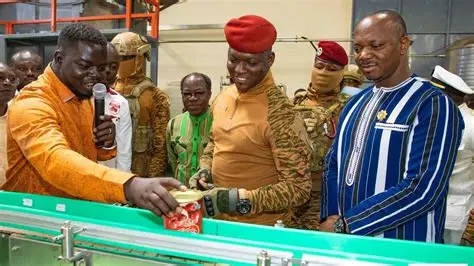
The captain Ibrahim Traoré has, in recent months, inaugurated numerous industrial projects across Burkina Faso, from tomato processing plants to gold refining facilities. Through meticulously orchestrated media campaigns, the transitional government seeks to project an image of progress toward economic emergence. Yet behind the carefully staged images broadcast by state television, the harsh realities of a nation gripped by insecurity and economic turmoil are impossible to conceal.
The rhetoric of self-sufficiency and symbolic progress
Adopting a well-trodden strategy among regimes seeking legitimacy, Burkina Faso’s leadership has embraced the politics of “grand projects.” In cities like Ouagadougou and Bobo-Dioulasso, Captain Traoré is portrayed as the champion of national economic sovereignty. The message is clear: despite regional blockades and the withdrawal of Western partners, Burkina Faso is forging its own path to prosperity.
Central to this narrative is the promise of self-sufficiency. Officials emphasize job creation and economic independence, framing each groundbreaking ceremony as a triumph over imperialism. However, economists caution that these staged events may represent a desperate attempt to project progress rather than evidence of a coherent development strategy.
Industries shrouded in opacity and financial irregularities
Scrutiny of these so-called industrial flagship projects reveals troubling inconsistencies. While inaugurations are conducted with great fanfare, critical details—such as actual funding sources, long-term production viability, and financial sustainability—remain conspicuously absent from public record.
Moreover, allegations of financial misconduct continue to swirl around the management of certain patriotic funds. Questions persist regarding the allocation of resources designated for both the war effort and industrial development. Meanwhile, traditional private enterprises face suffocating fiscal pressures and escalating insecurity, raising further doubts about the fairness and transparency of contract awards within emerging industrial ventures linked to the ruling circle.
The stark contrast between official narratives and public suffering
As government officials celebrate new factories, the daily lives of ordinary Burkinabè grow increasingly precarious.
- Rising inflation: Staple food prices—including rice, cooking oil, and millet—have surged to unprecedented levels, pushing basic necessities beyond the reach of vulnerable households.
- Humanitarian catastrophe: More than two million internally displaced persons now struggle to survive as entire villages remain under terrorist blockades, relying on unreliable humanitarian aid convoys for survival.
- Economic paralysis: The informal sector, the backbone of Burkina Faso’s economy, is in freefall. Persistent power outages and the escalating insecurity of major roads have brought commerce to a near standstill.
Propaganda as a shield against reality
The dissonance between the government’s carefully curated image and the lived experiences of its citizens has never been more pronounced. Polished videos showcase gleaming machinery and a resolute leader, while in reality, parents struggle to send their children to school and soldiers fight under extreme duress.
The narrative of a “prosperous Burkina Faso” is, at present, a media construct designed to foster hope and stifle dissent. Yet propaganda alone cannot sustain a population. Fields lie fallow due to inaccessibility, and the factories inaugurated exist primarily as television images. Captain Ibrahim Traoré’s gamble on perception carries significant risk—one of complete detachment from the hardships endured by his people.
While industrialization remains a commendable ambition, it cannot be erected on unstable foundations. Without transparent financial practices and genuine territorial security, these presidential appearances will remain nothing more than illusions in the Sahel’s harsh landscape.