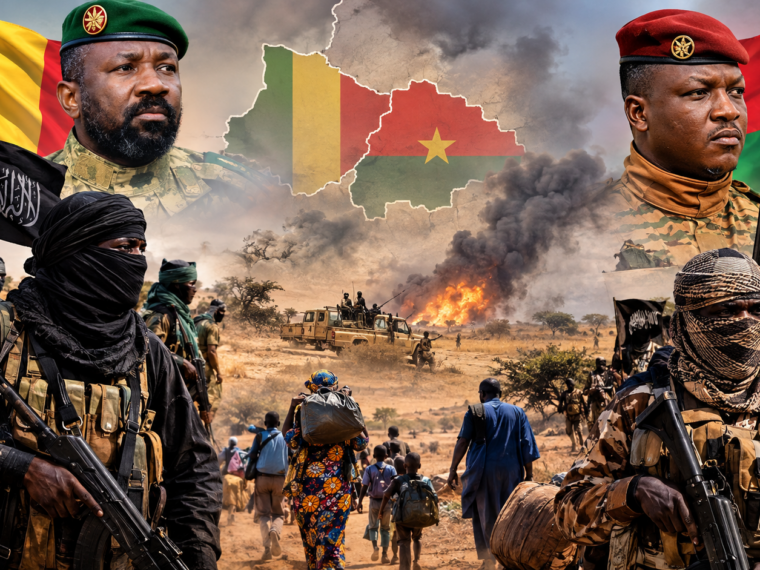
The frontier region between Mali and Burkina Faso has emerged as a critical flashpoint in the Sahel’s ongoing security crisis. Recent violent clashes between fighters from the Group for the Support of Islam and Muslims (JNIM), an Al-Qaeda affiliate, and the Islamic State in the Sahel (EIS) underscore the worsening instability in an area where armed groups compete for territorial dominance, control of key routes, and influence over local populations.
Violence escalates as jihadist factions battle for supremacy
These confrontations reveal a stark reality: vast portions of the Sahel now function as active war zones where armed factions dictate the rules, while military authorities struggle to reassert control. Both Mali and Burkina Faso have experienced leadership changes justified, in part, by the need to restore security, reclaim lost territories, and halt the advance of armed groups. Yet, years after the military juntas assumed power, the jihadist threat persists, and civilians in affected areas continue to face displacement, violence, and persistent insecurity.
Rival factions deepen the crisis for local communities
The conflict between JNIM and EIS adds a dangerous new layer to this already volatile environment. These groups are not merely targeting national armed forces; they are also engaged in direct combat with one another to expand their influence and consolidate power. Civilians are caught in the crossfire, facing threats to their livelihoods and daily safety.
The paradox is glaring: while military juntas have positioned territorial sovereignty as a cornerstone of their political narratives, critical border regions remain mired in jihadist infighting. This raises serious questions about the effectiveness of current military strategies and the ability of these regimes to protect their populations.
Military declarations fall short of restoring stability
Since assuming leadership Assimi Goïta in Mali and Ibrahim Traoré in Burkina Faso the authorities in both countries have repeatedly highlighted their counter-terrorism efforts. However, the unrelenting violence underscores a troubling gap between political rhetoric and on-the-ground realities. Demonstrations of force and claims of sovereignty have not translated into sustainable security for citizens.
The situation demands an honest assessment: when armed factions can continue to clash over territory without enduring state control, the credibility of the military response is fundamentally undermined. It is not merely a question of firepower or public declarations; it is about the ability to deliver long-term stability and safety.
Beyond the battlefield: systemic challenges in counter-terrorism
While military operations are critical, they represent only one dimension of a complex challenge. Effective counter-terrorism requires intelligence capabilities, sustained administrative presence, civilian protection, and tailored cooperation across border regions. The failure to address these broader issues has allowed jihadist factions to exploit vulnerabilities and maintain their foothold.
Ultimately, the clashes between JNIM and IS-Sahel along the Mali-Burkina Faso border expose a crisis far deeper than inter-group rivalry. They reveal the persistent difficulties faced by Sahelian states in containing jihadist expansion and preventing their territories from becoming battlegrounds for competing armed factions.
For civilians, the consequences are immediate and severe: insecurity lingers, displacement continues, and the promise of peace remains distant. For the military juntas, the time for action is now: how long before the rhetoric of territorial reclamation yields tangible, lasting security on the ground?
By Agnès Mvogo — Journalist