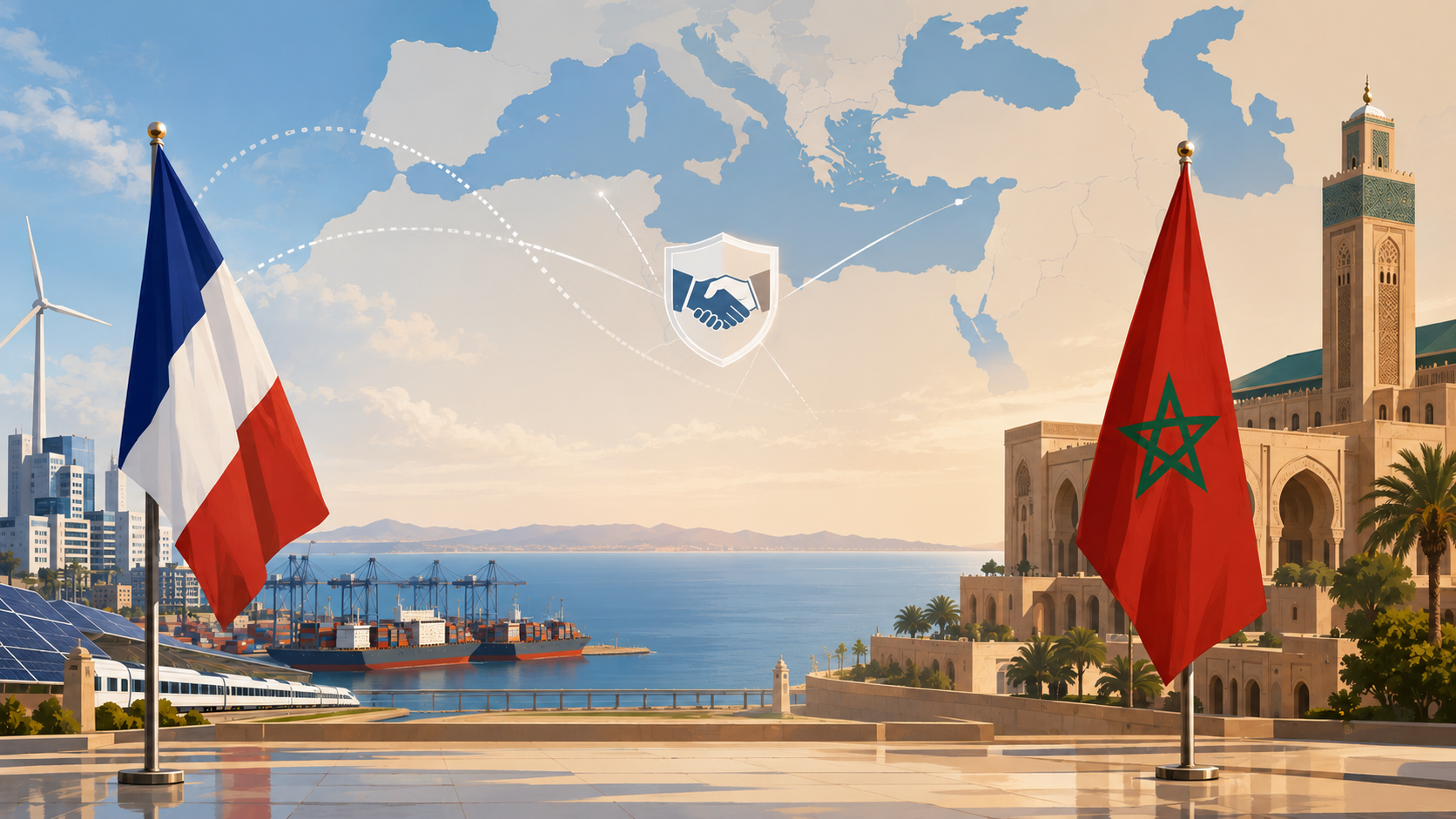
During this two-day official visit, French Prime Minister Sébastien Lecornu arrived in Rabat at the helm of a high-powered delegation, signaling a deliberate shift in bilateral relations. This gathering of over a dozen ministers marks the first intergovernmental meeting of this magnitude since 2019, underscoring a renewed momentum in ties between Paris and Rabat that has intensified since early 2024.
The visit goes beyond mere diplomatic formalities, cementing what is increasingly described as an exceptional partnership. This new phase is set to be formalized through a comprehensive bilateral treaty, reflecting the deepening strategic collaboration between the two nations.
Morocco: An anchor of stability in a volatile region
The Mediterranean and Middle East have become hotspots of instability, with persistent conflicts in the Sahel, ongoing tensions in Libya, and escalating crises in the Middle East. Against this backdrop, Morocco stands out as a rare bastion of stability. The Kingdom has not only maintained remarkable political continuity but has also spearheaded economic modernization, infrastructure development, and military advancements.
Its pragmatic diplomacy allows Morocco to engage constructively with a diverse range of international actors, from the United States to the European Union and Gulf monarchies. By fostering dialogue rather than division, the Kingdom has positioned itself as a crucial mediator in a fractured geopolitical landscape. Its growing influence on the African continent further solidifies its role as a key player in shaping regional dynamics.
France’s indispensable ally in a shifting world
The strengthening of Franco-Moroccan ties gained significant traction after France reaffirmed its support for Morocco’s sovereignty over the Sahara and following President Macron’s state visit to Rabat in late 2024. These developments paved the way for a reinforced partnership spanning critical sectors such as security, defense, energy, industry, innovation, infrastructure, and culture.
The Prime Minister’s visit, accompanied by a large ministerial delegation, demonstrates that this partnership is no longer confined to diplomatic declarations. It is now operational, with collaborative initiatives spanning defense, intelligence-sharing, domestic security, investment, renewable energy, transportation, artificial intelligence, and education. Few bilateral relationships have seen such a comprehensive alignment of national priorities.
A partnership rooted in shared strategic interests
Morocco has evolved from being merely a neighboring Mediterranean state to becoming a cornerstone of France’s regional strategy. The Kingdom plays a pivotal role in counterterrorism efforts, contributes to Sahel stability, and serves as a critical industrial and logistical hub connecting Europe to Africa. Its strategic infrastructure, such as the Tanger Med port, and its ambitious push into renewable energy further enhance its value as a partner.
In an era marked by disrupted supply chains, migration challenges, and shifting energy alliances, Morocco’s reliability offers France a significant strategic advantage. The collaboration between French and Moroccan intelligence and security services is widely recognized as one of the most effective in combating terrorism and organized crime—a relationship built on decades of mutual trust and shared objectives.
A future-oriented alliance
The Franco-Moroccan relationship is no longer confined to historical or human ties. Today, it is driven by a clear geopolitical reality. As Europe seeks to secure its supply chains, expand its presence in Africa, and stabilize its Mediterranean neighborhood, Morocco emerges as a natural partner. Its industrial growth, renewable energy initiatives, and strategic investments in Africa position it at the heart of new Euro-African value chains.
Areas such as automotive manufacturing, aerospace, green hydrogen, rail infrastructure, artificial intelligence, and military cooperation are all benefiting from this dynamic partnership. While many international alliances face strain, the Franco-Moroccan model highlights how mutual respect, political trust, and aligned interests can yield tangible results.
The recent high-level engagements, including the Prime Minister’s visit, reinforce the notion that in a politically turbulent Mediterranean and a rapidly evolving Middle East, Morocco stands out as one of France’s most steadfast and strategic allies. This exceptional relationship is no longer just an historical legacy—it is a forward-looking choice, and France would be wise to solidify Morocco’s position as its primary strategic partner south of the Mediterranean in response to today’s global uncertainties.