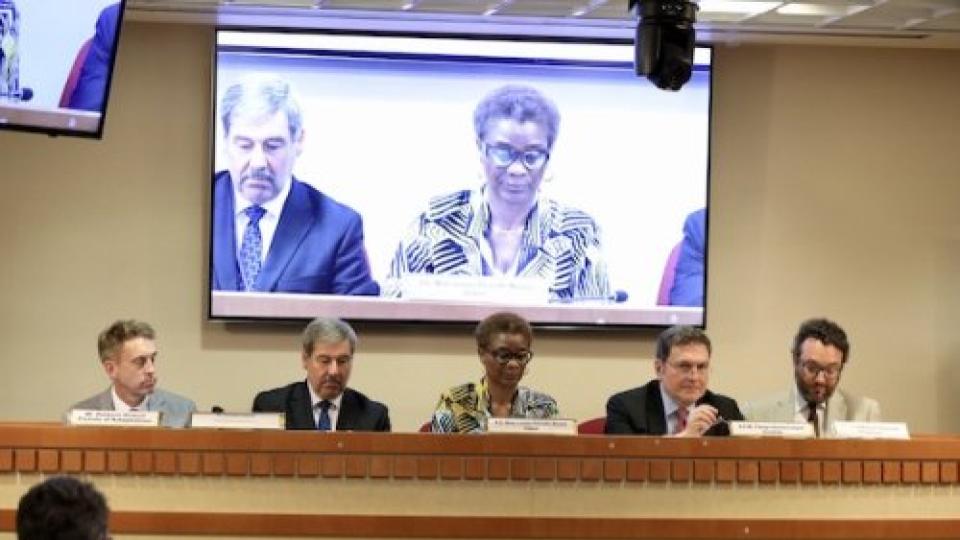
At the High-Level Political Forum (HLPF) in New York, the Permanent Mission of the African Union served as the venue for the launch of a significant joint report by the OECD and OIF/IFDD, focusing on access to ecological financing. Addressing an international gathering, Louise Pierrette Mvono, Gabon’s Minister of Planning and Foresight, stepped forward to articulate her nation’s position, advocating for a profound transformation of global aid structures.
With an impressive 88% of its territory covered by forests, Gabon has historically functioned as a net carbon sink, establishing itself as a pivotal force in global climate regulation. However, this status as a leader in conservation is continuously challenged by intricate procedural and linguistic barriers that significantly impede its access to essential climate funds.
Acknowledging the meticulous scientific foundation of the presented report, Minister Mvono underscored this glaring paradox: the monumental preservation efforts undertaken by her country demand, in return, a predictable, equitable, and proportionate international financial solidarity, free from the encumbrance of current bureaucratic delays.
A proactive national strategy already in motion
Far from passively awaiting a shift in global paradigms, Libreville is actively forging its own path. On the eve of presenting the country’s second Voluntary National Review to the United Nations, the Minister highlighted the robust framework guiding Gabon’s ecological transition.
The National Growth and Development Plan 2026-2030 already incorporates sophisticated instruments such as green bonds and carbon credits. Further demonstrating this commitment to financial autonomy, Gabon’s Caisse des Dépôts et Consignations (CDC) has received accreditation from the Green Climate Fund. Moreover, in a stride towards innovation, the $60 million “Country Package” partnership secured during COP16 in Cali exemplifies an integrated strategy, harmonizing climate action, biodiversity protection, and local development initiatives.
Three key levers to unlock future progress
To ensure that global commitments translate into tangible local impacts, Minister Mvono presented three critical recommendations to donor nations. These include: supporting local empowerment by prioritizing direct accreditation for national institutions, thereby reducing reliance on international intermediaries; fostering sustained expertise through the financing of continuous training programs, enabling the local design of bankable ecological projects; and monetizing natural capital by establishing rigorous payment mechanisms for ecosystem services and transparent carbon markets, which are indispensable for recognizing the systemic value of tropical forests.
Through this pragmatic appeal, Gabon reiterates a fundamental truth: the safeguarding of our planet hinges on the capacity of wealthier nations to streamline and expedite financial support for countries on the front lines of conservation.