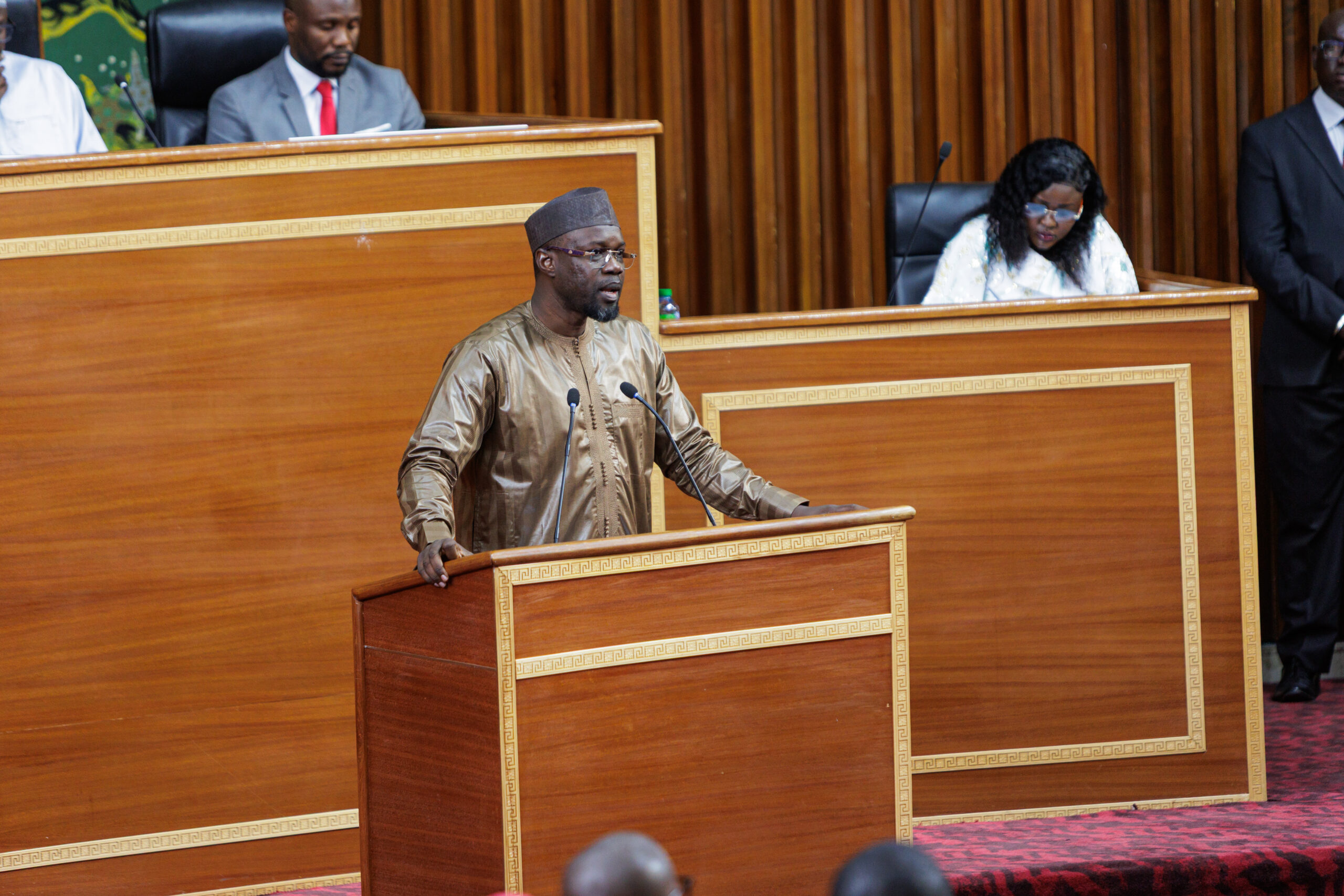
Senegal’s Prime Minister Ousmane Sonko has taken a resolute stance in defense of the newly reinforced legislation targeting unnatural acts, addressing the National Assembly with unwavering determination. During Friday’s session of parliamentary questions, the government chief articulated a clear and uncompromising position, framing the issue as a matter of national urgency.
In his address, Sonko emphasized that the adopted law is not directed at any individual or group. “A law, once passed, is impersonal by nature,” he declared before the assembled legislators. “No targeted interventions were ever intended.” His remarks underscored the government’s commitment to upholding justice without bias.
The Prime Minister also highlighted strong backing from religious authorities across the country. “Religious leaders have reached out to express their support for this legislative initiative,” he noted, signaling a rare alignment between secular governance and faith-based institutions. This collaboration, he argued, is essential in addressing what he describes as a growing societal concern.
Sonko’s speech adopted a combative tone, particularly regarding the alleged existence of organized networks promoting such acts in Senegal. He raised concerns about young students being coerced with financial incentives and electronic devices, warning that inaction could lead to the normalization of these practices. “The state cannot afford to remain silent,” he asserted, calling for immediate judicial rigor to prevent societal erosion.
Calling for strict enforcement, the Prime Minister urged the judiciary to apply the law fully, fairly, and without exception. “Justice must ensure total, complete, and impartial adherence to this legislation,” he insisted. “No one will be shielded from accountability—no matter their status.” His warning, “We will not hide the big fish,” left no ambiguity about the government’s zero-tolerance approach.
Addressing potential international criticism, Sonko firmly rejected any external interference. Referencing Western nations, he reaffirmed Senegal’s sovereignty in shaping its moral and legal framework. “We owe no explanations to anyone,” he declared. “The Senegalese people, as a whole, reject this practice.” He further criticized what he termed a cultural imposition by certain foreign powers, arguing that African nations should not be pressured to adopt alien social models.
In closing, Sonko dismissed any possibility of suspending or softening the law. “There will be no moratorium,” he stated unequivocally. His final words reinforced the government’s resolve: “The implementation of this law is non-negotiable.”