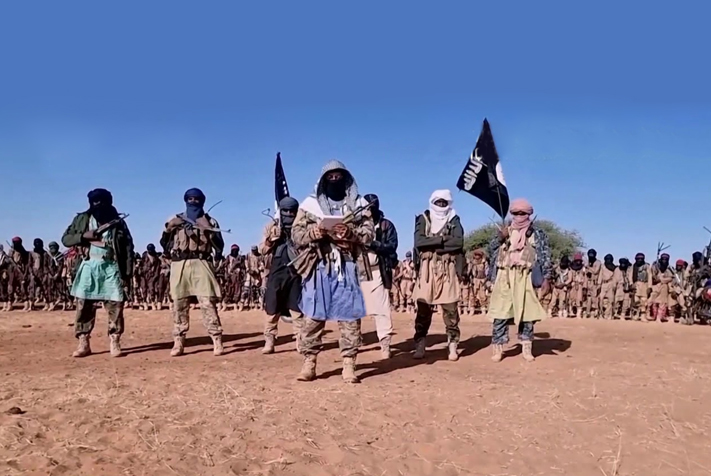
The Islamic State’s Sahel Province keeps a firm grip on Mali’s northeast, despite increasing attention on the JNIM.
The Gao and Ménaka regions, particularly the Ansongo district and the so-called “3 T” localities—Talataye, Tin-Hama, and Tessit—along with Labbezanga, remain hotspots where the Islamic State in the Greater Sahara (ISSP) maintains both territorial control and relentless pressure on local communities. This area, straddling the Mali-Niger border, serves as the operational backbone of the group, where it enforces its own brand of governance while undermining state authority.
Leadership and Adaptation
The ISSP is currently led by Abou Al-Bara, who took over after the death of Adnan Abu Al-Walid Sahraoui in 2021. While the group’s command structure remains partly shrouded in secrecy, its tactics have evolved significantly since 2020. Gone are the days of mass executions and indiscriminate violence designed to instill fear. Today, the ISSP focuses on subtle territorial control, local governance, and strategic pressure points, carefully avoiding high-profile attacks that could draw unwanted attention. This shift reflects a deliberate effort to embed itself within communities rather than merely terrorize them.
Military Pressure and Tactical Resilience
Malian armed forces have intensified their efforts to dismantle the ISSP’s networks. In a recent operation conducted in the early hours of May 15, 2026, a targeted airstrike in Bara, Ansongo district, neutralized a key operational leader of the ISSP along with several of his associates. This strike underscores the persistent military pressure on the group’s strongholds while also highlighting the ISSP’s ability to regroup and adapt, particularly in border regions where logistical networks remain resilient.
Strategic Operations and Regional Influence
The ISSP continues to assert its presence along critical corridors linking Mali and Niger, including Talataye, Tin-Hama, Tessit, Labbezanga, and Ménaka. By controlling the movement of people and goods, the group not only reinforces its dominance but also exerts influence over local armed factions. This strategy allows the ISSP to maintain operational freedom while undermining the authority of both state forces and rival armed groups.
The ongoing rivalry between the ISSP and the JNIM shapes the security landscape of the Sahel. While the JNIM has gained visibility through high-profile attacks, such as those coordinated in late April 2026 near Bamako, the ISSP’s approach remains distinct. The JNIM favors dramatic, media-centric operations, whereas the ISSP prioritizes discreet territorial control, community pressure, and the securing of strategic routes. This divergence in tactics has led to a dynamic where both groups occasionally focus on a common adversary—Malian forces—without any formal truce in place.
Escalating Threats and Regional Responses
Data from the Armed Conflict Location & Event Data Project (ACLED) indicates that 86% of Islamic State activities globally were concentrated in Africa during the first quarter of 2026. The ISSP has intensified its use of armed drones, motorized attacks, and economic pressure to extend its influence across urban and rural areas. Key targets include critical infrastructure along the Ménaka-Ansongo-Tessit axis and Labbezanga, where the group exploits local vulnerabilities to impose its de facto rule. The February 7, 2026, ambush on a civilian convoy near Kobé, just 35 kilometers from Gao, serves as a stark reminder of the ISSP’s operational reach and its ability to disrupt everyday life.
While international security cooperation has led to the elimination of several high-ranking ISSP figures—such as Abu-Bilal Al-Minuki, neutralized in a joint operation in the Lake Chad basin on May 16, 2026—the threat posed by the ISSP in northern Mali remains undiminished. Its deep-rooted presence in the “3 T” localities and Labbezanga, coupled with its ability to manipulate local dynamics, ensures that the group remains a formidable challenge to both Mali’s security forces and the broader regional stability.
The ISSP’s ability to thrive in the shadows, leveraging the media spotlight on other groups like the JNIM and FLA, demonstrates its strategic acumen. As long as it continues to exert control over key populations and territories, the group will remain a persistent threat, necessitating targeted and sustained military and security efforts, particularly along the Niger-Mali border.