
The Japan International Cooperation Agency (JICA) has highlighted its injection of over $646 million into Cameroon’s economy since establishing its presence in the country two decades ago. The announcement came during a high-level meeting in Yaoundé between Cameroon’s Minister of Economy, Planning and Territorial Development, Alamine Ousmane Mey, and JICA Vice-President Ando Naoki. The gathering marked the 20th anniversary of JICA’s operations and the Japan Overseas Cooperation Volunteers (JOCV) program in Cameroon.
This substantial financial commitment by Japan is not limited to loans alone. The support spans multiple forms of official development assistance (ODA), including grants for social infrastructure such as schools, classrooms, health centers, and community facilities. Additionally, concessional loans with low interest rates, extended repayment periods, and grace periods form a significant part of the funding.
The bulk of these funds targets critical sectors like transportation and energy infrastructure. Beyond financial aid, technical cooperation plays a pivotal role, encompassing the deployment of Japanese experts, capacity-building programs, technology transfers, and the presence of Japanese volunteers in Cameroon.
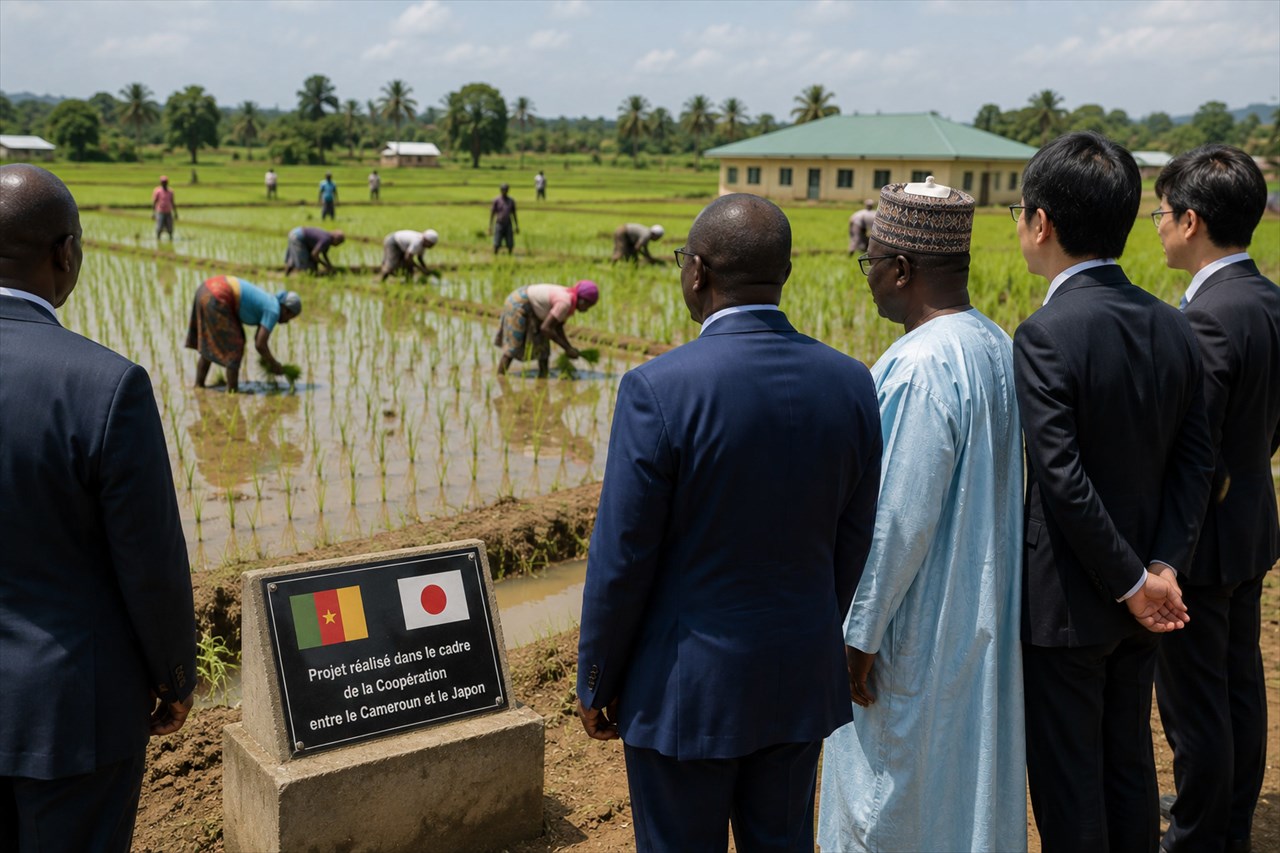
JICA’s interventions have yielded tangible results across various domains. Grants have enabled the construction of over 120 schools and 1,500 classrooms nationwide. Concessional loans have financed major projects such as the Mintom-Lele road, developed in partnership with the African Development Bank (AfDB), which aims to strengthen the corridor linking Yaoundé to Brazzaville. Meanwhile, technical cooperation has empowered nearly 36,000 rice farmers to bolster food security, supported around 1,500 businesses through the Japanese Kaizen methodology, and enhanced the skills of thousands of Cameroonians across multiple industries.
Future directions in Japan-Cameroon cooperation
The discussions in Yaoundé also focused on the future of bilateral cooperation, with both sides exploring ways to deepen collaboration in key areas. Priorities include agriculture, fisheries, education, infrastructure, environmental sustainability, human resource development, and business competitiveness—all aligned with Cameroon’s National Development Strategy 2020–2030 (SND30).
Recent initiatives underscore this evolving partnership. In late May 2026, JICA launched a technical cooperation project aimed at restoring savanna and forest landscapes through agroforestry. This reflects Japan’s growing emphasis on climate resilience and sustainable natural resource management, while continuing to prioritize infrastructure development and capacity-building—the cornerstones of its two-decade-long engagement in Cameroon.