Judicial appointments fuel speculation over Ousmane Sonko’s 2029 presidential bid
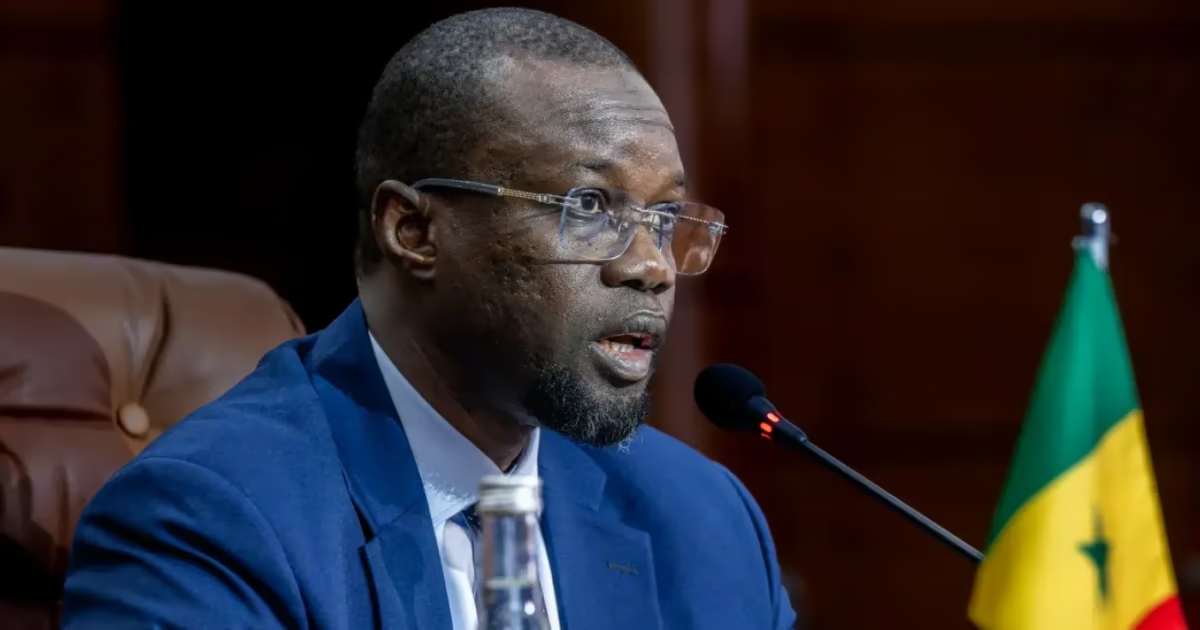
Recent judicial appointments in Senegal have intensified debates about their potential influence on the 2029 presidential race. Political analyst Mamadou Wane suggests President Bassirou Diomaye Faye may be maneuvering to sideline opposition leader Ousmane Sonko from the election while underestimating the resilience of Senegalese citizens.
The latest appointments to the Constitutional Council and the Saint-Louis Court of Appeal represent a significant shift in the judiciary. According to political scientist Mamadou Wane, often called “Mao,” President Faye is implementing a revisionist strategy aimed at reviving the former neocolonial order and politically sidelining Sonko ahead of 2029. This subtle power play is likely to clash with the unyielding spirit of Senegalese citizens, whose collective strength has grown through years of activism and the unprecedented momentum behind their dominant political party.
Wane argues that Faye may attempt to block Sonko from running by leveraging institutions—particularly the judiciary—through the appointment of former regime officials to critical roles. However, he warns that such efforts will fail, as they overlook the Senegalese people’s proven ability to resist political exclusion. The analyst points out that Sonko has consistently maintained strong public support, which has thwarted previous attempts to sideline him in past elections.
On July 13, 2023, President Faye issued a decree appointing magistrate Ousmane Diagne as president of the Constitutional Council, replacing the late Mamadou Badio Camara. Days earlier, the president had nominated former prosecutor Serigne Bassirou Guèye as the Advocate General of the Saint-Louis Court of Appeal—both controversial choices.
Diagne and Sonko had clashed over delays in auditing public accounts and reluctance to prosecute those responsible for crimes between March 2012 and February 2024. Sonko’s relationship with Guèye was even more contentious; the opposition leader repeatedly accused the prosecutor of falsifying a gendarmerie investigation report to frame him in a politically motivated case.
Wane reserves judgment on Diagne’s new role but is sharply critical of Guèye: “I won’t preemptively condemn Ousmane Diagne, but Serigne Bassirou Guèye’s actions went beyond mere bias. He was directly involved in fabricating evidence in Sonko’s trial. No one with such a record should hold judicial office.”
Is Senegal sliding back into a neocolonial system?
The analyst frames the appointments as part of a broader revisionist agenda—a push to restore the old political order. These moves align with what he describes as President Faye’s strategy to consolidate a new centrist force by co-opting former allies of the ousted regime.
“Revisionism, in this context, means a deliberate return to the past,” Wane explains. “There are now two distinct camps: one seeking to revive the neocolonial system and another rooted in sovereignty, patriotism, and democratic revolution.”
He cautions the president and his allies against attempting to exclude Sonko, arguing that such efforts ignore Senegal’s deep tradition of resistance. “Those pushing for Sonko’s political elimination are politically shortsighted. The people made this government possible through their mobilization. Trying to destroy Sonko by dissolving the Assembly or fabricating charges will only backfire.”
The PASTEF’s momentum and the awakening of Senegal’s youth
Wane highlights the surge in PASTEF party membership sales as proof of its dominance on the ground. “The party is the most organized, dynamic, and strategically led force in Senegal today, centered around Ousmane Sonko. This structure and its grassroots network are unmatched,” he notes.
The analyst emphasizes that Senegal has undergone an irreversible democratic awakening since the 2000 and 2012 transitions, further solidified by the intense resistance between 2021 and 2024. “In March 2021, the people didn’t just protest for days—they held the line for nearly three years. They’ve gained invaluable experience in resisting authoritarianism, regardless of the regime’s tools of control,” he states. This collective memory, he argues, makes any attempt to politically eliminate Sonko doomed from the start.