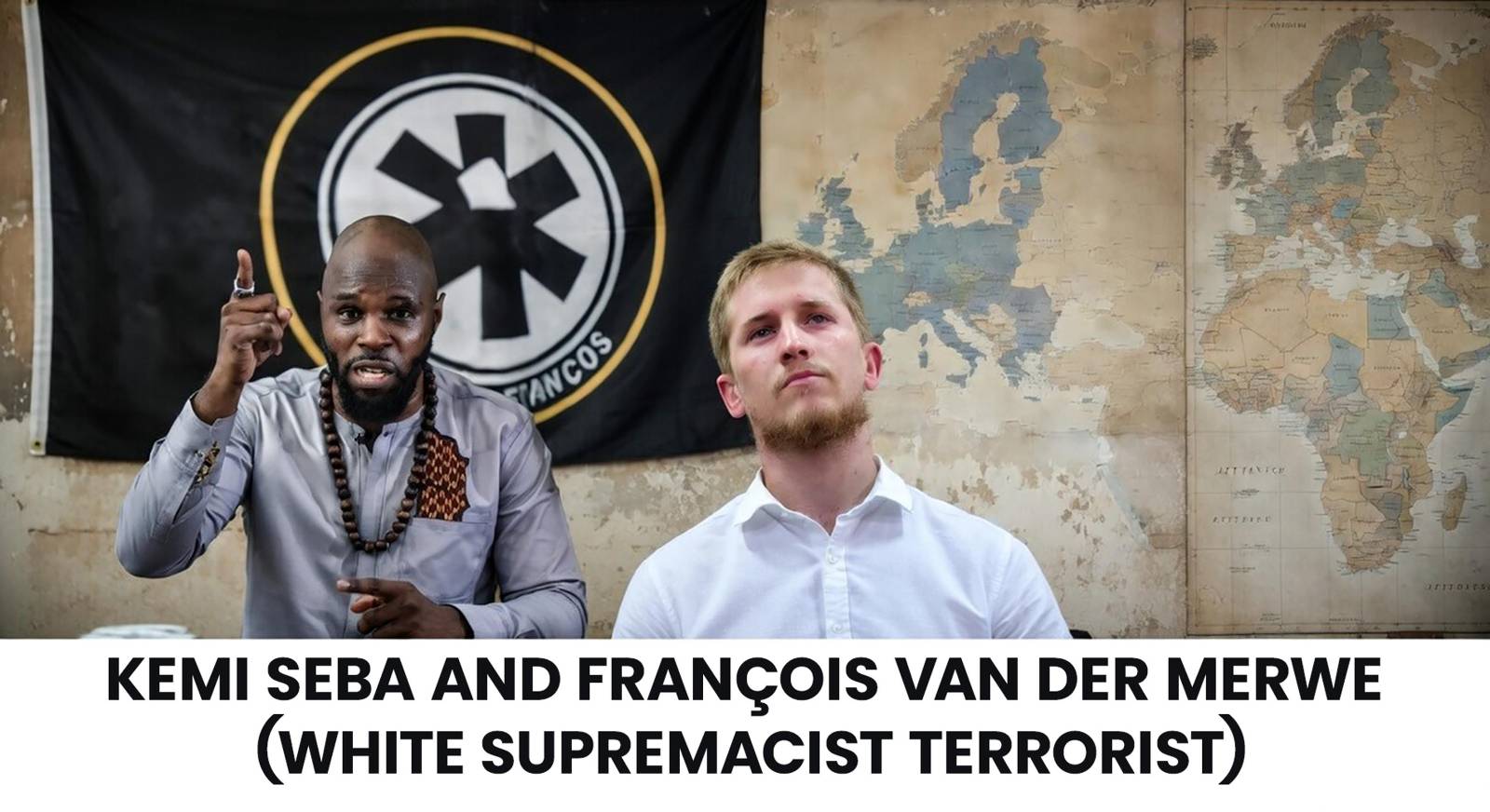
Certain arrests do more than just take a suspect off the streets; they serve as a profound revelation. The detention of activist Kemi Seba on South African soil on Wednesday, April 15, is a prime example. This event has pulled back the curtain on a startling partnership, specifically regarding the person arrested alongside him and the financial transaction that reportedly took place.
Apprehended with Seba was François van der Merwe, a 26-year-old Pretoria native born in 1998. Van der Merwe is the head of the Bittereinders, a group officially classified as a terrorist organization by South African authorities. To grasp the gravity of this connection, one must look into the history and radical objectives of this movement.
The roots and radicalism of the Bittereinders
The term “Bittereinder” originates from the final, desperate phase of the Second Boer War (1899–1902). It referred to Boer guerrillas who refused to accept defeat or negotiate with the British, viewing surrender as a betrayal of their civilization. Van der Merwe has intentionally resurrected this name for his modern organization, adopting not just the label but its uncompromising, fanatical ideology.
The contemporary Bittereinders emerged following the 2020 murder of farmer Brendan Horner and the subsequent unrest in Senekal. Van der Merwe saw an opportunity to mobilize young Afrikaners around a singular, extremist premise: that the political leadership of Black South Africans poses a lethal threat to the Afrikaner identity and way of life.
A mission for a racially exclusive state
The group’s agenda is transparent and exclusionary. Van der Merwe campaigns for the creation of a Volkstaat—a sovereign, racially segregated territory carved out of South Africa where Black citizens would be denied any rights or residency. This objective mirrors the demands of the most radical Afrikaner factions from the late Apartheid era, such as the AWB, which utilized violence and bombings to try and stop the 1994 democratic transition.
Since the group’s formation in 2021, Van der Merwe has been a vocal opponent of the ANC and EFF, characterizing the post-Apartheid democratic order as an illegal occupation. He views policies intended to address historical dispossession as active discrimination against white people. Consequently, the State Security Agency has placed the Bittereinders under heavy surveillance, especially as they openly conduct paramilitary training and tactical drills at private security facilities.
A history of violence and criminal activity
Van der Merwe’s personal legal history is as volatile as his politics. He was previously arrested in late 2023 for a pub assault and later faced charges for breaking police lines and inciting violence during a 2024 protest in Groblersdal. Far from being deterred by these legal troubles, he has used his time in custody to bolster his image within the movement, often reciting the phrase “Soet is die Stryd” (Sweet is the Struggle) to signal his deepening commitment to the cause.
The financial connection: 250,000 rands for an illegal escape
It is this radical figure that Kemi Seba allegedly sought out for assistance. According to the Hawks—South Africa’s elite organized crime unit—Van der Merwe acted as a paid facilitator. Seba reportedly handed over approximately 250,000 rands (roughly 13,000 euros) to the Bittereinders leader. This payment was allegedly intended to secure an illegal crossing over the Limpopo River into Zimbabwe, with the ultimate goal of reaching Europe.
Under South African law, providing funds to a designated terrorist entity is a major felony, regardless of what the money is used for. By allegedly putting cash into Van der Merwe’s hands, Seba has moved beyond mere association into the realm of criminal financing.
The collapse of a political narrative
For years, Kemi Seba has cultivated a public persona as a champion of Black sovereignty and a fierce critic of Western imperialism. He has built a significant following by preaching about African dignity and the need to dismantle oppressive systems. However, this image is now in total conflict with his actions.
By funding a movement that advocates for a return to Apartheid-style segregation and views Black political rights as an “aberration,” Seba has undermined his own platform. The group he supported does not just ignore the rights of Black South Africans; it actively seeks to erase them.
Kemi Seba now faces a complex legal battle involving charges of illegal immigration, conspiracy, and the financing of terrorism. Beyond the courtroom, he faces a historical reckoning: the man who claimed to fight for Black liberation is now accused of bankrolling a white supremacist extremist who dreams of a racially exclusive past.