The evolving discourse of Kemi Seba amid shifting alliances
Recent years have witnessed a striking transformation in the political landscape of West Africa, particularly within the member states of the Alliance of Sahel States (AES). Public demonstrations, often framed as sovereigntist movements, have increasingly featured the display of Russian flags and slogans extolling Moscow’s influence. For a vocal segment of activists, Russia has emerged as an indispensable alternative to long-standing Western powers, positioning itself as a champion of independence and self-determination.
Yet, this growing infatuation with Moscow raises fundamental questions, especially when it emanates from movements that claim to advocate for absolute autonomy. Today, the discourse of one of Africa’s most prominent panafricanist figures, Kemi Seba, appears to be undergoing a significant evolution—one that challenges the very foundations of this pro-Russian sentiment, even as he remains incarcerated in South Africa.
The illusion of emancipation: sovereignty or new dependency?
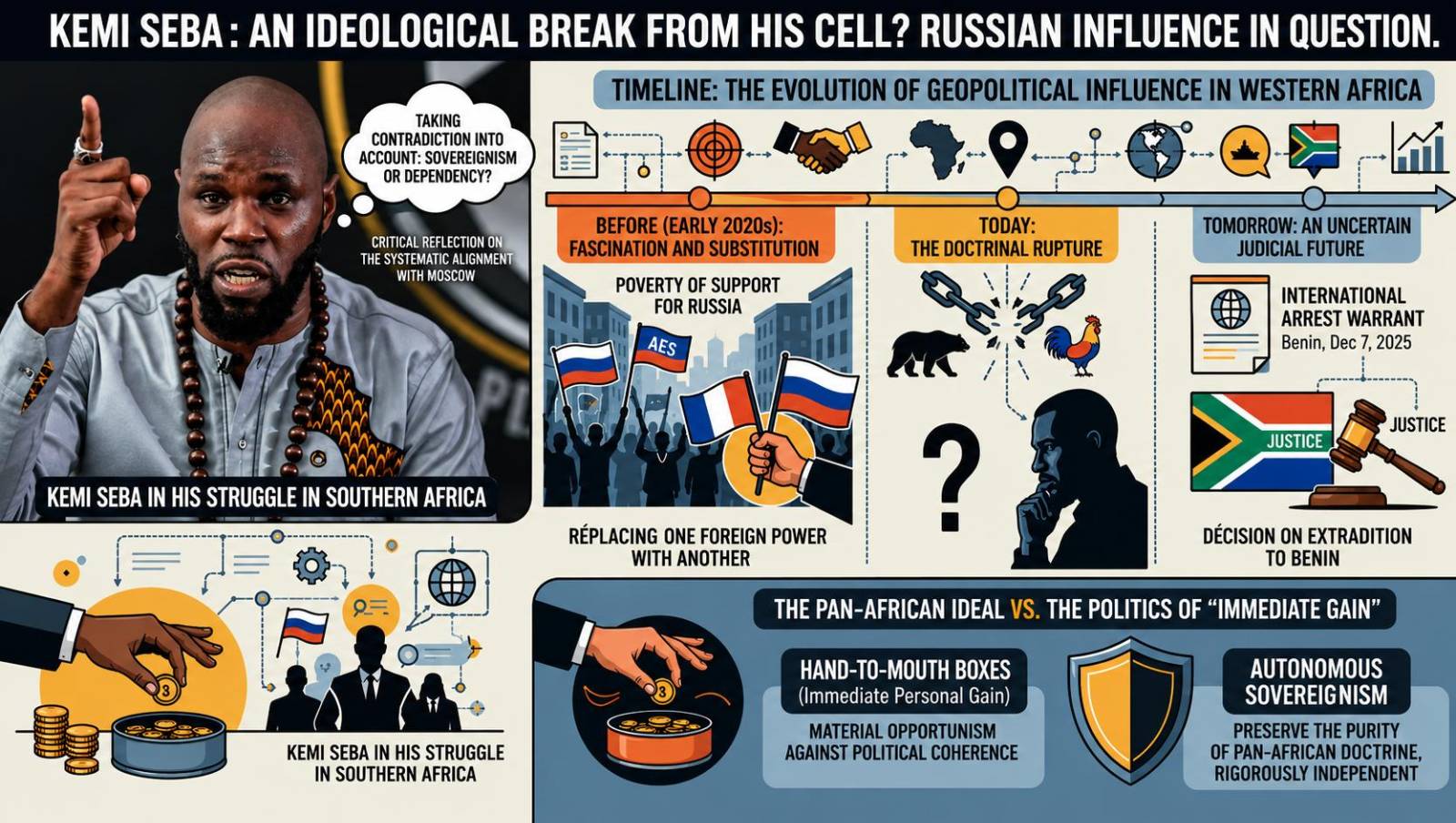
The pursuit of new international partnerships is, in principle, a legitimate diplomatic strategy for any state or political movement. However, the tendency to replace one foreign influence with another is widely regarded as a profound ideological inconsistency. Swapping the historical dominance of France for that of Russia does not, in itself, signify liberation; rather, it merely shifts the locus of dependence from one external power to another.
Observers note that Kemi Seba seems to have recognized this contradiction. The panafricanist ideologue has begun to critique the limitations of an uncritical alignment with Moscow, rejecting the notion of substituting one form of protectorate for another, regardless of its anti-Western stance.
Panafricanism versus the politics of short-term gains
This recalibration of perspective highlights a growing divide within sovereigntist movements. While some support for Russia stems from a genuine desire to break free from traditional geopolitical alignments, other dynamics appear driven by more pragmatic and immediate interests.
Kemi Seba has forcefully opposed this opportunism, which he describes metaphorically as the maintenance of « stew pots »—a vivid illustration of prioritizing personal enrichment and short-term material gains over the long-term coherence of political principles. By refusing to endorse this mercenary approach to ideology, the activist seeks to uphold the integrity of a panafricanism that demands absolute autonomy.
A legal and political crossroads in Pretoria
This ideological introspection coincides with a critical juncture in Seba’s personal and professional trajectory. The activist, who faces an international arrest warrant issued by the Beninese government following a reported coup attempt on December 7, 2025, is currently detained in South Africa. The Pretoria judiciary now holds the key to his immediate future, as it prepares to rule on Cotonou’s extradition request.
Whether this period of confinement will mark a definitive rupture in Seba’s political discourse or merely a recalibration of his stance remains uncertain. The coming weeks will be decisive not only for his own political trajectory but also for the broader direction of the movements he has inspired.