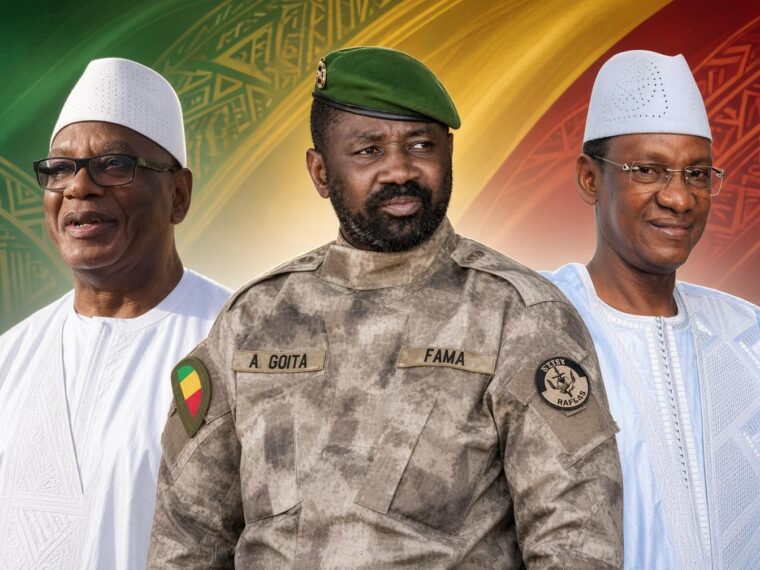
Where did Mali’s once-dominant political figures vanish to? For thirty years, leaders from parties such as ADEMA and RPM shaped governments, dominated media airwaves, and filled conference halls across the country. Under General Assimi Goïta and the military junta, this elite did not just fade into the background—they were systematically dismantled, silenced, and erased from public life.
The junta’s approach followed a clear blueprint: isolation through legal persecution, forced displacement, and enforced silence. Three pathways emerged for the old guard—prison, exile, or self-censorship under state pressure.
From boardrooms to prison cells: the legal purge of Mali’s politicians
The courts became the junta’s most effective weapon. Once-powerful party leaders now face endless prosecutions on charges ranging from ‘undermining state security’ to ‘financial misconduct’. Recent cases reveal no immunity—even former allies of the regime are not spared. The detention of Choguel Maïga, a former prime minister and key ideologue, underscores that loyalty to the past offers no protection under the new order.
Exile: the new home for Mali’s political opposition
Threatened by arrest warrants and shrinking civic space, dozens of ministers, opposition figures, and civil society leaders fled the country. From Abidjan to Dakar, Paris to Ouagadougou, they continue to plot resistance—but their influence is fading in a media landscape tightly controlled by Bamako. Without access to national platforms, their messages barely reach the Malian public.
The chilling effect: how fear silenced Mali’s political class
For those who stayed, the message is clear: speak out, and risk being labeled a ‘traitor’ or a ‘destabilizer’. The junta’s crackdown extends beyond courts and prisons—it reaches the airwaves. Independent media faces restrictions, political gatherings are banned, and parties are suspended. The result is a climate of fear where self-censorship replaces public debate.
The junta’s gamble: stability at the cost of democracy
While many Malians welcomed the fall of a corrupt and ineffective elite, the junta’s consolidation of power has gone far beyond dismantling the old regime. Elections are indefinitely postponed. Democratic institutions are sidelined. A tailor-made transition framework now governs the country—without the input of the political class that once defined it.
A future without political voices?
By neutralizing the old guard through arrests, exile, and fear, the junta has erased the political stage as Mali knew it. But this vacuum is not just missing old faces—it is missing any structured opposition at all. Without debate or intermediaries, the military-led government rules in isolation, focused narrowly on immediate security and economic crises, with no long-term political framework to guide its decisions.
The junta may have silenced dissent, but in doing so, it has also eliminated the possibility of renewal. Mali’s political future is no longer shaped by elected leaders, civil society, or multi-party consensus—it is shaped by force alone.