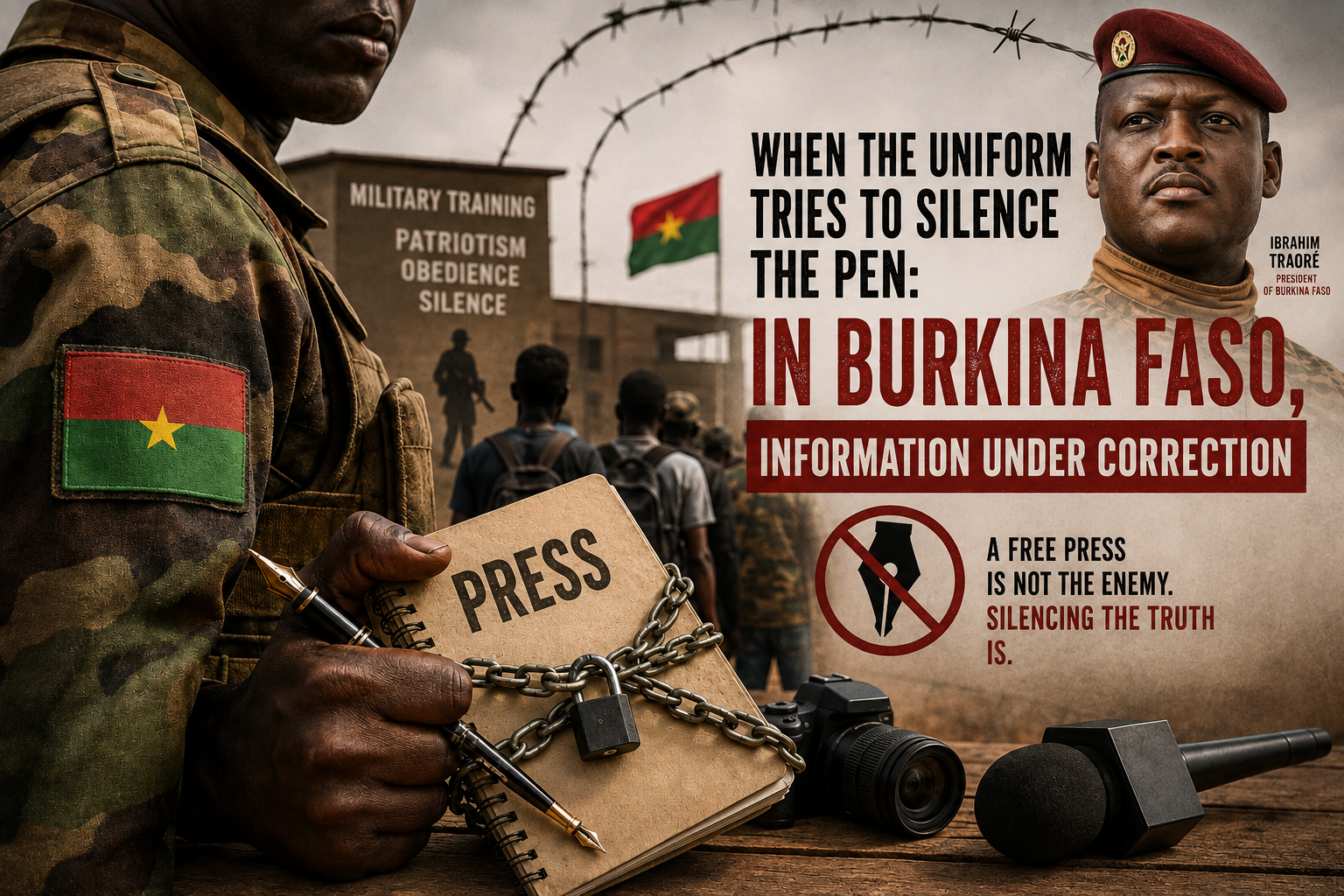
An unsettling trend has emerged in the vicinity of Ouagadougou, where over forty Burkinabè journalists recently completed a military-led training program framed as a ‘patriotic initiative.’ Beneath the polished rhetoric lies a stark reality: what is presented as civic education amounts to an attempt to re-educate and control the free press.
When a reporter is compelled whether through direct coercion or subtle pressure to attend a military camp to learn what they may or may not publish, what remains of the fundamental right to free expression?
Silencing the truth under the guise of patriotism
In Burkina Faso, investigative journalism and the accurate portrayal of public life have increasingly been treated as acts of defiance. Highlighting security failures, human rights abuses, or civilian suffering is now met with accusations of ‘treason’ or ‘lack of patriotism.’ By sending journalists to so-called re-education centers that operate without transparency, the current regime is not fostering informed citizenship it is manufacturing compliant mouthpieces for state propaganda.
This heavy-handed approach signals a dangerous shift. The crisis Burkina Faso faces is not merely a matter of security governance; it reflects the rise of an unchecked authority seeking to impose an absolutist vision across all spheres of society. By stifling public debate and monopolizing the flow of information, the state positions itself as the sole arbiter of national truth.
Journalism cannot thrive under ideological coercion
A press that aligns itself with state-imposed narratives ceases to be journalism. Suppressing dissenting voices or forcing reporters to adopt a uniform ideological stance does not resolve national crises it deepens them. When the media is silenced, citizens are deprived of reliable information, leaving room for rumor, misinformation, and unchecked speculation. The consequences are severe: a society stripped of its ability to distinguish fact from fiction is a society vulnerable to manipulation.
True patriotism is not synonymous with blind allegiance to those in power. It is the courage to confront uncomfortable truths, to hold authorities accountable, and to document the realities faced by ordinary citizens. A journalist’s duty is to inform the public, not to serve as a propagandist for the state. The government may demand restraint in reporting sensitive military operations or protect operational details, but such measures must not be weaponized to silence criticism or distort public discourse.
The blurred line between national security and political control
While security concerns may justify certain limitations on reporting, these constraints should never be exploited to transform journalists into instruments of political control. National security is not the same as regime security. A state facing armed violence may require media prudence, but it cannot demand that reporters abandon their professional integrity or suppress factual reporting under the banner of ‘patriotism.’
The danger of a domesticated press extends beyond the profession itself. When official and private media refrain from publishing critical information, the resulting void is quickly filled by unverified claims, social media speculation, and clandestine narratives. Rather than restoring public trust, such censorship erodes it further. Trust is not decreed by decree; it is earned through transparency, accountability, and the freedom to question official narratives.
A profession built on uncomfortable questions
At its core, journalism thrives on asking difficult questions. A reporter who cannot investigate public decisions, challenge official statements, or document the lived experiences of citizens ceases to function as a watchdog. This is particularly alarming in a context marked by armed conflict, mass displacements, and economic hardship circumstances where independent journalism is most vital. The need for verifiable, contextualized reporting has never been greater. When crises intensify, so does the demand for journalists who can uncover facts, give voice to victims, and scrutinize the actions taken in the public’s name.
The militarization of journalism raises a fundamental contradiction: Can those tasked with observing power be expected to adopt the same reflexes as those wielding it? The military operates on discipline, hierarchy, and confidentiality; journalism is built on verification, contradiction, and editorial independence. Merging these roles risks conflating obedience with professional duty a dangerous precedent with far-reaching implications.
A slippery slope for democratic values
Today, it is journalists who are being compelled to prove their patriotism. Tomorrow, which other professions might face similar ideological scrutiny? Academics, judges, artists, civil society leaders, or human rights defenders could all be labeled ‘insufficiently patriotic’ for challenging government policies. The implications are chilling: a democracy is measured not by its ability to silence dissent, but by its capacity to withstand criticism without resorting to coercion.
History shows that regimes attempting to control information comprehensively rarely succeed in the long term. While they may dominate official narratives and intimidate journalists, they cannot suppress reality indefinitely. Facts persist through personal testimonies, diaspora networks, social media, and international reporting. The real challenge is not enforcing a single narrative, but creating an environment where reliable information can flourish.
Patriotism must not become a license for censorship
The ultimate question facing Burkina Faso is not how to enforce a unified voice, but what kind of society it wishes to build. Do citizens deserve a system where information is vetted by the state before publication? Or should they live in a society where the truth even when inconvenient is acknowledged and addressed?
Patriotism should never serve as a pretext for censorship. Nor should it be used to divide citizens into ‘loyal’ and ‘disloyal’ categories. A journalist who exposes a state weakness is not betraying the nation; they may be preventing that weakness from escalating into catastrophe. The choice is clear: either Burkina Faso embraces a model where power dictates the narrative, or it upholds one where facts, no matter how uncomfortable, remain the foundation of public discourse.