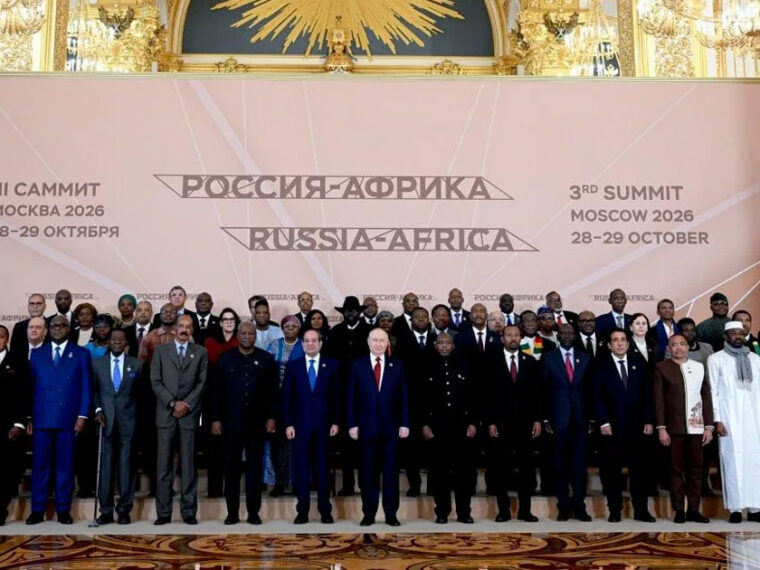
The Kremlin’s third Russia-Africa summit concluded with a carefully staged display of unity, but the real audience wasn’t in the room—it was in Brussels. As African leaders gathered under the glittering chandeliers of Moscow’s Grand Kremlin Palace, the message they carried home was less about partnership and more about leverage. Moscow’s latest diplomatic offensive reveals a calculated strategy to reshape global power dynamics, with Europe squarely in its crosshairs.

Vladimir Putin’s two-day address to African delegations was a masterclass in geopolitical messaging. While the summit produced a joint declaration, a 2029 action plan, and a carefully curated photo opportunity, the true significance lay in what wasn’t said. The Kremlin’s carefully chosen words—condemning the ‘illegal seizure of sovereign assets’—weren’t aimed at African capitals. They were a direct challenge to the European Union, framing Brussels as the real violator of international norms.
Moscow’s gamble is clear: by positioning itself as the defender of a ‘just world order’, Russia seeks to fracture Western unity and isolate Europe diplomatically. The summit may have been held in Moscow, but the bill was always meant for Brussels.
Trade as a distraction: Moscow’s real currency is influence
The numbers tell a sobering story. Last year’s Russia-Africa trade totaled just $27 billion—peanuts compared to China’s $348 billion or the EU’s $395 billion. Putin’s 2019 pledge of $40 billion in investments remains unfulfilled, with the latest summit announcing a meager $50 billion target that few expect to materialize. More revealing still is the trade imbalance: African nations bought $22.7 billion worth of Russian goods while exporting only $4.4 billion in return. For African farmers and manufacturers, Moscow offers little beyond rhetoric.
What Russia does offer—weapons, military advisors, and security guarantees—comes at a steep price. The Kremlin has signed military cooperation agreements with 45 African nations, with Ethiopia securing a deal for Russian fighter jets during the summit. Yet this security umbrella protects regimes more than it stabilizes countries. In the Sahel, where Russia’s Africa Corps backs three military juntas, violence has surged from an average of 927 deaths annually between 2016-2019 to over 10,000 between 2022-2025. Recent clashes in Mali, where separatists allied with Al-Qaeda forced Russian mercenaries out of Kidal, have exposed the fragility of Moscow’s promises.
The absentees who spoke volumes
The most telling moment of the summit wasn’t what was achieved—it was who stayed away. After personally delivering invitations to Mali, Burkina Faso, and Niger this summer, Sergei Lavrov watched as only two of the three juntas sent their leaders to Moscow. Burkina Faso’s Captain Ibrahim Traoré, despite his professed admiration for Russia, remained in Ouagadougou—a decision likely driven by his precarious hold on power after surviving multiple coup attempts. His absence sent a clear signal: even Moscow’s most vocal African supporters won’t risk everything for the Kremlin’s cause.
The final turnout of 21 African heads of state paled in comparison to the 43 who attended the 2019 summit in Sochi. While Moscow can claim this as a success for a sanctions-hit economy, the numbers reveal a different truth: Africa’s leaders are hedging their bets. They borrow from China, trade with Europe, and accept Russian security deals—but they’re not abandoning the West.
Libya: Moscow’s hidden launchpad into Europe
To understand Russia’s African strategy, look beyond the Sahel to Libya. After losing its foothold in Syria, Moscow shifted its focus to eastern Libya, where it now controls six air bases under the command of strongman Khalifa Haftar. These bases—including Al-Joufra, Al-Khadim, and Brak al-Chati—serve as staging grounds for operations across the Sahel. But their real value lies elsewhere: they provide Russia with a strategic platform to project power into the Mediterranean and threaten NATO’s southern flank.
Recent reports suggest Moscow is preparing to deploy anti-drone systems to protect Haftar’s forces in Tobruk. While no official contracts have been announced, the implications are clear. A fortified Russian presence in eastern Libya would give Moscow the capability to disrupt European security at will—whether through direct military action or by weaponizing migration flows. As one analyst noted, ‘The Mediterranean’s southern shore could become the next front in Europe’s security challenges.’
Africa isn’t choosing sides—Moscow is choosing targets
The Africa that emerged from this summit isn’t a continent turning toward Moscow. It’s a continent where leaders navigate a multipolar world with pragmatic precision. They accept Russian grain shipments, purchase Turkish drones, and court Gulf investors—all while maintaining ties with Europe. Moscow’s summit was just another stop on this diplomatic circuit.
For Europe, the lesson is stark. Russia doesn’t need to win over all of Africa to reshape global power structures. A few key alliances—support at the UN, military bases in Libya, and partnerships with Sahel juntas—are enough to tilt the balance. Moscow’s currency isn’t trade; it’s coercion. And Europe’s delayed response risks turning the Mediterranean into a new battleground where Brussels will only realize the cost too late.