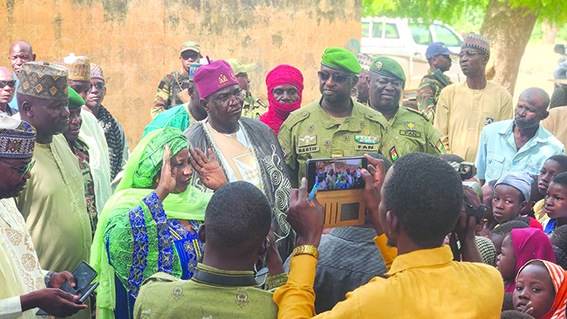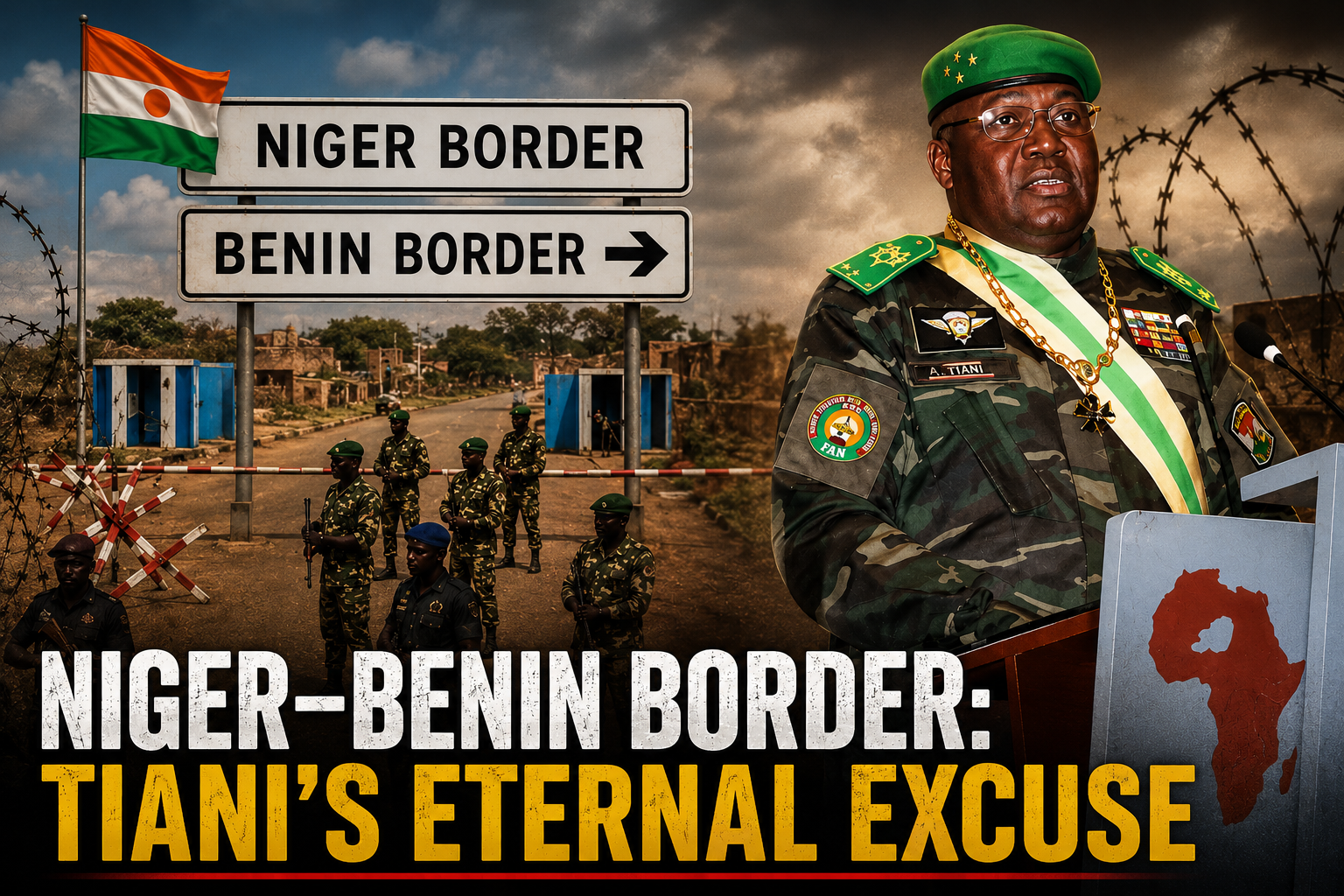
The recent diplomatic exchanges between Niamey and Cotonou had raised hopes of an imminent resolution to the long-standing border dispute between Niger and Benin. Following weeks of technical discussions between officials from both nations, expectations were high that a gradual reopening of the frontier was within reach. However, these prospects were abruptly dashed on July 26 during a national address by General Abdourahamane Tiani.
Marking the first anniversary of his rise to power, the Nigerien leader made it unequivocally clear that no immediate breakthrough was forthcoming. In a televised statement broadcast on the national channel ORTN, he declared, ‘Critical prerequisites must be addressed before any irreversible decision on reopening the border can be considered.’
Unclear demands, indefinite postponement
The crux of the impasse lies in the complete lack of specificity surrounding these so-called ‘prerequisites.’ No concrete criteria have been outlined to determine when—or even if—they might be satisfied. Similarly, no timeline has been proposed, leaving the door wide open for indefinite postponement under the guise of unresolved conditions.
This deliberate ambiguity serves a clear political purpose: it allows the military-led administration to defer the border’s reopening indefinitely without ever having to justify its stance with tangible evidence. Each new demand can be introduced, replaced, or reprioritized, ensuring that the dispute remains unresolved for the foreseeable future. The result is a perpetuation of uncertainty that systematically undermines any prospect of lasting normalization.
A security narrative that rings hollow
Since the 2023 coup, the Nigerien government has consistently framed the border closure as a necessary measure to counter external threats. Official statements have repeatedly alleged that Benin’s territory serves as a rear base for armed groups and foreign powers intent on destabilizing Niger. Yet, these claims have never been substantiated with publicly available evidence.
Meanwhile, terrorist attacks continue to ravage Niger’s western and eastern regions—particularly Tillabéri, Tahoua, and Diffa—undermining the government’s assertion that the closure has bolstered domestic security. This glaring contradiction raises a pressing question: if the border’s closure were truly enhancing national security, why do violent incidents persist at an alarming rate?
Technical progress sidelined by political calculations
Only weeks before the president’s announcement, joint technical teams from both countries had resumed dialogue to explore phased solutions that would address security concerns while gradually restoring trade flows. These discussions were designed to bridge divides through pragmatic, evidence-based mechanisms.
By dismissing these efforts implicitly, General Tiani has made one thing abundantly clear: the final decision rests solely on political grounds. The technical consultations, it appears, now serve primarily as a delaying tactic rather than a pathway to resolution.
Economic fallout: Niger bears the heaviest burden
The prolonged closure has exacted a severe toll on both nations, though the repercussions are far graver for landlocked Niger. Cotonou’s port, a vital trade gateway for Niger, has seen a sharp decline in transit traffic and customs revenue, while transport operators face mounting losses. For Niger, however, the costs are exponentially higher.
The enforced reliance on longer, costlier alternative routes has triggered a cascade of economic consequences:
- Sharp increases in the prices of staple foods;
- Rising costs for construction materials and imported goods;
- Escalating prices of essential medicines;
- Severe supply disruptions for local businesses;
- Erosion of competitiveness for Nigerien enterprises.
Small-scale traders along the border have been among the hardest hit, with many seeing their livelihoods evaporate. Entire communities that once thrived on cross-border commerce are now grappling with economic stagnation and dwindling opportunities.
A fractured regional cooperation
The closure has also cast a long shadow over broader regional collaboration. Joint initiatives—ranging from academic exchanges and cross-border development projects to efforts combating illicit trafficking—have become increasingly strained. Paradoxically, the official blockade has not eradicated clandestine activities; instead, it has driven them further underground, complicating oversight and control by authorities.
Sovereignty as a political tool
General Tiani’s reference to a potentially ‘irreversible’ decision was not merely a statement on border policy—it was a deliberate symbolic gesture. The closure is being framed as a bold assertion of sovereignty against external pressures, particularly from neighboring states and international actors.
Yet this narrative raises a fundamental question: does true sovereignty lie in isolating a nation’s economy, or in effectively safeguarding the well-being of its people? To many observers, the prolonged closure increasingly resembles a political communication strategy rather than a coherent security policy. It reinforces a narrative of perpetual resistance that bolsters the junta’s domestic legitimacy, particularly among its core support base.
The human cost of a protracted standoff
Beyond the geopolitical posturing, the human toll of this impasse is profound. Transport workers left without income, merchants facing ruin, students barred from crossing, families separated by arbitrary restrictions, and entrepreneurs mired in uncertainty—these are the silent victims of a dispute driven more by politics than by practical necessity. With each passing week, the cumulative damage deepens, pushing the prospect of normalized relations further out of reach.
An impasse with no end in sight
Three years into the crisis, the Niger–Benin border dispute has evolved from a security issue into a political lever, wielded with little regard for the economic and social fallout. By invoking vague and ever-shifting ‘prerequisites,’ the Nigerien leadership retains absolute discretion to prolong the status quo indefinitely. Meanwhile, citizens on both sides of the frontier continue to bear the brunt of a decision whose tangible benefits remain conspicuously absent.
For normalization to occur, the political calculus must yield to the pressing needs of ordinary people—and to the urgent restoration of regional cooperation grounded in dialogue, mutual trust, and pragmatic problem-solving.