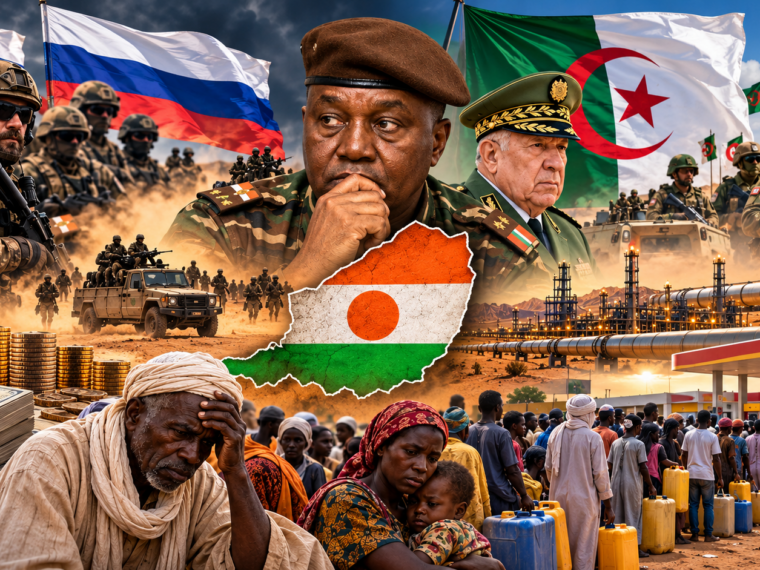
Algeria’s military deployment raises questions about Niamey’s shifting security strategy
In a decisive move reflecting the growing strain on its military partnerships, Niger’s transitional government has secured Algeria’s parliamentary approval for direct military support. The October 25 authorization marks a significant shift in Algeria’s traditionally cautious foreign intervention policy, but it leaves critical questions unanswered about the terms, costs, and objectives of this new cooperation.
From Russian mercenaries to Algerian troops: why is Niamey seeking new allies?
Since the 2023 coup that brought General Abdourahamane Tiani to power, Niger has leaned heavily on Russian military contractors particularly those linked to Africa Corps as its primary security partner. Yet despite these costly engagements, measurable improvements in territorial security remain elusive. The regime now appears to be hedging its bets, turning to Algeria for a more structured military arrangement. But what exactly is being negotiated, and why has Niamey opted for yet another foreign partner?
Security results fall short of expectations
Niger’s military partnerships, whether with Russian groups or others, have not yielded the promised dividends in terms of operational security. Key benchmarks such as reductions in armed attacks, protection of civilians, safeguarding of critical infrastructure, and the restoration of state authority in contested regions have not yet been achieved. This raises a pressing question: if foreign troops are already deployed, why is Niger still seeking additional military backing?
Reports suggest that Russian contractors may cost as much as $10,000 per month per operative, though these figures lack public contractual verification. Regardless of the exact cost, the lack of transparency surrounding these expenditures, combined with the absence of clear operational outcomes, demands scrutiny. How much of Niger’s national budget is being diverted to these contracts, and what tangible security gains justify such financial sacrifices when social and economic needs remain unmet?
Algeria’s calculus: security, energy, or both?
The recent parliamentary green light in Algiers is not merely a military gesture; it also aligns with Algeria’s strategic interests in Niger’s energy sector. Oil fields, exploration projects, and the proposed Trans-Saharan gas pipeline represent high-value assets that both countries are keen to protect. While Algeria’s stated priority is combating cross-border threats, its economic stakes in Niger add a layer of complexity to the partnership.
This dual agenda raises concerns: Is this cooperation primarily about Niger’s security needs, Algeria’s economic interests, or a combination of both? For Niger’s citizens, the distinction matters. A military presence that prioritizes the protection of infrastructure over the safety of rural communities or urban populations could leave substantial segments of society unprotected.
Operational transparency is non-negotiable
For Niger’s government, the decision to invite foreign troops must be accompanied by full disclosure. What are the specific mission objectives for Algerian forces? Will their role be limited to border surveillance and infrastructure protection, or does Niamey envision a broader deployment? Who bears the financial burden Algiers, Niamey, or a shared arrangement? Without clear answers, the population is left in the dark about the costs and benefits of this alignment.
The absence of publicly available agreements makes it difficult to assess whether Algerian involvement will translate into measurable security improvements or merely add another layer of foreign military dependency. Niger’s sovereignty often invoked as justification for rejecting past alliances now hinges on its ability to demonstrate that this new partnership delivers concrete results for its people.
The cost of military partnerships: a bill Niger may not afford
Niger faces immense challenges, including education deficits, healthcare shortages, crumbling infrastructure, and a persistent security crisis. In this context, every major security expenditure must be evaluated against its return on investment for the population. If the deployment of Algerian troops introduces new financial obligations, the government must clarify who will foot the bill: Algiers, Niamey, or a cost-sharing model?
Potential financial burdens could manifest in several ways subsidized logistical support, facilities for foreign troops, or indirect economic concessions. While current information does not confirm that Niger’s budget will directly absorb these costs, the ambiguity surrounding funding structures is itself a red flag. Unchecked military spending without corresponding security gains risks diverting resources from essential public services, deepening economic strain, or creating unsustainable financial dependencies.
Sovereignty demands accountability
General Tiani’s regime has framed sovereignty as a cornerstone of its legitimacy, yet the successive reliance on foreign military partners first Russia, now Algeria creates a paradox. Sovereignty, in this context, cannot be reduced to rejecting old alliances or signing new ones. It must also mean transparent governance, responsible budget management, and a clear demonstration that external partnerships serve the national interest.
If the Russian model has failed to deliver security, the government must acknowledge this and justify the shift. Similarly, if Algerian assistance becomes necessary, it must explain its strategic value, operational scope, and financial implications. Trust is earned not through diplomatic posturing but through measurable results and fiscal responsibility.
The bottom line: security for whom?
The Algerian military’s potential deployment in Niger could reshape the security landscape in the Sahel, but it is not a panacea. Success will be measured not in joint statements or parliamentary votes, but in tangible outcomes: fewer attacks, safer roads, protected communities, and restored state authority in vulnerable regions. Above all, it will be judged by whether Niger’s citizens see real improvements in their daily lives.
As Niamey continues to diversify its military alliances, one question looms large: How many more partnerships will it take before the population witnesses a lasting reduction in violence? Foreign troops can complement a national security strategy, but they cannot replace it. The ultimate test of this cooperation will be whether it delivers on the fundamental duty of any government to protect its people and manage public resources with integrity.
By Agnès Mvogo — Journalist