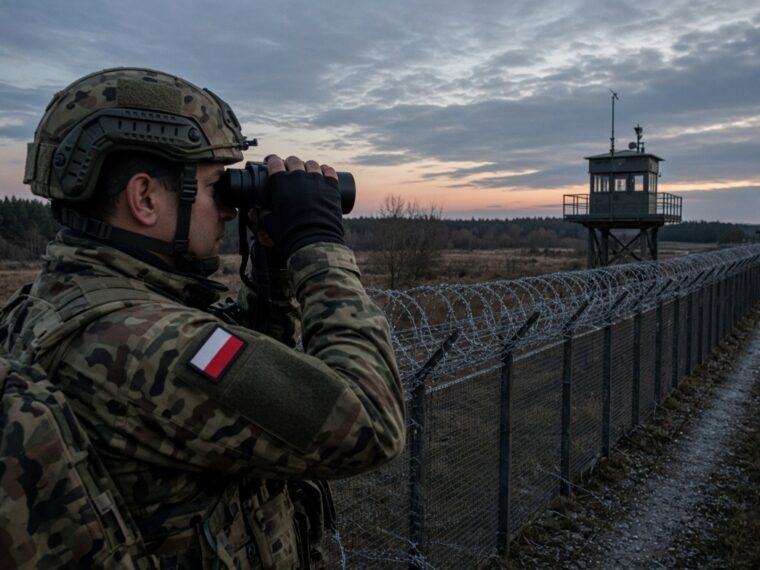
Europe’s eastern flank has entered a new phase of geopolitical brinkmanship as Poland rolls out an unprecedented security operation along its northeastern frontier, confronting a surge in clandestine threats emanating from Russia’s militarized enclave of Kaliningrad.
From suspicion to action: Poland’s emergency border lockdown
Citing actionable intelligence and a pattern of growing provocations—including unauthorized aerial incursions and drone overflights—Warsaw has initiated a sweeping security campaign aimed at sealing off its Baltic frontier. The operation integrates multiple security layers: border guards, national police, elite counterterrorism units, and regular army battalions, creating a synchronized shield against infiltration and sabotage.
Why Kaliningrad makes this border a flashpoint
The Russian exclave of Kaliningrad, sandwiched between Poland and Lithuania, has become a hotbed of hybrid warfare tactics. Moscow’s playbook includes cyber disruptions, disinformation campaigns, and the movement of operatives under civilian cover—all designed to probe and destabilize NATO’s eastern defenses. Poland’s response is not just about border control; it’s a strategic countermeasure to protect national infrastructure, including energy grids, transportation hubs, and communication networks.
Key threats driving the response
- Unmanned intrusions: Repeated unauthorized drone flights over Polish sovereign airspace, some within meters of critical military zones.
- Migratory exploitation: Attempts to weaponize migration flows by funneling non-state actors toward Polish checkpoints.
- Digital aggression: Systematic cyber probes targeting government and utility systems, likely aimed at creating chaos in a crisis.
- Sabotage planning: Evidence of reconnaissance by suspected Russian-linked groups near key transit corridors.
Poland at the forefront of NATO’s eastern defense
By fortifying this frontier with military precision, Poland is asserting its role as a bulwark of NATO’s eastern defense. The move sends a clear signal: Warsaw is no longer waiting for provocation—it’s preempting hybrid assaults with active deterrence. This shift marks a turning point in Europe’s shadow war with Moscow, where ambiguity has given way to resolute action.
The stakes: more than just a border
The Baltic coastline is not just a geographic line but the frontline of a broader conflict. With Ukraine still under siege and tensions rising across Eastern Europe, Poland’s proactive stance is a bellwether for regional security. It underscores a harsh reality: the Kremlin’s hybrid strategy—once considered deniable—now faces a wall of reinforced deterrence.
As the world watches events in Ukraine, a quieter but equally critical battle unfolds daily along the Baltic. Poland’s security surge is not just a response to immediate threats—it’s a statement that in the face of Russian aggression, resilience begins at the border.