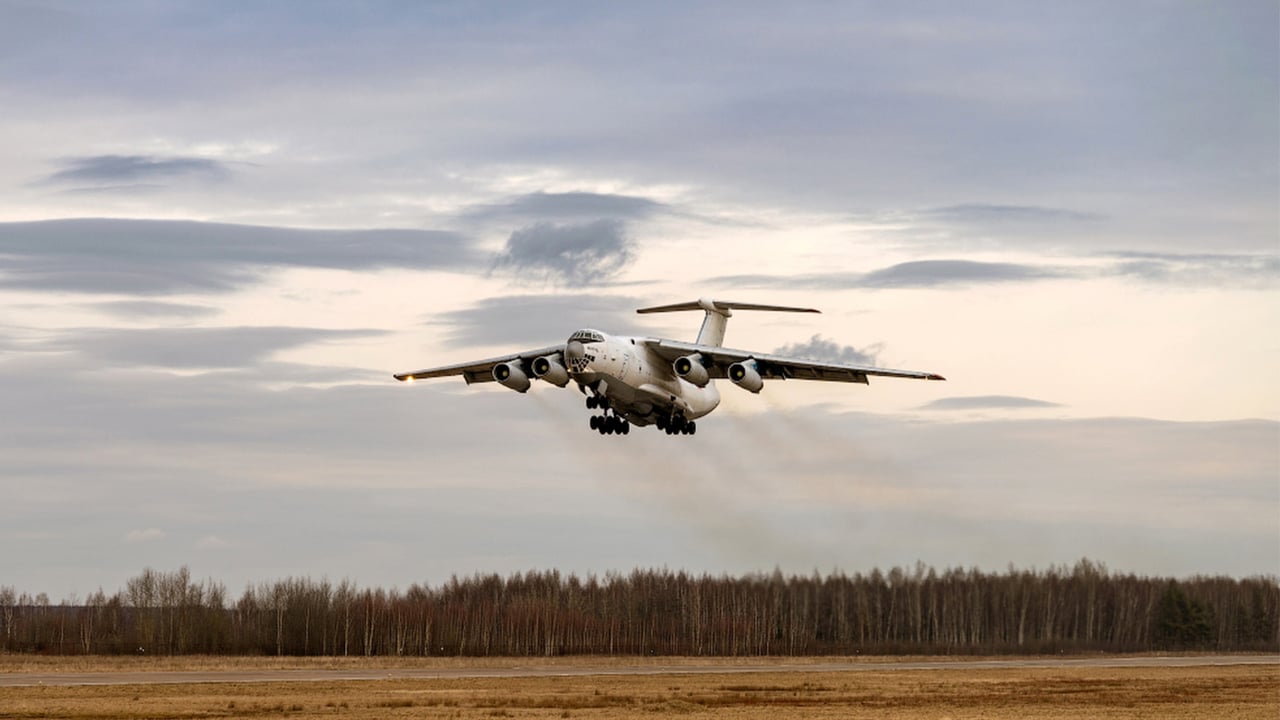

The Russian Africa Corps has quietly established an air bridge to the Sahel, using civilian-marked cargo planes to transport troops and weaponry across the continent. Recent flight patterns reveal a sophisticated logistics network connecting Moscow with key Sahelian hotspots, including Niamey in Niger, where regional alliances are reshaping security dynamics.
Unseen but strategic: The air bridge’s role in Sahelian security
Commercial aircraft such as the IL-76, operated by Russian firms like Zitotrans, have become instrumental in Moscow’s strategy to extend influence in Africa’s volatile Sahel belt. These flights, often disguised as routine cargo operations, carry personnel, supplies, and military equipment to allies in the Alliance of Sahel States, a bloc formed to counter external interference.
The timing of these deployments aligns with the region’s escalating instability, where jihadist factions and political unrest threaten local governments. Russia’s Africa Corps, a successor to the Wagner Group’s operations, appears to be filling the void left by departing Western forces, leveraging air transport to quickly reposition troops and assets.
The use of civilian aircraft for military purposes is not unprecedented, but the scale and opacity of these operations raise questions about compliance with international aviation norms. Niamey, a critical hub for both French and Russian operations in recent years, has become a frequent stopover for these flights, underscoring its geopolitical importance.
From Wagner to Africa Corps: A shift in Moscow’s Sahel strategy
The transition from Wagner to Africa Corps marks a formalization of Russia’s security engagements in Africa. While Wagner operated with a degree of plausible deniability, the Africa Corps is presented as a state-backed entity under President Vladimir Putin’s direct oversight. This evolution reflects Moscow’s long-term ambition to secure strategic partnerships across the continent.
Analysts note that the air bridge serves multiple objectives: reinforcing military presence, delivering humanitarian aid (often tied to political concessions), and projecting soft power through cultural and economic exchanges. The cargo planes also transport Russian advisors and technicians to train local forces, further embedding Moscow’s footprint in the region.
The Africa Corps’ activities coincide with the Alliance of Sahel States’ push to reduce dependence on former colonial powers. By offering an alternative security model, Russia positions itself as a key ally, even as its methods draw scrutiny from Western capitals and human rights organizations.
Flight routes and logistical hubs
Open-source flight tracking data highlights several recurring routes linking Russian airfields to Sahelian destinations. The most prominent include:
- Moscow (Vnukovo) to Niamey (Diori Hamani International Airport)
- St. Petersburg (Pulkovo) to Bamako (Modibo Keïta International Airport)
- Voronezh to Ouagadougou (Ouagadougou Airport)
- Regular stopovers in Libya (Mitiga International Airport) for refueling and crew changes
These flights often use cargo charters, avoiding commercial passenger routes to minimize scrutiny. The IL-76’s heavy-lift capacity makes it ideal for transporting armored vehicles, artillery, and other military hardware, though the exact nature of the cargo remains unverified due to restricted access to Sahelian airspace.
Geopolitical implications for the Sahel
The Africa Corps’ air bridge has significant repercussions for regional power dynamics. For the Alliance of Sahel States, Moscow’s support provides a counterbalance to French and American influence, particularly in former French colonies like Burkina Faso, Mali, and Niger. The rapid deployment capability demonstrated by the air bridge allows Russia to respond swiftly to emerging threats, a capability that Western nations have struggled to match in recent years.
However, the opaqueness of these operations has fueled tensions with neighboring countries and international observers. Accusations of arms trafficking and unauthorized military presence have already sparked diplomatic confrontations, particularly with the Economic Community of West African States (ECOWAS).
As the Sahel’s security crisis deepens, the Africa Corps’ air bridge is likely to play an increasingly pivotal role in shaping the region’s future. Whether this translates into lasting stability or further instability remains a subject of intense debate among policymakers and analysts alike.