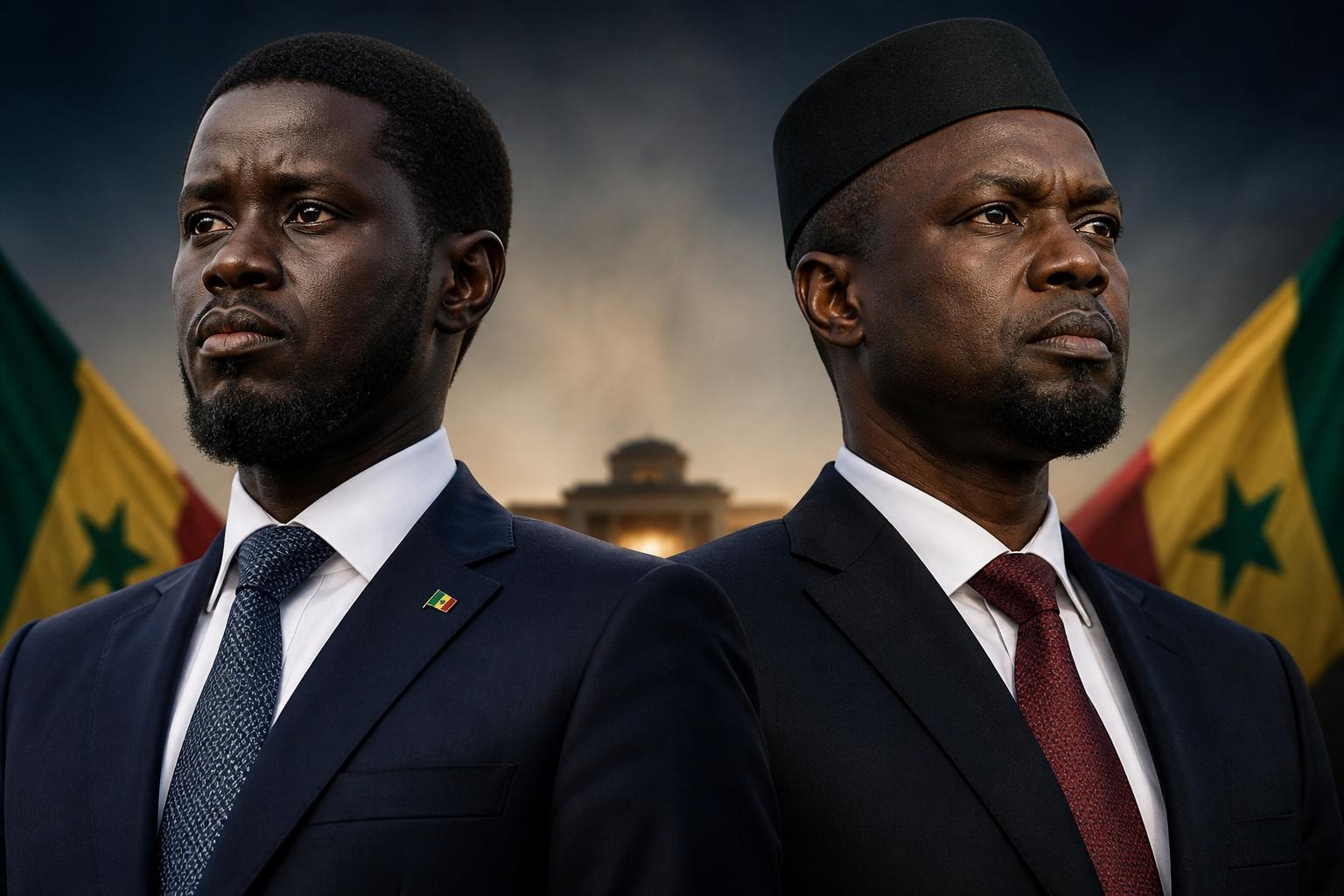
Senegal’s political landscape is undergoing a significant transformation as President Bassirou Diomaye Faye takes bold steps to assert his authority, signaling a potential rift with his Prime Minister and former mentor, Ousmane Sonko. This strategic shift, emerging during a pivotal weekend in early May 2026, underscores a shift from unified governance to a more assertive presidential stance, leaving the nation to ponder the implications of this evolving power dynamic.
Breaking point in the political narrative
The catalyst for this political recalibration came in the form of a single, carefully chosen statement during a national press interaction. For months, the official discourse had painted a picture of an inseparable duo—where the president and his prime minister moved in lockstep toward a shared vision. Yet, the tone shifted dramatically when President Faye addressed mounting tensions between government policies and the Pastef party’s vocal factions.
In a move that stunned political observers, Faye emphasized his detachment from partisan affiliations, declaring his loyalty to the nation above all else. His words carried the weight of a constitutional oath as he asserted his readiness to sever ties if partisan interests clashed with his vision for Senegal. This declaration not only redefined his political identity but also set the stage for a potential realignment of power structures in Dakar.
The shadow of Ousmane Sonko: a prime minister overshadowing the presidency
The roots of this tension trace back to the regime’s inception, when Faye was elected under a slogan that equated voting for him with choosing Sonko. From the outset, Sonko’s charismatic leadership and relentless public engagements blurred the lines between his roles as party leader and Prime Minister. His frequent media appearances and direct appeals to the public often overshadowed official government communications, creating an unspoken rivalry between the two centers of power.
Divergences have intensified on critical issues such as debt management and international relations, where Sonko advocates for radical reforms while Faye adopts a more measured, diplomatic approach. The appointment process has also become a battleground, with the president favoring technocrats and Sonko pushing for loyal party members. The contrast in their leadership styles—Sonko’s fiery rhetoric versus Faye’s measured governance—has further strained their working relationship.
Is a political divorce imminent?
While an immediate split remains unlikely, the possibility is now firmly on the table. President Faye’s willingness to entertain the idea of separation reflects a broader strategy to carve out an independent path. In response, Sonko’s camp has downplayed the remarks as mere role differentiation, but the president’s message is clear: the presidency will not be held hostage by partisan agendas. This stance signals a historic moment for Senegal, where institutional stability may take precedence over party loyalty.
However, the road ahead is fraught with challenges. A potential break could leave Faye without the robust support of the Pastef machinery, forcing him to navigate governance through alternative means or risk institutional paralysis. The uncertainty has left many wondering whether Senegal is heading toward a period of political gridlock or a new era of presidential autonomy.
The stakes of an empowered presidency
For Faye, the stakes are high. He must reassure international partners of Senegal’s stability while proving to citizens that he is firmly in control. Public opinion is divided: younger voters, drawn to Sonko’s charisma, may view Faye’s move as a betrayal, while others see it as a long-overdue assertion of presidential authority. The president faces a delicate balancing act—asserting his dominance without triggering social unrest that opponents could exploit.
The core issue is no longer about personal rapport but the sustainability of a governance model with two competing power centers. Faye’s recent actions suggest he is prioritizing the state over the party, a shift that could redefine Senegal’s political future. As the nation watches, one question looms large: Can the presidency stand alone, or will the legacy of the ‘Duo’ endure as a cautionary tale of political collaboration?