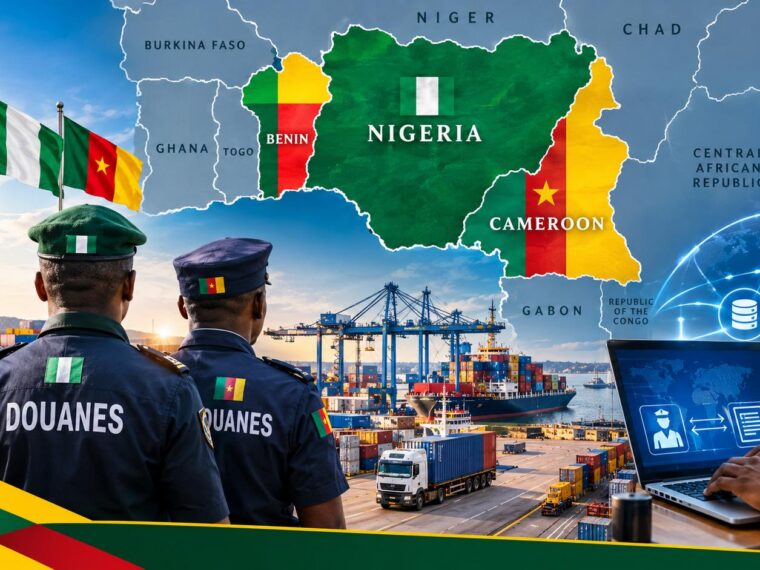
The governments of Benin, Nigeria, and Cameroon have taken a decisive step toward streamlining regional trade by advancing plans to digitally integrate their customs systems. Under the technical and financial support of the Afreximbank, the initiative aims to dismantle bureaucratic hurdles, accelerate border clearances, and foster seamless cross-border commerce across West Africa.
Digital customs interlinking: a trade facilitation breakthrough
At a high-level roundtable in Cairo on October 12, 2026, senior customs authorities from the three nations laid the groundwork for a shared digital platform designed to synchronize customs data. The primary objective is to reduce the time and cost burdens on businesses engaged in intra-African trade, where repetitive documentation, inconsistent procedures, and fragmented data flows currently cause significant delays.
By enabling real-time exchange of customs information between customs departments in Cotonou, Abuja, and Yaoundé, the system aims to eliminate duplicate data entry, streamline inspections, and shorten clearance times. However, digital interconnectivity alone will not guarantee success it must be paired with synchronized regulations, adequate infrastructure, staff training, and robust inter-agency coordination.
Benin’s strategic opportunity in regional logistics
For Benin, this initiative is not merely a modernization effort it is a strategic economic lever. The Port of Cotonou serves as a vital gateway for goods heading to landlocked neighbors, making customs efficiency a cornerstone of national competitiveness. A seamless digital link with Nigeria and Cameroon would enhance supply chain predictability, reduce clearance costs for importers and exporters, and improve traceability of goods moving across borders.
The integration could also enhance fraud detection by enabling cross-referencing of shipment data across the three countries, strengthening regulatory oversight and reducing the risk of document tampering or under-invoicing.
Afreximbank’s role in accelerating African trade integration
The involvement of Afreximbank underscores the broader continental push to dismantle non-tariff barriers and deepen intra-African trade through digital solutions. The bank’s backing signals more than financial support it reflects a regional commitment to harmonize customs practices and create a unified data ecosystem that supports predictable, transparent trade flows.
Critical questions remain unanswered: What timeline will guide the rollout of this interconnected system? Which data fields will be shared between customs authorities? How will data security, platform compatibility, and system reliability be ensured? And most importantly, what concrete performance metrics will be used to measure reductions in clearance times and operational costs?
From policy to performance: turning vision into reality
The success of this initiative hinges on execution. While the concept of digital customs interlinking holds immense promise, its real value will be measured in tangible outcomes: shorter clearance delays, lower logistics costs, fewer procedural redundancies, and improved transparency in cross-border trade.
As African economies seek to capitalize on the African Continental Free Trade Area (AfCFTA) and reduce reliance on imports from outside the continent, the modernization of customs processes is a strategic imperative. For Benin, Nigeria, and Cameroon, the challenge now is to transform this digital connectivity plan into a reliable, secure, and scalable mechanism that delivers equitable benefits to businesses, consumers, and regional economic growth.
By Thomas Nkoulou — Journalist