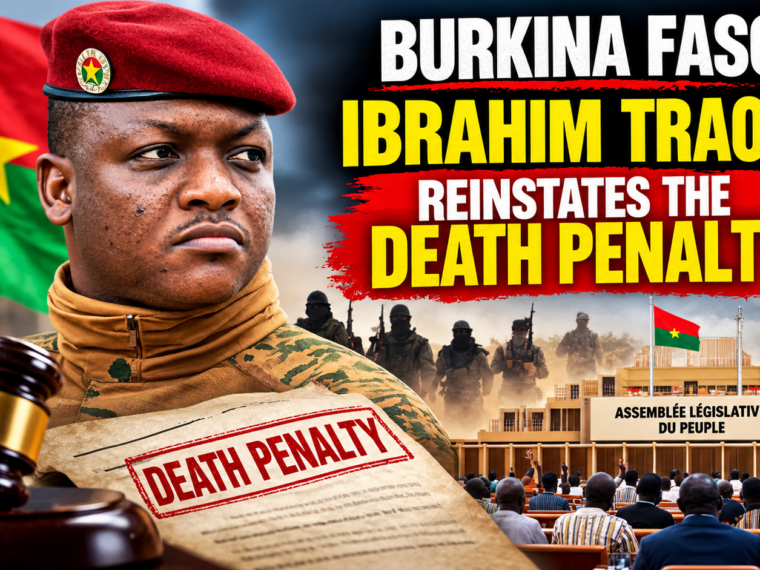
The government of Burkina Faso has taken a decisive step in its fight against insecurity by reinstating the death penalty, a move that has sparked intense debate. While authorities argue the measure is necessary to restore order, critics question whether this drastic approach will truly enhance public safety or further erode already fragile democratic norms.
Legislative milestone: the new penal code
On October 20, 2026, Burkina Faso’s legislative body, the Assemblée législative du peuple (ALP), unanimously adopted a sweeping revision of its penal code. Among the most controversial changes is the reintroduction of capital punishment, abolished in 2018. The reform targets serious crimes including terrorism, espionage, treason, and parricide, as well as the importation of expired or banned products resulting in death. Proponents frame it as a bold response to jihadist violence that has ravaged the country for years.
Security crisis fuels punitive justice
Since 2015, Burkina Faso has faced an escalating security crisis, fueled by armed attacks attributed to jihadist groups. Thousands have died, and over two million people have been displaced. In this climate of fear, the government contends that harsher penalties send a clear message to perpetrators and restore public confidence. Yet the critical question remains: can severe punishments alone address the root causes of violence?
Security experts emphasize that effective crisis management depends on more than penalties. Intelligence gathering, preventive strikes, robust judicial investigations, and sustained state presence in vulnerable areas are indispensable. Without these, the reintroduction of the death penalty risks being little more than a symbolic gesture.
Ibrahim Traoré’s hardline stance
Captain Ibrahim Traoré, Burkina Faso’s leader, has consistently framed the new penal code as a defense of national sovereignty. His public statements underscore an uncompromising approach to security threats, particularly in cases of espionage and treason. Such rhetoric signals a broader shift toward militarized justice, where punitive measures are prioritized over procedural safeguards.
Yet a justice system defined by severity must also uphold fairness. When a sentence is irreversible, the margin for error narrows dramatically. False convictions, flawed investigations, or political interference can lead to irreparable harm. The challenge for Traoré’s administration is to reconcile firmness with justice, ensuring that due process remains a cornerstone of the legal system.
Pressures on civil liberties and dissent
The reintroduction of capital punishment coincides with growing concerns over civil liberties in Burkina Faso. Reports have highlighted increased restrictions on press freedom, forced enlistments, and targeted detentions of critics and legal professionals. While national security is a legitimate concern, the simultaneous criminalization of certain press offenses raises alarms about the weaponization of justice to silence dissent.
In a functioning democracy, public scrutiny and criticism are vital. Journalists must investigate, activists must voice concerns, and courts must operate without intimidation. When penalties become tools of political control, the line between state defense and authoritarianism blurs.
Fear as governance: a flawed strategy
The heart of the debate lies in perception. A state that governs through fear may suppress dissent, but it cannot inspire trust. Citizens yearn for genuine security: safe markets, functioning schools, and the ability to farm and sleep without terror. The government’s approach must address these immediate needs, not merely impose harsh consequences for criminal acts.
Traoré’s administration faces a defining test. Can it demonstrate that punitive justice translates into tangible safety improvements on the ground, all while preserving citizens’ fundamental rights?
A reform with lasting consequences
The reinstatement of the death penalty is not a technical legal adjustment it is a political watershed. It signals how Burkina Faso chooses to confront crime and assert state authority in a time of crisis. Yet history cautions that justice systems built on fear often falter under scrutiny.
For a nation battered by jihadist violence, the priority must remain restoring stability without sacrificing the principles that define a just society. Security and freedom are not mutually exclusive. They thrive when state power operates within a transparent, accountable framework, rooted in law and respect for human dignity.
By Agnès Mvogo — Journalist