On Tuesday, July 28, 2026, at the prestigious Palais de la Marina, President Romuald Wadagni formally inaugurated the members of the Permanent Committee for the National Legal Reform Commission. This significant institutional milestone aims to revitalize Bénin’s legislative framework, transforming it into a powerful driver for socio-economic advancement and enhanced national appeal.
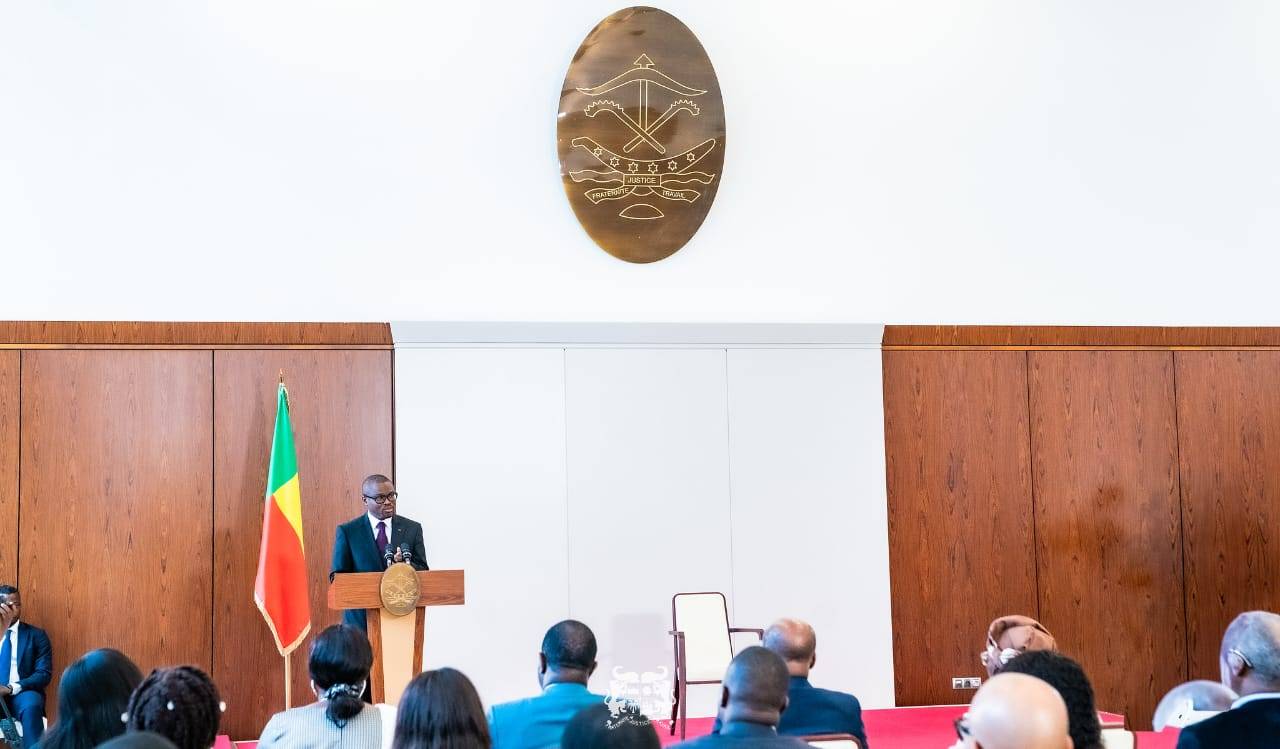
A pivotal moment in Bénin’s institutional history unfolded on this Tuesday, July 28, 2026. Within the distinguished Ambassadors’ Room of the Palais de la Marina, President Romuald Wadagni presided over the solemn inauguration ceremony of the Permanent Committee of the National Legal Reform Commission. Surrounded by the Vice-President of the Republic, leaders of major state institutions, and the Minister of Justice and Legislation, the Head of State initiated an ambitious legislative undertaking. By establishing this body, the executive branch underscores its dedication to embedding the nation in a modernized legal governance framework, one that is responsive to contemporary challenges and resolutely forward-looking.
A key institution born from national ambition
This inauguration ceremony culminates a process initiated several months prior. The National Legal Reform Commission’s establishment was officially ratified by the Council of Ministers on October 15, 2025, aligning with the government’s broader structural reform agenda. To steer this crucial institution, a select yet highly qualified Permanent Committee was appointed on July 1, 2026. Its members include Mr. Noël Gbaguidi as President, Mr. Djidjouè Gboyou as Vice-President, and Mr. Igor Guedegbe serving as Rapporteur.
The mandate bestowed upon this body is comprehensive and multifaceted. The Commission’s primary objectives will involve maintaining constant legislative and regulatory oversight, alongside conducting studies in prospective and applied legislation. It will also be tasked with supporting public institutions in drafting rigorous legal texts and streamlining the transposition and implementation of regional community law.
Updating the legal arsenal: a security imperative
In his opening address, President Romuald Wadagni meticulously outlined the Committee’s strategic roadmap. The paramount challenge involves undertaking an unsparing assessment of Bénin’s existing legal framework to rectify its structural deficiencies. The Head of State emphasized the critical need to identify and repeal provisions rendered obsolete by socio-economic evolution. In a rapidly transforming world, clinging to antiquated regulations impedes national dynamism. He further urged the Committee to address legal vacuums concerning emerging issues and to resolve internal contradictions that weaken the very fabric of justice.
From the presidential perspective, the clarity, coherence, and accessibility of legal texts form the bedrock of legal certainty. This, in turn, is indispensable for bolstering the credibility of public authority and fostering citizen trust.
Law as an accelerator of national development
However, the ambition driving this reform extends beyond mere technical legal considerations. The most innovative aspect of the presidential discourse lies in a strategic re-evaluation of the law’s fundamental role.
“Our legal framework must no longer solely be an instrument that guarantees order and justice within the nation. We must perceive the law as a genuine accelerator of our development,” declared President Romuald Wadagni.
By articulating this vision, the Head of State encourages the Permanent Committee to adopt a forward-looking methodology. To cultivate an environment conducive to growth, legal provisions must anticipate significant transformations. Whether addressing ecological transition and climate change challenges, modernizing agricultural practices, managing rapid urbanization, or framing new technologies and the digital sphere, Bénin is committed to developing avant-garde regulations.
This approach yields tangible and measurable benefits for the nation. Firstly, it enhances economic attractiveness: for both national and international investors, a predictable, modern, and harmonized legal framework mitigates uncertainty and reduces transaction costs. Secondly, it ensures environmental and social protection, as forward-looking regulation enables development oversight while safeguarding national resources and vulnerable populations. Finally, it boosts the efficiency of public services by updating texts that simplify administrative processes and accelerate the execution of major infrastructure projects.
Inclusivity and state support: conditions for success
Cognizant of the undertaking’s magnitude, the President of the Republic urged Committee members to avoid insular work. The success of this national endeavor hinges on a participatory and open methodology. The Committee is thus strongly encouraged to engage a broad spectrum of stakeholders, including academics, magistrates, lawyers and professional associations, as well as civil society representatives and sectoral experts. It is through this extensive dialogue that future legal standards will acquire their legitimacy and practical efficacy on the ground.
To ensure the achievement of these ambitious objectives, the Head of State affirmed that the executive would spare no effort. The government pledges to provide the Commission with all essential logistical, technical, and financial resources required for the smooth execution of its mission.
Towards a new era for the rule of law
Officially inaugurating Mr. Noël Gbaguidi and his colleagues on the Permanent Committee, Romuald Wadagni issued a fervent call for the development of ambitious, rigorous, and consensual reforms.
With the official launch of the National Legal Reform Commission, Bénin equips itself with a contemporary legal engineering instrument. Should the upcoming work fulfill the promises articulated during this inauguration day, legal norms are poised to shed their traditionally defensive posture, transforming into one of the most potent drivers of the nation’s economic and social transformation.