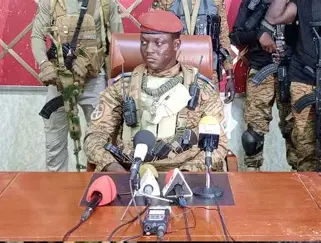
In Burkina Faso, each public statement by Captain Ibrahim Traoré further fuels discussions about the nature of his leadership and the country’s political trajectory since the September 2022 coup d’état. Recent remarks by the transitional leader leave no room for ambiguity: they openly embrace a seizure of power outside constitutional frameworks and reframe this breach as an emerging political standard.
From rebellion to governance: a contested legitimacy
Captain Traoré did not ascend to power through universal suffrage. His rise followed a military overthrow of Lieutenant-Colonel Paul-Henri Sandaogo Damiba, who himself had seized power in a prior coup against President Roch Marc Christian Kaboré. This chain of violent takeovers underscores a fundamental rupture with the democratic principles that typically underpin a head of state’s legitimacy.
Critics argue that the issue extends beyond the circumstances of his ascent. More alarming, they contend, is the narrative framing military force as a legitimate source of power—provided it garners fleeting popular support. Such a precedent, they warn, risks normalizing the use of arms as a viable pathway to governance, eroding the foundations of democratic stability.
The fragility of a power built on force
If political legitimacy no longer derives from institutions, elections, or the rule of law—but from the ability of armed factions to impose their will—then future grievances could similarly justify fresh military interventions. This cycle of instability threatens to replace ballots with bullets, entrenching chronic fragility where governance should prevail.
Proponents of the current regime emphasize restored sovereignty, a break from foreign influence, and renewed national pride. Yet these rhetorical victories cannot substitute for tangible governance outcomes. History demonstrates that nationalist slogans, however resonant, do not compensate for economic stagnation, unmet security needs, or institutional dysfunction.
Symbolism over substance: the paradox of governance
Today, political communication dominates the national discourse. Patriotic symbols saturate public life, social media amplifies staged displays of support, and official narratives prioritize spectacle over substance. Meanwhile, pressing challenges—terrorism, territorial recovery, and livelihoods—remain unresolved despite the pretexts used to justify the coup.
The unmet security imperative
Security remains Burkina Faso’s most critical test. Despite announced reforms and military restructuring, deadly attacks persist in vast regions, displacing hundreds of thousands. In many communities, civilians face relentless threats, while access to healthcare, education, and public services remains severely compromised.
Economic stagnation amid instability
The insecurity stifles agriculture, trade, and investment, exacerbating poverty and unemployment. Citizens demand tangible improvements: sustainable livelihoods, purchasing power, essential services, and stability to rebuild their futures. Two years after the coup, these expectations remain largely unmet.
The narrowing space for dissent
Another concern is the centralization of authority. Independent voices—journalists, civil society actors, and opposition figures—operate in an environment where criticism is increasingly equated with disloyalty. This conflation of patriotism with unconditional support for the regime represents a dangerous erosion of democratic norms. True civic pride does not demand blind allegiance to those in power.
The adage ‘Jupiter renders mad those he seeks to destroy’ resonates here not as personal condemnation, but as a universal caution. History is replete with leaders who, intoxicated by perceived indispensability, reject dissent, sideline opponents, and mistake their personal survival for national salvation. Such hubris often precipitates collapse when reality intrudes.
Legitimacy beyond force and rhetoric
Ultimately, a leader’s legitimacy cannot rest on coercion, slogans, or defiant declarations alone. It is measured by respect for institutions, protection of citizens, preservation of fundamental freedoms, improvement of living conditions, and the understanding that power is a means—not an end. Ibrahim Traoré’s tenure will be judged against these benchmarks. Until concrete progress is made in addressing the country’s security, economic, and social crises, questions about his authority’s durability will continue to shape Burkina Faso’s political landscape.