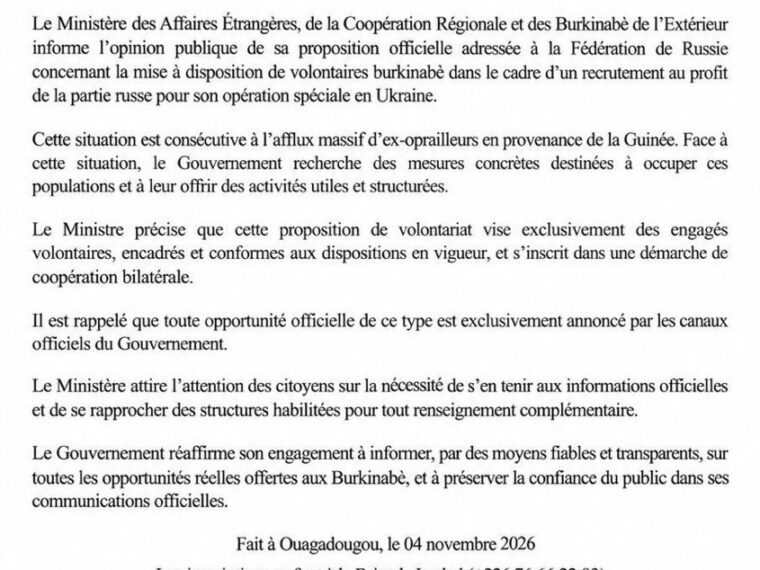
Ouagadougou is considering a contentious proposal to send Burkinabè gold miners, expelled from Guinea, to join Russian forces in Ukraine a move that raises serious ethical and operational concerns.
From Guinean exile to potential Ukrainian frontlines
The Burkinabè government is reportedly organizing the repatriation of miners expelled from Guinea, but reports suggest this effort may be a front for military recruitment for Moscow. The question is no longer just about humanitarian aid but about whether vulnerable returnees are being funneled into a distant war zone.
These miners, already displaced and economically strained, could now face a new and far more perilous path one that exploits their precarious situation to bolster Russia’s war effort in Ukraine.
Russia’s growing demand for foreign fighters
With Russia facing significant military losses in Ukraine, its need for additional combatants has intensified. The Kremlin has increasingly turned to recruitment campaigns targeting foreign nationals, including through partnerships with African governments.
The Burkina Faso-Russia relationship, already strengthened by paramilitary deployments, may now extend to human resources. Reports indicate that Ouagadougou has floated the idea of transporting expelled miners to the capital before allegedly redirecting them to military training or deployment abroad.
This raises critical questions: Were these individuals informed of a possible military engagement? What guarantees exist for their safety and rights? And most importantly, was their consent genuinely voluntary?
Ethical red flags in the recruitment process
The core issue lies in the power dynamics at play. Men already struggling with expulsion, financial ruin, and unstable prospects could be pressured whether explicitly or implicitly into signing up for a war they neither chose nor fully understand.
If these miners were gathered under false pretenses told they were returning home or receiving economic support only to be offered a combat role in Ukraine, the ethical implications are severe. Humanitarian repatriation should never serve as a recruitment pipeline for foreign conflicts.
Burkina Faso’s evolving alliance and its consequences
Since seizing power, Burkina Faso’s transitional leadership has prioritized closer ties with Russia, positioning Moscow as a key security partner. While this shift breaks from past Western alliances, it also carries unpredictable human costs.
The potential deployment of Burkinabè fighters in Ukraine would mark a dramatic escalation one that transforms a security partnership into a direct involvement in a foreign war. For a government claiming to protect its citizens, sending them into harm’s way in a conflict thousands of miles away demands urgent scrutiny.
Where sovereignty meets responsibility
A nation’s sovereignty is not just about choosing allies; it’s about safeguarding its people. If Burkina Faso is facilitating the transfer of its citizens to a war zone under the guise of humanitarian assistance, it betrays a fundamental duty to its population.
Transparency is essential. Authorities must clarify:
Who proposed this initiative?
What was the full purpose of transporting miners to Ouagadougou?
What legal and financial protections were offered to recruits?
How was consent obtained, and was it truly informed?
Without clear answers, this operation risks becoming a cautionary tale about how strategic partnerships can endanger the very citizens they are meant to serve.
A human crisis masked by geopolitical maneuvering
Behind the diplomatic posturing, there are real lives at stake men who have already lost their livelihoods and homes. Using their misfortune to fuel a foreign war turns a humanitarian issue into a geopolitical tool.
If Burkina Faso goes forward with this plan, the world will be watching to see if it honors its citizens’ dignity or sacrifices it on the altar of alliance politics.
By Agnès Mvogo — Journalist