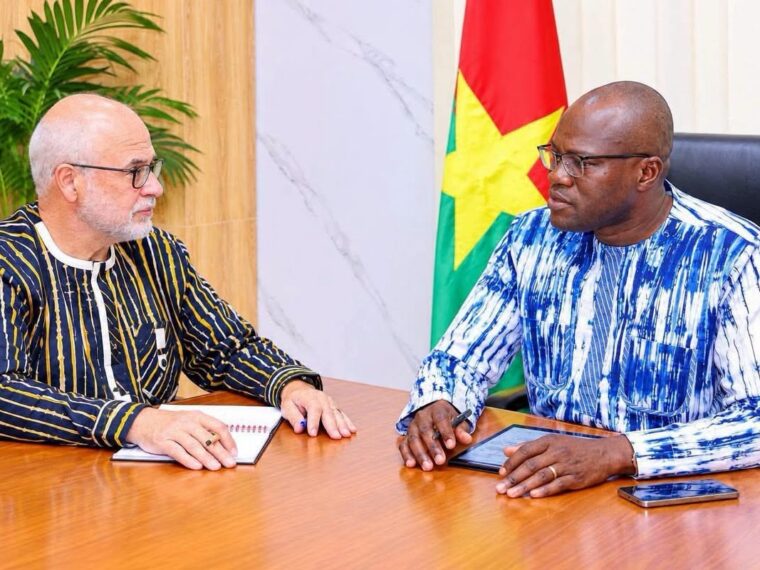
New FMI funding agreement exposes gap between Burkina Faso’s financial rhetoric and reality
The Burkina Faso government, led by Captain Ibrahim Traoré, has consistently promoted a narrative of financial autonomy, positioning itself as a sovereign actor freed from traditional international financial dependencies. Yet, the recent announcement of a potential $87.67 million funding package from the International Monetary Fund (FMI) reveals the stark contradictions embedded in this discourse.
On November 4, 2026, the FMI disclosed a technical agreement with Burkinabè authorities, outlining a conditional disbursement of $65.38 million under the Extended Credit Facility (FEC) and $22.29 million under the Resilience and Sustainability Facility (FRD). The total package amounts to approximately $87.67 million or 49.6 billion West African CFA francs though final approval from the FMI’s Executive Board remains pending until mid-January 2027.
Despite repeated claims of self-sufficiency, Burkina Faso continues to rely on external financial mechanisms, raising critical questions about the alignment between policy declarations and economic practice.
Economic rhetoric vs. financial necessity: A persistent contradiction
No nation should be criticized for seeking international financial support when economic exigencies demand it. However, the disconnect between Burkina Faso’s proclaimed self-reliance and its persistent recourse to the FMI demands scrutiny.
How can the government justify its insistence on domestic funding capabilities while simultaneously negotiating new lines of credit with multilateral institutions? If national resources suffice to drive development, why seek external financing? Conversely, if the FMI remains indispensable, why sustain a narrative of financial emancipation?
This juxtaposition of rhetoric and reality requires transparent explanations rather than political posturing.
Gold reserves: A potential yet unrealized tool for fiscal independence
Burkina Faso’s gold reserves represent a significant economic asset, with high global prices, expanded mining operations, and sectoral reforms contributing to macroeconomic stability. Yet, the mere existence of natural resources does not equate to fiscal strength without strategic allocation.
The government must clarify critical aspects of its mineral revenue management: What proportion of gold proceeds feeds into the national budget? How are these funds distributed across public expenditure? What tangible benefits do citizens derive from these revenues? Economic sovereignty is not defined by political speeches but by the tangible conversion of national wealth into improved living standards.
FMI’s transparency demands highlight the transparency deficit in Burkina Faso
In June 2026, the FMI underscored key priorities for Burkina Faso, including enhanced domestic revenue mobilization, improved public financial governance, and strengthened social spending for vulnerable populations. The institution also emphasized prudent debt management and increased transparency in public fund utilization.
These recommendations underscore a fundamental question: beyond political declarations, what concrete assurances has the government provided to its citizens regarding the management of public funds?
Citizens deserve clarity, not slogans
While official narratives champion financial independence, the Burkinabè people are entitled to a transparent account of their nation’s financial health and the terms of external engagements. The FMI’s role does not inherently signal economic failure; however, the discrepancy between claims of self-reliance and continued dependency warrants scrutiny.
The debate transcends the $50 billion figure. It revolves around consistency between political promises, economic choices, and the actual state of public finances.
True sovereignty is not demonstrated by denouncing international financial institutions in public while negotiating their support behind closed doors. It is built on honesty on informing citizens about the country’s real financial capacity and the responsible use of their resources.
By Agnès Mvogo — Journalist