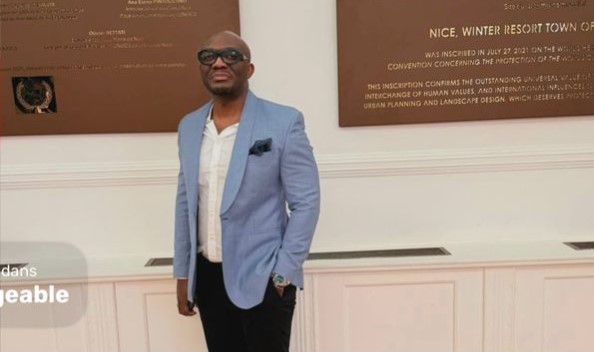
Insults directed at President Brice Clotaire Oligui Nguema, his mother, and his wife have triggered a strong response from Hugues Ongoundou. In a particularly firm statement, Ongoundou clarifies that his stance is not one of political support for the government or its policies. He asserts that targeting a mother and grandmother, who are far removed from the political sphere, or an official’s spouse or parents, crosses a fundamental line that extends beyond the individuals themselves. Denouncing what he terms “verbal insalubrity” and the normalization of obscenity in Gabon’s public discourse, Hugues Ongoundou calls for a clear distinction between freedom of criticism and vulgarity, announcing his intention to explore potential legal actions.
The insults aimed at the Head of State’s mother—a discreet woman, a mother and grandmother with an unblemished reputation, far from political battles—as well as those targeting his wife and the President himself, are profoundly serious. I must confess: these remarks left me utterly stunned.
My concern here is not politics. I am not defending a track record, an ideology, or any closeness to the government. I am addressing something far more fundamental: the dignity, values, and very soul of our nation.
It’s not just three individuals being insulted
When a mother and grandmother, who has no involvement in political sparring, is dragged through the mud with vile remarks simply because she is the Head of State’s mother, a critical boundary is breached.
When a woman, a wife and First Lady, is similarly targeted by obscene comments, it is our collective moral compass that comes under attack.
It is no longer just the Head of State, his mother, and his wife who are being insulted.
Symbolically, it is all our grandmothers, all our mothers, all our wives, all our sisters, and all our daughters who are being demeaned.
It is the very image of our country that is tarnished.
It is our values that are eroding.
Ultimately, it represents a form of spiritual desertion by the very essence of a people.
And I choose my words carefully.
The symbol transcends individuals
Within any nation, certain symbols rise above individuals. The mother embodies transmission. The grandmother represents memory.
The woman represents an essential part of the family and society. The father also represents this chain of transmission that connects generations.
When these figures are publicly humiliated and turned into objects of political insults, a part of our moral heritage is trampled upon.
It is the symbolic strength of our country that is undermined.
Not in its trivial sense, but in what it embodies: power, uprightness, symbolic authority, and a people’s capacity to stand tall.
These excesses signal a nation in distress
What has just transpired should not be dismissed as a mere slip-up on social media platforms.
These excesses are, in my view, symptoms of a sick, suffering, and wandering nation. They indicate a gradual weakening of certain societal benchmarks.
There was a time when patriotism, respect for elders, consideration for parents, and a sense of honor were integral to civic education and transmission.
Today, a portion of that teaching appears to have vanished.
This marks the misfortune of virtue and the prosperity of vice.
We are witnessing a troubling inversion: the one who insults sometimes becomes a celebrity, the one who humiliates gains popularity, the one who provokes receives more attention than the one who builds.
And when insult becomes a spectacle, when it becomes entertainment, when it transforms into a media commodity, virtue itself ends up being relegated.
Every laugh, every normalization makes us collectively responsible
I will go further.
Every Gabonese who laughs at such vile remarks, shares them for amusement, or contributes to their dissemination, participates, willingly or not, in their normalization.
Every citizen who accepts that political debate devolves into an insult contest contributes to the weakening of our societal standards. And every time we turn an insult into a celebrity, canonize the insulter, or promote them simply because they create noise, we participate in the slow destruction of what should unite us.
We are all responsible when insult becomes entertainment. We are all responsible when it becomes a directive.
We are all responsible when those who insult become the most listened to voices. I am not seeking favor.
I am not seeking favor
I want to be very clear.
I am not trying to curry favor with the government.
I am not seeking recognition.
I am not defending the Head of State against his political adversaries.
I am here to say STOP.
There is an urgent need to act against this verbal degradation that is progressively invading our public space.
And conversely, I wish to commend those Gabonese who challenge the President and his policies without crossing these boundaries.
Responsible opponents exist.
Men and women who know how to acknowledge what is well done and denounce what is not.
Citizens capable of combating a policy with arguments, without insulting the mothers, fathers, wives, or children of those they oppose.
That is the essence of true democratic debate. Activism has nothing to do with vulgarity.
Activism is distinct from vulgarity
Another confusion must also be dispelled. Being an activist does not grant unlimited rights.
Being an opponent does not mean one can say anything. Being free does not mean being irresponsible.
Activism is a form of civic engagement. It therefore implies civic responsibility.
One can denounce.
One can investigate.
One can challenge.
One can demonstrate.
One can question.
One can even be extremely harsh in criticism.
But obscene insults targeting a mother or a woman are neither an argument, nor a sign of courage, nor a demonstration of patriotism.
I have a father. I have a mother.
This sentence is perhaps the simplest in this entire statement.
I have a father. I have a mother.
And being their son connects me to an upbringing, a history, a responsibility.
I understand what respect is owed to those who gave us life.
I know what a mother represents.
I know what a father represents.
It is precisely this upbringing that compels me today to reject the normalization of this media monstrosity.
I cannot ask my children to respect their parents tomorrow if, today, I accept that the humiliation of parents becomes a public spectacle.
I will assume my share of responsibility
Given this situation, I will therefore take my share of responsibility.
I will consult with legal counsel to examine existing legal avenues and the judicial actions that could be taken in response to such remarks.
This initiative will be strictly personal.
I do not claim to speak on behalf of the Head of State, his family, his entourage, or any institution.
I speak in my own name.
As a Gabonese. As a citizen. As a son.
I want things to be clear: my objective is not to silence political criticism.
Quite the opposite.
I wish for us to rediscover a political debate where intelligence, constructive disagreement, and responsibility progressively replace insult, obscenity, and humiliation.
We must choose between virtue and the normalization of vice
Gabon cannot sustainably settle into this pattern.
A nation is not destroyed solely by economic or political crises.
It can also be destroyed by the gradual collapse of its moral foundations.
When insult becomes normal, verbal violence becomes acceptable.
When verbal violence becomes acceptable, humiliation becomes a spectacle.
When humiliation becomes a spectacle, those who produce it become celebrities.
And when those who destroy values become society’s role models, state decline also begins with moral decay.
I refuse this fate.
I refuse for our mothers to become targets.
I refuse for our women to be used as instruments of political humiliation.
I refuse for our fathers to be insulted because their children hold positions of responsibility.
I refuse for our children to grow up in a society where vulgarity is rewarded more than virtue.
Enough is enough.
I am not asking anyone to love the President of the Republic.
I am not asking anyone to approve of his policies.
I am simply asking that we remain capable of respecting ourselves.
Because ultimately, when we insult another’s mother, we also insult the idea we hold of our own mother.
And when a people no longer protects its own values, it begins to lose its soul.
It is now up to each individual to assume their responsibilities.
As for me, I have chosen to assume mine.
Hugues Ongoundou
