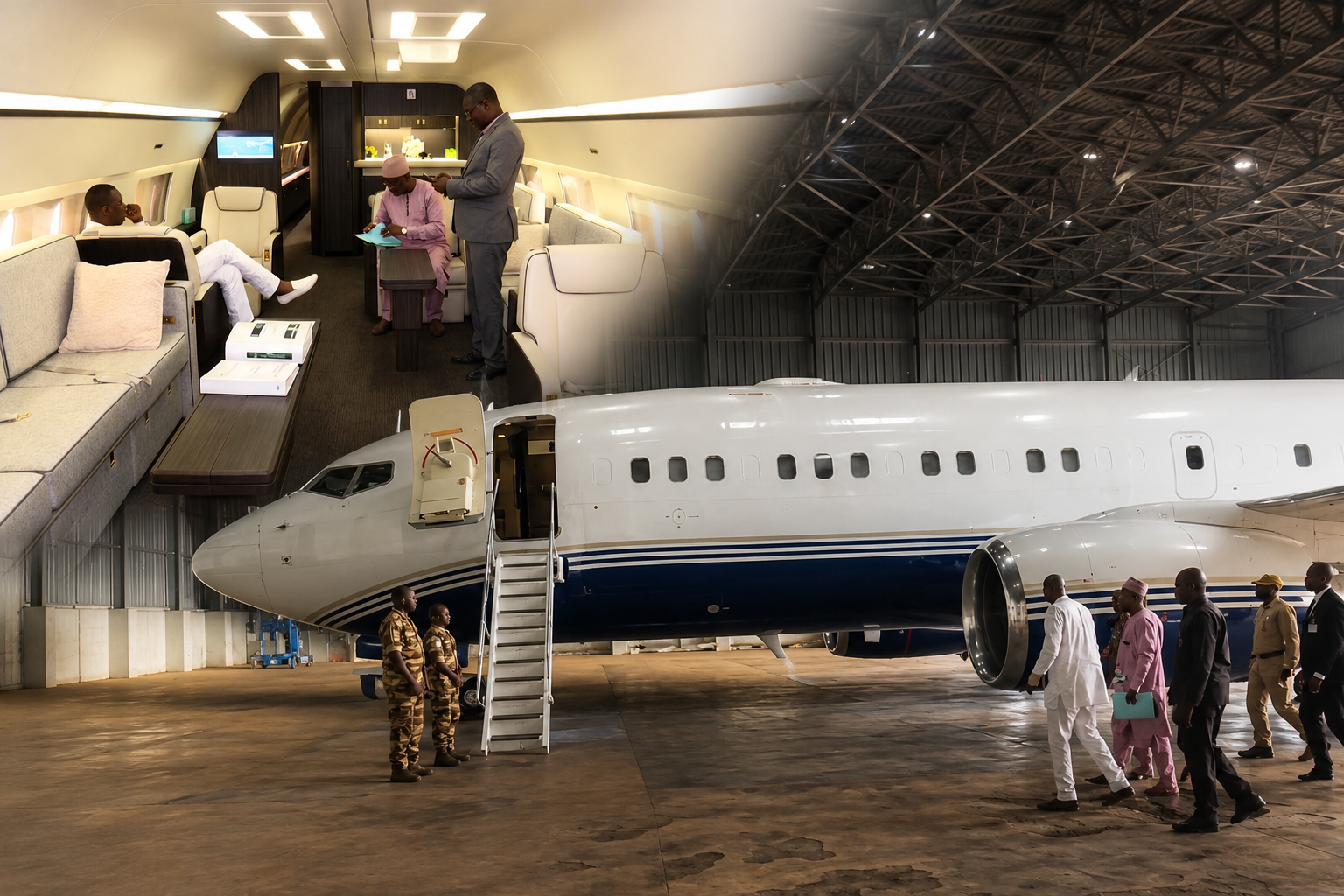
The unveiling of Mali’s latest presidential aircraft on national television this week has ignited a wave of public discussion, raising critical questions about the government’s priorities in a period of profound national strain.
An acquisition presented as financially sound, yet deeply controversial
The administration has defended the purchase of a new Boeing 737, valued at 15.6 billion West African CFA francs, as a financially sound decision. Officials claim the net cost will be reduced to approximately 6 billion francs once insurance payouts and proceeds from the sale of parts from the previous aircraft are accounted for. While the government emphasizes the economic rationale behind the transaction, the timing and symbolism of the announcement have drawn sharp criticism.
A stark contrast to the realities of a nation in crisis
The timing of the unveiling could not be more ill-suited to the realities facing Mali. Despite repeated calls for national unity, sacrifice, and resilience, the introduction of a state-of-the-art presidential jet has been perceived by many as a display of extravagance rather than a response to the immediate needs of the Malian people.
The security situation remains precarious across vast regions of the country. Military outposts continue to come under attack, roadways are frequently ambushed, and civilians bear the brunt of escalating violence. Entire communities remain isolated, with state authority struggling to regain a foothold in contested territories.
Security challenges persist despite repeated commitments
Three years after the Transition declared the restoration of state control its top priority, the security landscape remains fraught with danger. In the northern regions, coalitions such as the Permanent Strategic Framework—including the Azawad Liberation Front—continue to exert significant influence and contest control over key zones.
Meanwhile, in central and southern Mali, the Group for the Support of Islam and Muslims (JNIM) has steadily expanded its operations, targeting military installations, critical infrastructure, and state representatives. Vital transportation routes remain perilous, disrupting commerce, mobility, and economic activity.
A budget reallocation under scrutiny
Even with the government’s assertion that the financial burden is significantly lower than the initial figure, critics argue that the funds could have been redirected toward pressing national priorities, including:
- Enhancing the operational capabilities of the Malian Armed Forces
- Acquiring armored vehicles, advanced communication systems, and protective equipment
- Strengthening intelligence and aerial surveillance capabilities
- Providing medical care and support for wounded soldiers and the families of fallen servicemen
- Assisting internally displaced persons and funding the reconstruction of war-damaged infrastructure
Beyond the financial ledger, the acquisition has sparked a broader debate about the hierarchy of state priorities.
A departure from the narrative of austerity
Since assuming power, the Transition authorities have cultivated an image of fiscal restraint and national service, positioning themselves in opposition to the perceived excesses of previous regimes. The procurement of a high-capacity presidential jet, however, risks undermining this message. For many citizens, the move signals a return to the very practices of conspicuous consumption and personal aggrandizement that the new leadership had pledged to reject.
This perception is further compounded by persistent economic hardships: soaring living costs, strained public finances, unmet social needs, and sluggish economic growth across key sectors.
Diplomatic symbolism versus domestic legitimacy
Proponents of the new aircraft argue that a modern presidential fleet facilitates high-level diplomatic engagement, official missions, and international representation. Yet this justification struggles to resonate with those who believe a nation’s credibility on the world stage is fundamentally tied to its internal stability, the security of its citizens, and the effective functioning of its institutions.
To many observers, sovereignty is not measured by the sophistication of a presidential fleet, but by the state’s ability to exercise genuine control over its territory and protect its population.
A decision that fuels political skepticism
The acquisition has become a lightning rod for criticism from opposition figures and independent analysts. Some interpret it as evidence of a government more invested in its own mobility than in the functioning of the state. Others speculate that a long-range aircraft, continually at the disposal of top officials, may serve as a safety net in the event of a further deterioration in security conditions.
Though unproven, such interpretations reflect the growing climate of distrust surrounding the Transition’s decision-making processes.
Governance in question: where do priorities lie?
The introduction of the new Boeing 737 transcends a mere procurement decision. It has reignited a fundamental inquiry into the strategic direction of the Transition.
As security threats persist, attacks continue, and economic hardship deepens, every expenditure perceived as symbolic is met with heightened scrutiny. For a growing number of Malians, true sovereignty is not demonstrated through the modernization of a presidential fleet, but through the state’s capacity to safeguard its citizens, restore its authority across the nation, and improve the daily lives of its people. Until these imperatives are met, investments in prestige risk underscoring an ever-widening gap between government priorities and public expectations.