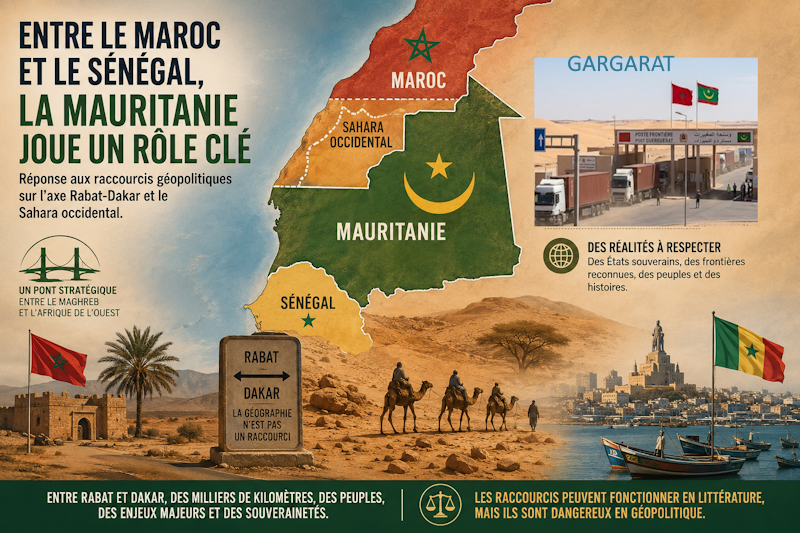

An unexpected diplomatic flare-up in Dakar last July has thrust Mauritania’s carefully crafted position on the Western Sahara dispute into sharp focus. As regional tensions simmer, Nouakchott finds itself walking a tightrope—balancing its “positive neutrality,” economic imperatives, and sovereign interests to avoid alienating Morocco.
The incident unfolded during a high-profile event at the Moroccan embassy in Dakar, where former Senegalese Foreign Minister Cheikh Tidiane Gadio made contentious remarks. By suggesting Morocco lies just “a few kilometers” from Senegal—a veiled reference to pre-colonial borders—he reignited historical sensitivities that Mauritania has long sought to keep dormant.
The Mauritanian representative, Mohamed Ould Abdellahi Ould Ethmane, promptly interrupted the speech, condemning what he called an attempt to rewrite history by erasing Mauritania’s very existence. Though the Moroccan ambassador, Hassan Naciri, stepped in to mediate, the damage was done. The episode laid bare the contradictions in Mauritania’s delicate balancing act: maintaining a presence at an event celebrating Moroccan claims to Western Sahara while insisting on strict neutrality in the decades-old conflict.
Reactions in Mauritania were swift and unequivocal. Former Mauritanian Foreign Minister Isselmou Ahmed Izidbih took to social media to demand Gadio be declared persona non grata in Mauritania, its territorial waters, and airspace—a rare public rebuke that underscored the fragility of the country’s diplomatic posture.
Nouakchott’s strategic balancing act
This diplomatic dance is no accident. Mauritania’s stance is a deliberate strategy, not indecision. Officially, Nouakchott recognizes the Sahrawi Arab Democratic Republic (SADR)—a decision made in 1984—and maintains open dialogue with the Polisario Front, a key ally of Algeria, which remains crucial for Mauritania’s northern security.
Yet, Mauritania stops short of granting the SADR full diplomatic status in its capital. This subtle concession to Rabat reflects a reality: recognizing Western Sahara’s independence could provoke Morocco, whose historical claims once included Mauritanian territory. By attending Moroccan commemorations, Mauritania signals respect for its northern neighbor—while ensuring that old tensions over the so-called “Greater Morocco” do not resurface.
Guerguerat: the economic lifeline
Beyond symbols and diplomacy, Mauritania’s choices are driven by hard economic realities. The Guerguerat border crossing, straddling Western Sahara and Mauritanian land, has become the economic backbone of the region. Daily, hundreds of Moroccan trucks pass through, ferrying agricultural and manufactured goods that sustain markets in Mauritania, Senegal, and Mali.
Blocking this flow would cripple Nouakchott’s economy and destabilize its supply chains. By keeping its borders open, Mauritania tacitly accepts Morocco’s de facto control over Western Sahara—without ever endorsing it legally. The arrangement allows Mauritania to reap economic benefits while avoiding direct confrontation with either Rabat or Algiers.
The high stakes of neutrality
To regional analysts, Mauritania’s “both/and” approach is not weakness—it’s survival. Trapped between an economically assertive Morocco and a geopolitically assertive Algeria, Nouakchott cannot afford to take sides without risking retaliation, border instability, or economic fallout.
The clash triggered by Gadio’s remarks serves as a reminder: Mauritania’s neutrality, no matter how carefully calibrated, remains a delicate equilibrium. Whenever its national sovereignty or territorial integrity appears threatened by neighboring ambitions, Nouakchott reacts swiftly—reasserting its role as the indispensable, sovereign linchpin of Maghreb stability.