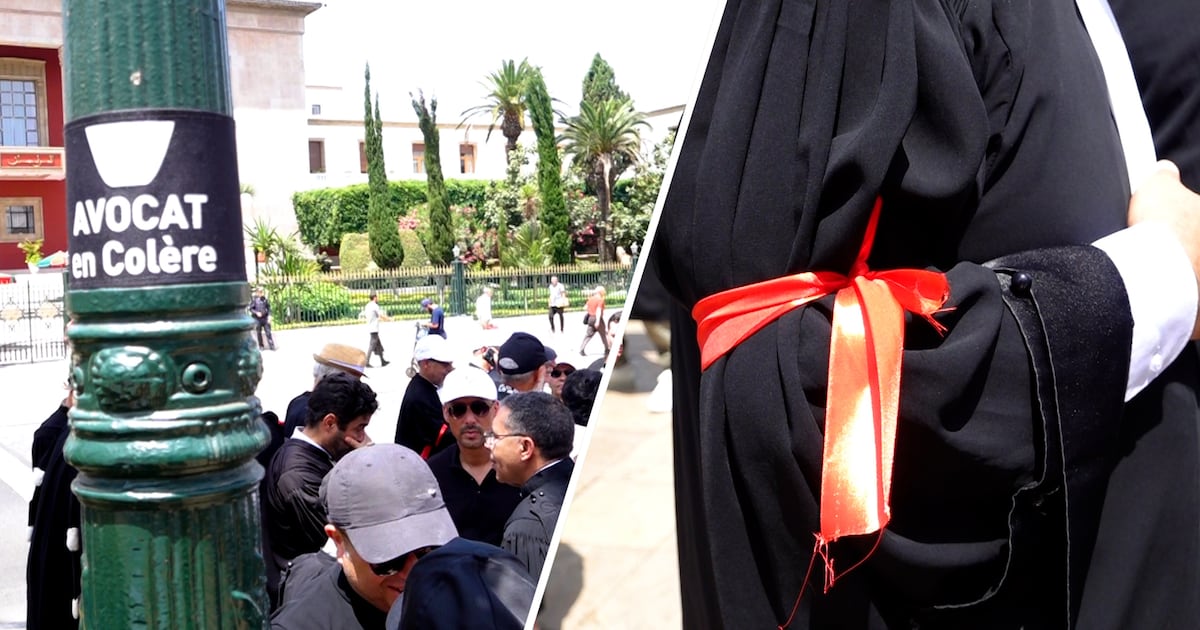
With red armbands wrapped tightly around their sleeves, lawyers on an open-ended strike have regrouped for another day of protest outside the Parliament building in Rabat. Their determination remains unshaken as they intensify their demonstration against the proposed legislation governing their profession, which they view as a clear democratic setback.
The sea of black robes filling the square reflects the scale of opposition to the draft law. Lawyers argue that the proposed changes undermine their professional independence, particularly concerning disciplinary oversight by the public prosecutor’s office and the Ministry of Justice. They also express strong reservations about transferring control over lawyer training to the Ministry of Justice and the new provisions governing entry into the profession—most notably, the proposal to lower the age requirement for the qualifying examination.
Last week, during an earlier gathering outside Parliament, legal representatives delivered a firm warning: “This fight has only just begun.” They have since vowed to escalate their action unless the controversial bill is withdrawn entirely.
Aziz Rouibah, the Bâtonnier of Rabat, reiterated the profession’s resolve during discussions with reporters. “Our very existence as lawyers is under threat,” he stated, accusing unnamed actors of attempting to “symbolically dismantle” the legal profession. “It is our moral duty—and an absolute necessity—to resist this aggressive legislative assault,” he emphasized.
Mounir Belghiti, a member of the Rabat Bar Council, framed the ongoing standoff as a crisis of trust. The protest, he explained, is not merely a demonstration but “a final appeal to lawmakers”, whose decisions will shape the future of the legal system. The proposed law, he insisted, must reflect “the interests of the nation and the rule of law,” rather than being driven by “personal grievances.” In his view, compromising on these principles would erode one of democracy’s foundational pillars: “a shared legal framework that applies equally to all.”
The legislative debate is expected to resume this week in the Chamber of Advisors. If amendments are approved, the revised draft will be sent back to the Justice Commission of the Chamber of Representatives for further review.
In the meantime, Morocco’s courts continue to grapple with the fallout of the indefinite strike. Legal proceedings—especially those involving detainees awaiting trial—have been delayed for nearly a month, leaving many plaintiffs and defendants in legal limbo.
The Association des barreaux du Maroc (ABAM), also known as the National Association of Moroccan Bar Associations, serves as the umbrella organization uniting all local bar associations across the Kingdom.